Author: SkillStacked

  • Daily Kaizen #2 – How Mental Forgiveness Frees Your Energy for What Matters

    Daily Kaizen #2 – How Mental Forgiveness Frees Your Energy for What Matters

    🧠 The Problem

    You’re not “over it” — you’re just carrying it quietly.

    We often think forgiveness is something we give to others.

    But the truth is: we forgive to free ourselves.

    The longer we carry resentment, the heavier our day becomes — even if we never say it out loud.

    🪞 My Story

    I used to tell myself I was “fine.”

    That what someone said or did didn’t bother me.

    But my body always knew better. Tension. Stress. Emotional weight I couldn’t explain.

    Then one day I whispered to myself:

    “I forgive them. Just for now.”

    Not forever.

    Not fully.

    Just for this moment — so I could stop replaying the tape and get back to living.

    It didn’t fix everything.

    But it lightened everything.

    🔨 Daily Kaizen #2:

    Forgive someone mentally — even if it’s just for now.

    You don’t have to text them.

    You don’t have to agree with them.

    You don’t have to forget what happened.

    Just choose — silently — to let it go for this moment.

    💡 Why It Works

    Forgiveness isn’t weakness.

    It’s emotional weightlifting.

    By mentally forgiving, you take back your attention, your calm, and your power.

    And even if the feeling creeps back later, you’ll know what to do:

    Forgive again. For now.

    🎯 The 1% Advantage

    You don’t have to forgive forever.

    Just enough to move forward with a lighter heart — and a clearer mind.

  • Daily Kaizen #1 – How Celebrating One Tiny Win Each Day Boosts Discipline

    Daily Kaizen #1 – How Celebrating One Tiny Win Each Day Boosts Discipline

    🧠 The Problem

    Most people sprint through their day, chasing productivity but rarely acknowledging progress.
    They believe only big wins deserve recognition — and in doing so, they miss the small moments that build real discipline.


    🪞 My Story

    I used to do everything “right”: eat clean, train, write, stay on track…
    But I’d still go to bed feeling like I hadn’t done enough.
    No satisfaction. Just another checkbox ticked.

    Then I tried something strange:
    I started celebrating the smallest wins — out loud.

    “I published my post.”
    “I trained even though I didn’t feel like it.”
    “I turned down a distraction.”

    It felt silly at first.
    But over time, it rewired how I saw myself.


    🔨 Daily Kaizen #1:

    Celebrate one tiny win out loud.

    • Say it.
    • Whisper it.
    • Write it down.
    • Tell someone.

    Just make it real.


    💡 Why It Works

    Your brain responds to what you reinforce.
    When you celebrate a tiny win, you tell your nervous system:

    “This matters. Let’s do more of this.”

    Tiny wins compound. But only if you notice them.
    This is how you build momentum from the inside out.


    🎯 The 1% Advantage

    You don’t need a perfect day to feel progress.
    You just need to honor one moment of self-respect.

    Start small.
    Say it out loud.
    Stack it tomorrow.


    📬 Want More Like This?

    I’m building a 100-Step Personal Development System – Coming Soon…

  • 💪 Add a 30-Second Dead Hang

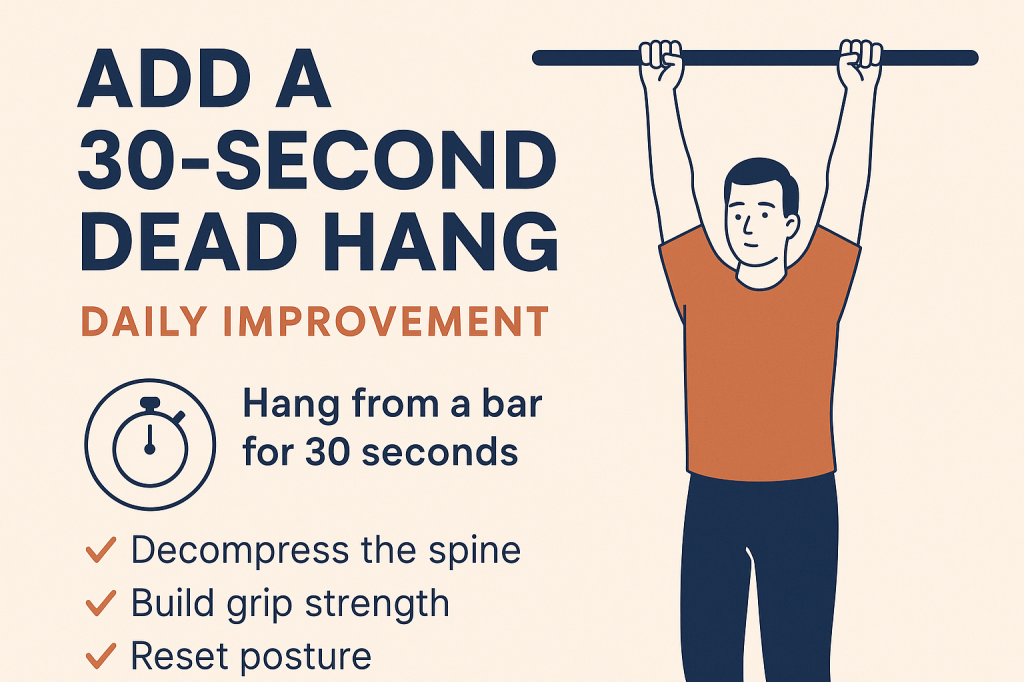
    💪 Add a 30-Second Dead Hang

    Daily Improvement – Build Strength, Decompress, Reset

    This one move can improve your posture, your grip strength, and your mindset — all in just 30 seconds.

    Today’s improvement is simple:

    Find a bar or sturdy ledge and hang from it.

    For 30 seconds. That’s it.

    🧠 Why It Works:

    Hanging is one of the most primal, powerful things you can do for your body.

    It:

    Decompresses your spine Builds grip strength Opens tight shoulders Boosts shoulder health and mobility Resets your posture from hours of sitting

    And mentally?

    Holding on when your body wants to let go builds discipline fast.

    🧰 How to Do It:

    Find a pull-up bar, monkey bar, or sturdy door frame Grab overhead with both hands Let your body hang freely (feet off the ground if possible) Engage your core lightly, breathe slow Aim for 30 seconds — or as long as you can hold

    Bonus: Do this mid-day to reset posture and energy.

    🪜 Daily Improvement Stack:

    Hang 30 seconds → Decompress body → Build grip → Strengthen discipline

    ✅ Final Thought:

    This is a micro-practice with macro benefits.

    It’s a “keystone movement” — the kind that improves multiple areas at once.

    Today, add one hang to your day.

    You’ll feel stronger before your feet even touch the ground.

  • 🔁 Refine a Habit Trigger

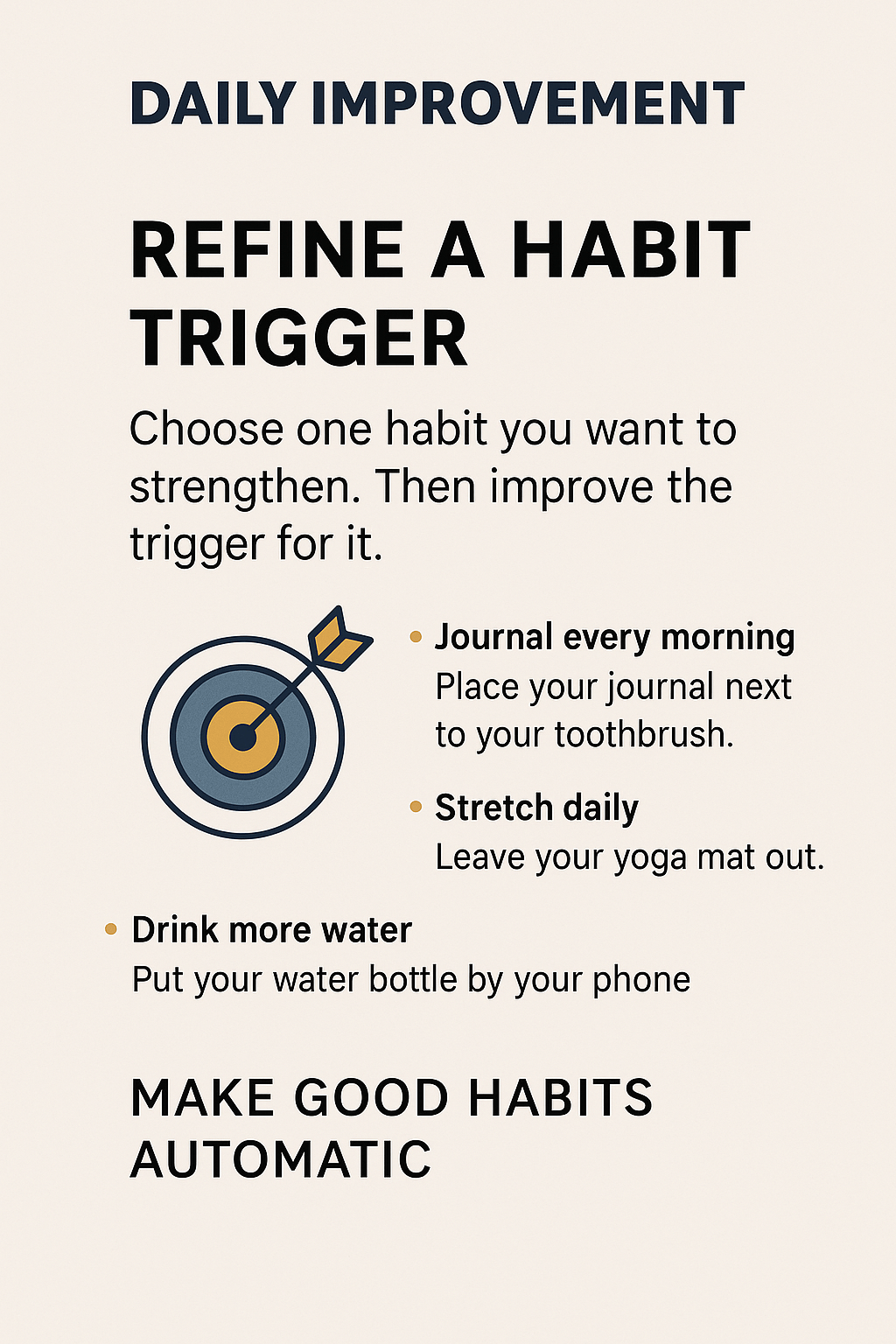
    🔁 Refine a Habit Trigger

    Daily Improvement — Make Good Habits Automatic

    We often fail at habits not because we lack motivation,

    but because we haven’t made the habit obvious.

    Today’s improvement is simple but powerful:

    Pick one habit you want to strengthen. Then improve the trigger.

    🎯 What’s a Trigger?

    A trigger is what prompts the behavior.

    It can be:

    A time (e.g., after waking up) A location (e.g., at your desk) An object (e.g., a notebook, water bottle) A preceding action (e.g., after brushing your teeth)

    If the habit isn’t sticking, the trigger probably isn’t clear or consistent.

    🔧 Examples:

    Want to journal every morning? → Place your journal on your pillow or next to your toothbrush. Want to stretch daily? → Leave your yoga mat unrolled in your living space. Want to drink more water? → Put your water bottle next to your phone or on your laptop.

    Make the habit so easy to start that it becomes harder to ignore.

    🧠 Why It Works:

    Your brain runs on patterns.

    The stronger and more obvious the cue, the faster the habit locks in.

    This isn’t about willpower — it’s about architecture.

    🪜 Daily Improvement Stack:

    Refine the trigger → Reduce friction → Repeat the action → Strengthen the identity

    ✅ Final Thought:

    A habit is only as strong as its trigger.

    Improve the cue — and you improve the behavior.

    Today, move one object or shift one moment to create a new loop.

    Small change, big ripple.

  • Master Your Self-Image and Performance Mindset with Maxwell Maltz’s Psycho-Cybernetics

    Master Your Self-Image and Performance Mindset with Maxwell Maltz’s Psycho-Cybernetics

    Ever feel stuck by self-doubt or a nagging inner critic? Imagine waking up believing you can hit your goals – every day. According to Maxwell Maltz’s classic Psycho-Cybernetics, your mind works like a goal-seeking machine, and the only limits it obeys are the ones in your self-image. In other words, what you truly believe about yourself shapes everything you do. If your mental picture is small or negative, it caps your success; but if you rewrite that picture, you can transform your identity and unleash a new performance mindset. This isn’t just wishful thinking. Maltz observed that “we act and feel in accordance with what we imagine to be true about ourselves” . By changing that inner vision – through visualization, positive self-talk, and trusting your subconscious (your “success mechanism”) – you literally reprogram your mind for success.

    Your Inner Self-Image: The Blueprint of Success

    Your self-image is the mental blueprint of who you think you are – built from every success, failure, and remark you’ve experienced. Maltz insisted this self-image is “cornerstone of all personal development,” because it sets the limits of what you can achieve . In practice, this means if you subconsciously see yourself as “not a leader” or “not creative,” you’ll unconsciously behave that way. He famously noted, “You can’t outperform your self-image” . In other words, until you upgrade your self-image, no amount of external training will break the ceiling.

    So how is your self-image formed? Often from childhood messages and past failures. Psycho-Cybernetics teaches that you internalize these beliefs early on – so a negative offhand comment can become a limiting program. But here’s the empowering flip side: beliefs can be changed. Maltz shows that by deliberately building a new, positive self-image, you redirect your “servo-mechanism” (your goal-seeking brain) to support the person you want to become . In fact, “your beliefs about yourself set the limits for what you can achieve” . Entrepreneurs and creators take note: anyone who wants an identity change first defines who they intend to be. The good news? You already have the toolkit inside you.

    Visualization & Mental Programming: Rewriting Your Inner Script

    What does it take to change that mental blueprint? Maltz’s answer: imagination and repetition. The subconscious mind can’t tell the difference between real experiences and vividly imagined ones . By regularly picturing yourself succeeding – in crystal-clear detail – you create a “blueprint” your brain will work to fulfill. In Psycho-Cybernetics, this is called the “Theatre of the Mind.” Athletes, performers, and high achievers use these same techniques: they mentally rehearse winning the game or nailing the presentation before they actually do it.

    Imagine it: spend just a few minutes each day visualizing your next big win – sensing the sights, sounds, and emotions as if it’s happening now. Maltz wrote that your nervous system “reacts appropriately to what [you] think or imagine to be true” . In practice, this means a daily habit of positive visualization reprograms your identity. Over time, the image you’ve repeatedly fed your mind takes over, guiding your behavior. Coupled with affirmations – simple positive statements like “I am confident and capable” – you overwrite old doubts. Maltz highlighted the power of self-talk, urging readers to replace “self-defeating thoughts with constructive affirmations” . This mental programming trains your subconscious for success.

    The Cybernetic Success Loop: Goals, Feedback, and Motivation

    Think of your brain as a cybernetic guidance system (like a heat-seeking missile) that constantly adjusts course toward a target. Maltz explains that once you feed your success mechanism a clear goal or self-image, it automatically works toward it . This is the essence of the “performance mindset” – you set the aim and trust the process. Importantly, in this loop every mistake is feedback, not failure. Maltz encourages us to “make mistakes” because each one acts like an autocorrect, nudging you closer to the goal . After learning from the misstep, you simply let it go and focus on the target.

    To harness this, focus on positive, successful memories as fuel. Maltz advised emphasizing times you were “in the zone” or “in your element” and consciously forgetting past failures . Reliving a past win can shift your self-image into one of capability and strength. Then, set a vivid goal and relax into it – don’t overthink. As one teaching puts it, once your goals are set you should “concentrate upon these rather than on what you do not want” , trusting your mind to fill in the path. This relaxed trust is key: resist micromanaging every step. Your success mechanism will find the way, using feedback to keep you on course .

    Key Takeaways & Action Steps

    Define your ideal self-image. List the traits of who you want to become (e.g. confident leader, healthy athlete, creative entrepreneur). Picture this identity clearly. Remember: your beliefs set your limits , so build them big. Visualize daily. Spend 5–10 minutes each day in your “Theatre of the Mind,” vividly imagining yourself achieving a specific goal. Feel the emotions of success. This mental rehearsal programs your mind for reality . Use positive self-talk. Notice any negative inner dialogue and flip it. Create empowering affirmations that reinforce your new self-image (for example, “I am a bold and creative problem-solver”). Repeat them often – your subconscious will start to believe them . Set clear, worthy goals. Write down one or two stretch goals aligned with your new identity. Keep them visible. Your brain needs a target for its guidance system . Focus on the end result, not micromanaging each move. Embrace mistakes as feedback. When you stumble, ask, “What’s this teaching me?” Maltz reminds us errors are “data points that refine your trajectory” . Learn, adjust, and move on—don’t dwell. This keeps your self-image growing stronger, not weakened. Celebrate wins and strengths. Frequently remind yourself of past successes (“I nailed that presentation,” “I solved that tough problem”). These memories reinforce a powerful self-image . Relax and trust the process. Over-control can block your creative mechanism. Practice relaxation (deep breathing, short meditation) to let subconscious insights surface. After preparation, let your automatic success mechanism work its magic .

    Conclusion: Embrace the Transformation

    Psycho-Cybernetics shows that the biggest change often comes from within. By deliberately changing your self-image through visualization and positive programming, you unlock a performance mindset that drives real-world results. Imagine the impact: an entrepreneur who truly sees herself as a leader will naturally act more confidently in pitches; a creative who pictures success will find inspiration and solutions more easily. You have the power to transform your identity – and with it, your life.

    Now it’s your turn: try a simple exercise today. Close your eyes for a minute and vividly imagine accomplishing a goal you care about. Notice how you feel. If this post resonated, share it with friends or comment below with your biggest insight. Even better, pick one tip (visualization, affirmation, or goal-setting) and apply it this week. Watch as psycho-cybernetic magic gradually shifts your reality. Comment, share, or start practicing – your future self will thank you!

    Sources: Core ideas are drawn from Maxwell Maltz’s Psycho-Cybernetics (via analyses and summaries) . These confirm that your self-image governs your results, and show how visualization and feedback loops can rewire your mind for success.

  • Eliminate One Destructive Trigger: Break Bad Habits and Upgrade Your Daily Routine

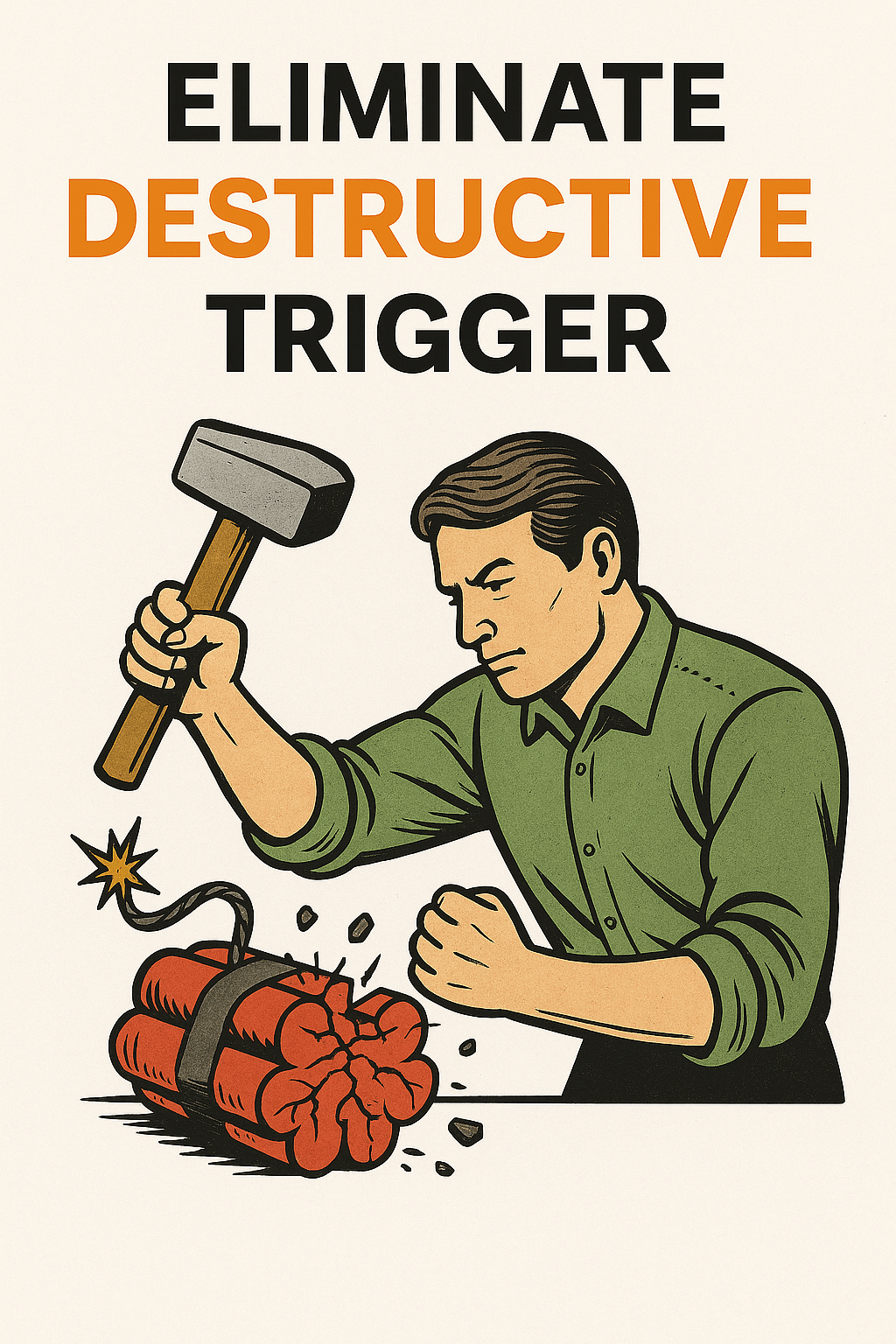
    Eliminate One Destructive Trigger: Break Bad Habits and Upgrade Your Daily Routine

    We all have that one invisible saboteur – a hidden cue or habit that derails our best intentions.  Perhaps it’s the ping of a phone notification that pulls you off task, a snack stored in plain sight that triggers mindless munching, or a late-night routine that leads to sleep loss.  These destructive triggers can quietly sabotage productivity, health goals, and personal growth, even when our motivation is high.  Imagine flipping the script: by identifying and eliminating just one key trigger, you could stop the chain reaction of self-sabotage and take control of your day.  In this post (Part 9 of our series on self-mastery), we’ll dive into the psychology and neuroscience of habit triggers, help you spot your own biggest trigger, and guide you through practical steps to remove or replace it.

    “Identify one destructive cue, remove it, and watch the dominoes of your day fall into place.”

    What Is a Destructive Trigger?

    Every habit starts with a cue – an environmental or emotional trigger that ignites a routine .  In psychology, this is often called the “cue” in the habit loop (cue–routine–reward). For example, seeing your smartphone buzz is the cue that launches a scrolling session, or feeling stressed at the office cues the routine of stress-snacking.  Over time, these cue–response loops become wired into the brain’s habit centers (the basal ganglia) .  The result is automatic behavior: you don’t even think before you reach for that cookie or flip open your phone – the trigger did it for you.

    A destructive trigger is simply one of those cues that consistently leads you off-track.  It’s a part of your environment or routine that sparks an unwanted behavior.  Importantly, removing or modifying this one trigger can prevent the unwanted habit from ever starting.  As cognitive neuroscience research shows, removing the environmental cue for a bad habit can “disrupt[]” the loop that keeps it going .  In other words, break the cue and you break the habit.

    A destructive trigger might be a time of day (e.g. 8 PM signals snack time), an emotion (like stress or boredom), a person, or even a physical object (like a cluttered desk or a pile of unfinished tasks on your calendar).  Whatever it is, it’s a predictable catalyst for self-sabotage.  It aligns closely with what experts call self-sabotage – behaviors that create problems in daily life and interfere with long-term goals .  For instance, Psychology Today notes that procrastination, comfort eating, or phone addiction can all be forms of self-sabotage triggered by specific cues .  Our job is to uncover which cue is your culprit, so you can stop it.

    The Brain and Habit Loops

    Understanding why triggers have such power means looking at your brain’s wiring. Neuroscience tells us that the brain uses habits to conserve energy – routine actions move from the deliberate prefrontal cortex down into the automatic basal ganglia .  Once this happens, a cue can flip the switch on a habitual routine without much conscious thought.  As one science news article summarizes: “habits happen when automatic responses outweigh our ability to consciously control them” .

    In practice, this means even a tiny cue (like your phone lighting up) can hijack your attention and automatically pull you into a familiar, often unwanted behavior .  For example, researchers have found that just hearing your phone buzz (even in your pocket) is enough to break your focus: “Unless your phone is fully silenced or off, it’s probably still distracting you…The familiar buzz buzz of a new notification is not as innocuous as it seems” .  That buzzing sound is literally a trigger that your brain has learned to respond to automatically, over and over again.

    The key insight from neuroscience is that good or bad, habits form from repeated cue–action pairings .  Repetition plus reward cements these associations.  But this also means that those same principles can be used in your favor.  You can replace an unwanted routine with a new one by linking it to the same cue or creating a new cue.  For example, if stress is your cue to snack, you might attach a different routine to that stress cue (like a short walk or a breathing exercise) that still delivers a reward (calm, or a sense of accomplishment) but is healthier . Over time, your brain will forge a new habit loop around the positive routine instead.

    Spot the Cue: Identifying Your Trigger

    First, let’s shine a light on that destructive trigger. This often takes conscious attention, because triggers act on autopilot.  Start by observing and documenting the problem behavior.  Keep a brief “trigger log” or journal. Whenever you catch yourself doing something unhelpful (procrastinating, over-snacking, doomscrolling, etc.), note what happened just before: the time, your location, your feelings, even who or what was around.  Psychology Today advises that “documenting and analyzing behavior is a key component of preventing self-sabotage” . In practice, this might mean writing down, “It’s 3 PM, I feel stressed and the first thing I did was open Instagram,” or “After dinner, saw chips on counter and snacked.” Over days or weeks, patterns will emerge.

    You can also apply a simple question when a negative habit occurs: “What was the trigger?”  Ask yourself what thought or emotion popped up just before the urge hit .  Often we find it was something like boredom, anxiety, or even a specific place or time.  For example, many people discover that Mondays in the office cue a sugary coffee or that arguing with family cues comfort eating.  By bringing this automatic link into awareness, you can catch the trigger in the act.

    Another check is to evaluate whether your behavior is aligned with your goals . If it’s not, the environment or cue around you may be to blame.  Psychology Today notes that misaligned behaviors that repeatedly undermine long-term goals are the hallmark of self-sabotage .  If you find yourself repeatedly veering off-course, look at what external or emotional cue led there.

    “Your environment is a radar; remove one blip, and your signals clear up.”

    Why That One Trigger Matters

    It might sound simple – one cue – but its effect can be huge.  Think of triggers as the first domino in a long chain.  When a trigger hits, it sets off a chain reaction of habits and justifications. For instance, one email notification at the wrong time can spiral into a day lost to distraction, or seeing a piece of cake can spark an entire evening of overeating.  Productivity and habit experts often point out that bad habits and procrastination usually start with an unnoticed trigger .

    Research confirms that even brief distractions have an outsize impact.  A Harvard Business Review article highlights how simply hearing your phone buzz—even if you don’t pick it up—harms your performance .  Similarly, studies on habit change emphasize that even one environmental cue can sustain a pattern of behavior .  That’s why zeroing in on one destructive trigger can feel so effective: when you remove that cue, the whole routine often fizzles out.

    Moreover, eliminating a trigger can help you break the cycle of self-sabotage.  Instead of using willpower alone, you starve the habit of its signal.  Scientists stress that removing triggers is often more reliable than fighting the urge after it appears .  In practice, that means you can stop unwanted habits before they even start.  Personal growth happens incrementally: by tackling just one habit loop at a time, you lay the foundation for bigger change .

    Remove or Replace: Transforming Your Trigger

    Once you’ve identified the culprit trigger, it’s time to eliminate or rewire it.  Here are evidence-based strategies:

    Modify Your Environment. Adjust your surroundings to cut off exposure to the trigger. As researchers note, “making desired behaviors easier to access encourages good habits, while removing cues that trigger unwanted behavior disrupts bad habits” .  For example, if junk food on the counter is your trigger, put it away or replace it with fruit. If your phone buzz distracts you, turn off notifications or place it in another room during focus times. Psychology Today even finds that changing locations can reset patterns: when people visit a new place or rearrange their space, their old habits “don’t stand a chance” thanks to different cues .

    A clutter-free, intentional workspace eliminates many visual cues that could derail focus.

    Use Implementation Intentions. This is a fancy term for “if-then” planning. Set a clear plan for what you’ll do when the trigger appears. For instance, “If I feel stressed in the afternoon, then I will take three deep breaths and stretch for two minutes.”  This kind of pre-planning has been shown to bridge the gap between intention and action by giving your brain an alternative response to an old cue . Replace the Routine. You’re not just ripping out a habit; you’re grafting in a new one. Decide on a positive action to follow the trigger instead. For example, if TV time at night cues snacking, vow to drink herbal tea instead whenever you start that show. Over time, your brain will form a new habit loop: the same cue (TV) now triggers tea and relaxation, not chips.  Western University research on habit change emphasizes this: instead of eliminating a behavior, “the routine can be replaced with a healthier alternative” so long as the new routine yields a satisfying reward .  Consistency is key: each time you honor the new routine, the old neural pathway for the bad habit weakens and the new one strengthens . Practice Mindfulness. Cultivate awareness of the trigger in the moment. Mindfulness slows down the automatic pilot. When you feel the cue or crave hit, pause and take three deep breaths. Ask yourself if you really want to follow the old routine or if there’s another choice. Science suggests that staying mindful and intentional can prevent you from defaulting into bad habits under stress .  Even a few seconds of breathing or noting your thoughts can break the automatic link. Align with Your Identity. Shift your mindset to reinforce the change. According to habit experts, lasting change often starts with believing you are the kind of person who doesn’t fall for that trigger .  Consciously tell yourself, “I am someone who doesn’t use my phone during dinner,” or “I’m the kind of person who chooses a short walk over a sugary snack.”  Each time you act in line with this identity, you gather small wins that prove it to yourself (for example, taking a walk three nights in a row) . Over time, your brain starts to embody that identity and the new behavior becomes second nature.

    These steps combine to break the trigger–habit loop. First, you starve the trigger of its power (by hiding or avoiding it). Then you rewire the loop with a new, healthy response and reward.  Remember: change is most achievable gradually, one small step at a time . Trying to remove every trigger at once can be overwhelming, so focus on the single most destructive one.  Once you eliminate that cue, celebrate the progress and notice how the rest of your day flows more smoothly.

    Action Steps: Your Daily Routine Upgrade

    Ready to put this into practice? Follow these action steps to eliminate your top trigger:

    Identify and Log: Keep a simple log for a few days. Note each time you slip or procrastinate. Write down the preceding cue (time, place, feeling) and your response. This will reveal your key trigger(s) . Analyze the Impact: Ask yourself, “How does this cue derail me?” and “How does the routine serve me (or not)?” Recognize the cycle of self-sabotage it creates . Alter Your Environment: Remove or hide the cue. If possible, take the object or context off the table entirely. (E.g., block distracting websites, put the candy dish out of sight, switch up your workspace .) Plan an Alternative: Decide on a healthier habit to follow the cue. Write an “If trigger, then do X” statement. Practice it until it feels natural . Leverage Identity: Frame the change in terms of who you want to become. Use affirmations or small identity-based goals (e.g. “I’m the type of person who …” ). Each time you act consistently, mentally tick it as a win. Reflect and Reward: Notice the difference when the trigger strikes and you make a new choice. Celebrate any success, no matter how small. This reward reinforces the new habit.

    By taking control of one destructive trigger, you upgrade your daily routine and break free from that nagging cycle of failure.  Over time, your progress compounds.  Eliminate the smallest trigger, and you might find yourself accomplishing tasks you once resisted, sleeping better, or finally sticking to a workout plan. This is the power of habit change: small shifts, big results.

    Actionable Takeaway: Commit right now to tackle one trigger. Carry a notebook or use a phone app for 3 days and track when your bad habit happens and why. Identify the cue. Then remove or change that cue in your environment (move it, hide it, silence it) and plan a positive alternative.  Use your identity (“I am someone who…”) to reinforce this change.  You will be amazed how one smart, research-backed tweak can turn your self-sabotaging patterns into empowerment for personal growth
  • 6 Transformative Lessons from The Untethered Soul by Michael A. Singer

    6 Transformative Lessons from The Untethered Soul by Michael A. Singer

    Imagine stepping out of the endless noise in your head and into a life of true freedom and joy. In The Untethered Soul, Michael A. Singer shows how you can untie yourself from fear, ego, and stress to live more fully in the present. These insights – about the inner witness, open heart, and letting go – aren’t just theory. They are practical keys to inner peace and growth. Read on for 6 life-changing lessons that make Singer’s teachings simple and inspiring, and discover how they can transform your mindset and life.

    Key Lessons from The Untethered Soul

    Lesson 1: You Are the Witness (Not Your Thoughts). Singer reminds us that you are not your inner monologue or your self-image. Instead, you are the awareness behind your thoughts – the calm observer of your mind . When you realize you’re watching thoughts (rather than being them), anxiety and self-doubt lose their grip. This shift is powerful: instead of being swept away by a negative thought (“I’m a failure”), you simply notice it and let it pass. In practice, this means pausing when stress hits and asking, “Is this really me, or just a thought I’m watching?” – a simple step that brings clarity and calm to your day. Lesson 2: Keep Your Heart Open (Let Energy Flow). Singer teaches that a healthy heart is always open, allowing energy, love, and inspiration to flow through . Every time we “close” our hearts – by clinging to anger, fear or past hurts – we block that positive energy. Personal growth and productivity skyrocket when we consciously choose openness instead. For example, after a tough day, you might practice relaxing your heart with a deep breath. Over time, this gentle habit “heals” emotional wounds and fills your life with greater compassion and creativity. As Singer says, an open heart is “the instrument of the heart as it was meant to be” – a source of unending love and openness . Lesson 3: Release and Surrender (Letting Go). The path to lasting peace comes from constant letting go of inner baggage. Singer emphasizes that every time you let go of anger, jealousy or pain, you fall “back into an ocean of energy” and inner light . In other words, surrender and acceptance are practical skills, not weakness. For busy professionals and emotionally aware people, this means noticing triggers (like criticism or a deadline panic) and deciding not to give them power. As Singer writes, “Deep inner release is… the path of nonresistance, the path of acceptance, the path of surrender” . Practicing this daily – pausing, breathing, and relaxing your grip on the thought – transforms stress into peace. Lesson 4: Commit to Inner Work (Find Liberation). True freedom comes from within. Singer says we each have the power to liberate our soul by doing the inner work of self-inquiry . He puts it bluntly: “the only price you have to pay is letting go of yourself” . In practice, that means being brutally honest with yourself about what holds you back – perfectionism, fear of rejection, the need to control outcomes – and then facing those fears head-on. This lesson resonates with anyone seeking growth: the minute you stop protecting your ego, you start to “steal freedom for your soul” . Embrace challenges (instead of avoiding them) and the reward is a lightness of being that comes from knowing you’re enough as you are. Lesson 5: Choose Unconditional Happiness. Singer argues that happiness is a choice and a practice, not a result. He encourages us to decide, right now, “you’re going to be happy from now on for the rest of your life” . That might sound simple, but it’s transformative. For example, when traffic jams or delays normally trigger frustration, tell yourself, “I choose peace right now.” This small act trains your mind. Singer calls this “the highest technique” to awakening . Personal development experts know that our mindset shapes our results – by choosing happiness (even in hard moments), you literally rewire your life toward more joy, resilience, and even creativity. Lesson 6: Live Fully (Death Teaches Life). Finally, Singer uses the mirror of mortality to inspire you to live more intensely now. He calls death “the best teacher of life” – meaning that remembering our limited time sharpens what truly matters . If you really believed life was short, what would you do today? Maybe you’d call that friend, take a risk, or let go of old grudges. This lesson is powerful: it invites you to fill every moment with presence and gratitude. As Singer puts it, if you live each experience fully, “death doesn’t take anything from you” . It’s a reminder to stop postponing happiness. You are alive now – so make every breath count.

    Your Next Step: Reflect and Act

    Now that you’ve seen these core ideas, it’s time to put them into practice. What thought or fear will you observe instead of believing today? What tiny tension can you release with a deep breath? Singer’s message is deeply personal: the real learning happens in your heart and mind, not just on the page. Consider picking up The Untethered Soul and letting it guide you further. In the meantime, start small. Maybe set an alarm to pause and check in with yourself once a day. Remember Singer’s words: “everything will be okay as soon as you are okay with everything” . Embrace that transformation. You have the power to untether your soul – one breath, one choice, one moment at a time.

  • Create Your Environment to Force Success

    Create Your Environment to Force Success

    Ever set a goal – like hitting the gym at 6 AM or finally cutting out late-night snacks – only to see your willpower fizzle out by day two? It’s not just you. In fact, studies show that a large portion of our daily actions are automatic responses to the cues around us . Your kitchen counter and living room layout might be quietly training you more than your intentions. As Stanford researcher B.J. Fogg puts it, “There’s just one way to radically change your behavior: radically change your environment” . In other words, if willpower isn’t doing the trick, change your surroundings. By redesigning your space, you can turn good habits into the easy, default choice and make bad habits much harder.

    Why Environment Trumps Willpower

    Habit experts agree that willpower alone is a weak strategy. James Clear bluntly notes, “in the long-run (and often in the short-run), your willpower will never beat your environment” . People who seem ultra-disciplined aren’t superhuman – they’ve simply structured their lives so they don’t have to rely on heroic self-control . For example, nearly identical neighbors can behave very differently if their environments differ. In one striking study, Denmark and Sweden had wildly different organ donation rates (4% vs 86%) even though their cultures are similar . The only difference was the forms people were given – in Sweden citizens were by default organ donors (opt-out), whereas Danes had to opt in. This tiny tweak in the choice architecture shows how your environment can heavily sway decisions .

    Instead of expecting yourself to fight every craving or distraction, make the healthy or productive choice the path of least resistance. Each time you step into your kitchen, gym, or home office, you should ideally be funneled toward positive actions – not sabotaged by hidden temptations. Remember James Clear’s insight: your environment is the “default option to which you are assigned” . If junk food is on the counter and veggies are hidden, you’ll snack mindlessly. If your desk is cluttered and your phone is buzzing, focus will slip away. The good news? You can design your environment for success . By placing hurdles in the way of bad habits and removing barriers to good ones, healthy choices become automatic and willpower is freed up for truly tough tasks.

    5 Ways to Create a Habit-Friendly Environment

    Pre-Plan and Prepare: Reduce friction for good habits. Lay out your gym clothes or set your sneakers by the door the night before so it’s easy to exercise in the morning . Fill a few water bottles each morning and place them in spots you frequently visit . If you want to take vitamins or medications, leave the bottle right next to your toothbrush or coffee mug. These small prep steps mean you have one less excuse to skip your new habit. In a habit-friendly environment, the right tools and gear are always within reach. Make Healthy Choices Obvious: Arrange visual cues so the good stuff grabs your attention. Keep a bowl of fruit on the counter and hide sugary treats in a cupboard or another room . Buy fun, colored plates that make veggies look more appealing – one study found people serve themselves 30% more on larger, dark-green dishes . Similarly, if you want to read more, place books or study materials in clear sight (and put your remote out of sight). When the reminder is right in front of you, you’re far more likely to act. As James Clear advises, make cues for your preferred habits big and prominent, so the best choice is also the obvious one . Increase Friction for Bad Habits: Do the opposite for temptations. Put the cookie jar on a high shelf or empty it entirely. Hide the TV remote in a drawer and toss a book in its place . In one clever example, simply turning living room chairs so they don’t face the TV made people watch way less TV (and pick up a book instead!) . The goal is to create tiny hurdles for bad habits – even an extra 10-second walk to the snack drawer or phone creates a pause where you can choose differently. Remember: if the junk food is visible, you’ll eat it . Out of sight usually means out of mind, so clear the clutter that triggers your worst impulses. Optimize Your Work Space: Clear, focused spaces foster productivity. Designate a tidy “work only” area and keep it free of entertainment cues . Silence or put your phone on Do-Not-Disturb, and if needed use website blockers during deep work sessions. Organize your desk so only what you need is on it – for example, leave your computer on a page you want to study or a project to work on tomorrow. As one writer found, strictly associating his desk with writing (and removing “fun” apps and games) eliminated most distractions . By treating your environment like a training partner, you set yourself up to succeed: a clutter-free space and clean desktop mean you expend less mental energy fighting distractions . Leverage Your Social and Digital Environment: The people and platforms around you count too. Join a workout group, find a study buddy, or post your goals to friends – social pressure can be a powerful cue. In digital spaces, uninstall apps or mute channels that derail you, and fill your feeds with inspirational or educational content instead. For example, if you want to write more code, join an online coding community; if you want healthier eating, follow recipe bloggers. Surrounding yourself with supportive friends and positive influencers creates a naturally habit-friendly environment. As FasterCapital points out, even our homes benefit from social cues – think about coworkers reaching for doughnuts less often when everyone in the office is on a shared health kick .

    Each of these tweaks follows one core idea: make the right choice the easy choice . Reduce steps to good behavior and add steps to bad behavior. Over time, these small changes compound. As Fogg reminds us, “Don’t rely on willpower alone, design your environment to support your desired behavior” .

    Your Next Move: Redesign One Thing Today

    Don’t wait for “motivation” to strike. Be proactive. Ask yourself: What one change in my surroundings would make success inevitable? It might be as simple as placing a water bottle on your desk or moving your alarm clock across the room so you have to get up. Maybe unplug the TV for the week, or park your bike right by the front door. Take action now: pick one key area (kitchen, bedroom, office, or digital space) and tweak it.

    By taking control of your space, you’re “the designer of your world and not merely the consumer of it” . A well-designed environment is a powerful ally – it nudges you toward workouts, healthy meals, focus sessions and away from bad habits, often without any extra effort. Remember the mantra of environment design: if you can’t change yourself, change your surroundings. Transform one corner of your life today and watch how easy, automatic success becomes in your new, habit-friendly world.

    Bold takeaway: Start small but think big – make one small environment change now and let your space help you succeed.

  • The Four Agreements by Don Miguel Ruiz: 4 Rules That Will Change Your Life

    The Four Agreements by Don Miguel Ruiz: 4 Rules That Will Change Your Life

    What if your life could be transformed by just four simple agreements?

    Don Miguel Ruiz’s The Four Agreements offers ancient Toltec wisdom in a modern package — and the results are radical. These aren’t fluffy affirmations. They are practical commitments to self-liberation.

    By breaking the mental “agreements” we’ve unconsciously made with fear, guilt, and conditioning, we unlock freedom, peace, and personal power.

    Let’s break down each of the Four Agreements and how to live them today.

    1️⃣ Be Impeccable with Your Word

    Your words create your world.

    Ruiz says this is the most important agreement. To be “impeccable” means to use your word with integrity — no gossip, no self-hate, no lies (especially to yourself). Speak truth. Speak life.

    🔁 Takeaway:

    Speak to yourself like someone you deeply love.

    Before speaking, ask: Is this kind, true, and necessary?

    2️⃣ Don’t Take Anything Personally

    Nothing others do is because of you — it’s a projection of their own world.

    When you take things personally, you hand your power to someone else’s emotional state. Ruiz says: “Even when a situation seems so personal, even if others insult you directly, it has nothing to do with you.”

    🔁 Takeaway:

    Someone cut you off, criticized your work, ignored your text?

    Say it to yourself: “That’s about them, not me.”

    3️⃣ Don’t Make Assumptions

    Assumptions create drama. Clarity creates peace.

    We assume people understand us. We assume we know their intentions. And then we get angry over things that aren’t even real. Ruiz urges: Ask. Clarify. Communicate.

    🔁 Takeaway:

    If something feels off, don’t spiral — ask.

    Just say: “Can I clarify something?”

    It saves relationships.

    4️⃣ Always Do Your Best

    Not perfection. Not overachievement. Just your best — and it changes daily.

    This agreement reminds us that our “best” will look different when we’re rested, stressed, or learning. But if you consistently give your honest best effort, you’ll avoid regret, shame, and self-judgment.

    🔁 Takeaway:

    Whatever you do today — training, working, resting — do it fully, with intention. That’s your best.

    💡 1% Better Challenge:

    Choose one agreement you’ve broken lately.

    Recommit to it just for today.

    Maybe it’s pausing to clarify (no assumptions) or saying something kind to yourself (impeccable word).

    One small act of integrity shifts everything.

  • Use Identity-Based Habit Formation

    Use Identity-Based Habit Formation

    Every new year or major goal season, we’ve all been there: fired up one day, and weeks later frustrated that the habit still didn’t stick. The problem may not be what you want to achieve, but who you think you are. Instead of focusing on outcome-driven goals, imagine shifting your mindset: “I am the type of person who [lets X happen].” This simple switch – an identity-based habit – can make habits far easier to form and sustain. As habits expert James Clear explains in Atomic Habits, “your current behaviors are simply a reflection of the type of person you believe that you are” . In other words, true habit change starts by creating a new self-image first.

    Outcome vs. Identity: Two Approaches to Habit Change

    Many people set goals like “I want to run a marathon” or “I want to lose 20 pounds.” These are outcome-based habits: the focus is on a result, not on the person you become. It’s no wonder they often fizzle out; once the goal is reached (or missed), motivation vanishes. In contrast, identity-based habits start by asking: Who do I want to become? For example: instead of “I want to run a marathon,” an identity-based thinker says, “I am a runner.”  When you see yourself as a runner, every action you take (training, eating right, getting enough sleep) feels like an expression of that identity – not just a means to an end .

    This identity-first mindset flips traditional habits on its head. As one habits coach puts it, “Who do I want to become?” replaces “What do I want to achieve?” . Seeing your habits as reflections of your self-image is powerful. For instance, if you identify as a healthy person, you’re naturally more likely to choose salad over fries. This happens because our actions follow our beliefs . If your inner story is “I am disciplined and fit,” you won’t struggle as much to eat well or exercise. In fact, psychologists find that when habits are tied to identity (especially core values), people integrate them more deeply and stick with them long-term .

    Why Identity-Based Habits Are More Powerful

    Identity-based habits build internal motivation and make lasting change more likely.  As one recent guide explains, “Identity-based habits work differently” – they “start with the question: ‘Who do I want to become?’ rather than ‘What do I want to achieve?’” . This creates three big advantages:

    Internal Motivation: When a habit is part of who you believe you are, it feels natural and purposeful. For example, if you think “I’m the kind of person who always exercises,” going to the gym isn’t a chore but an expression of you. This alignment boosts motivation – you’re not just chasing a number on a scale, you’re living your identity . Less Inner Conflict: Trying to quit a bad habit by force often creates internal war (“I should be healthy, but I really want junk food!”). With identity-based thinking, you eliminate that conflict. It’s easier to say “I am not a smoker” than “I’m trying to quit smoking” . There’s no battle between “should” and “want,” because your chosen identity has already won. Sustainable Change: Goals are by nature temporary, but identities endure. When your habits align with how you see yourself, they become part of your lifestyle, not just things to tick off. Research confirms that linking habits to identity helps new behaviors stick and leads to more effective behavior change . In short, identity-based habits turn once-a-day efforts into years-long routines, making personal growth feel more automatic than an uphill struggle.

    This identity-first approach is at the heart of James Clear’s bestselling strategy. In Atomic Habits (25+ million copies sold), Clear stresses that lasting change happens when “creating a new identity” comes before chasing results . When you internalize “I am X,” every choice reinforces that label. Even small victories (“I ate a healthy lunch today”) become proof that this new identity is real and powerful.

    Real-Life Examples: Turning Goals into Identities

    Let’s make this concrete with a few examples. Instead of saying “I want to lose weight,” reframe it as “I’m someone who moves my body every day.” You might start with tiny steps like a 5-minute walk after dinner. Each day you follow through, you prove to yourself “I am a person who stays active,” and that identity propels you further. For instance, James Clear shares a story: after his wife memorized all 30 names in a new class, she thought, “I’m the type of person who is good at remembering names.” From then on, she effortlessly remembered names everywhere she went . That shift in identity – from “I try to remember names” to “I do remember names” – turned a one-time success into a permanent habit.

    Here are a few more identity-based habits in action (adapted from habit experts):

    “I am a learner.” Action: Read 10 pages of a book or listen to an educational podcast each day . Over time, that micro-habit becomes a learning routine. “I am an organized person.” Action: Keep a daily to-do list and tidy your workspace at the end of each day . Small steps like these reinforce the belief that you’re naturally organized. “I am an early riser.” Action: Set a consistent bedtime and wake up 15 minutes earlier tomorrow. Repeat until this new schedule feels normal . Now mornings align with your identity, not just an alarm clock. “I am a writer.” Action: Write one paragraph or journal entry each morning. No pressure for brilliance – just ink a tiny bit and prove you’re “a writer” by writing.

    The key is consistency. Each small action – even a glass of water each morning if you aim to be healthy – serves as “evidence” for your self-image. Celebrate these wins! Every time you live up to your identity (by going on a run, preparing a healthy meal, writing a page), take a moment to acknowledge it. Studies show that reflecting on progress and celebrating identity-aligned actions not only feels good, but cements the new identity even further .

    How to Build Identity-Based Habits: Practical Steps

    Define Your New Identity.  Start by asking yourself, “Who do I want to be?” Pick a clear identity that matches your goals. It could be “the kind of person who reads daily,” “someone who values fitness,” or “a skilled communicator.” Be as specific as possible . For example, instead of just “I’m athletic,” try “I am a runner” or “I am the kind of person who never skips leg day.” Choose Tiny Habit Actions.  Identify one small habit that person would naturally do. If your identity is “I am a fit, healthy person,” you might start with 50 jumping jacks every evening or one extra serving of vegetables at dinner. The goal is to make the habit so easy that it requires no willpower – say, just 1% effort each day . These micro-wins accumulate and reinforce your identity. Attach Habits to Your Identity.  Whenever you perform the habit, mentally note “I am doing this because I am [identity].” For example, tell yourself “I’m having an apple snack because I am a healthy eater.” This mental link turns the action into a statement about you. According to experts, consciously proving your identity to yourself (even in tiny ways) is what makes the new identity stick . Track and Celebrate Wins.  Keep a simple log or journal of your habit actions. Every time you follow through, give yourself a quick pat on the back. This positive reinforcement is like flexing your identity muscle. Remember the birder in James Clear’s story: once she saw a proof (“I remembered that name!”), it confirmed her belief. You can do the same – a 10-minute workout or writing a paragraph is proof of the identity you claim. As researchers note, acknowledging these wins builds self-esteem and strengthens the new habits . Iterate and Deepen the Identity.  As these small habits become routine, you’ll notice your mindset shifting. Keep expanding: increase your habit slightly (walk 5 more minutes, write one more sentence) to continue proving your identity. Over time, “I am a runner” will feel completely natural, and skipping workouts will start to feel like stepping outside who you are.

    By following these steps, you’re literally becoming the person who lives the habits you want, rather than just chasing abstract goals. Each tiny act stacks up to make that identity undeniable.

    The Impact: Personal Growth That Lasts

    Imagine seeing yourself transform: tasks that once felt like chores now feel like parts of your character. That’s the power of identity-based habits. In Skill Stacker’s Personal Development System, we emphasize this approach because it aligns behavior change with personal growth. As you adapt your self-image, you’ll often find that other good habits naturally follow. A tidier desk might lead to clearer thinking, a consistent workout routine could boost your productivity at work, and so on. It becomes a virtuous cycle.

    Hundreds of thousands of people have seen this mindset shift work wonders. Authors, entrepreneurs, and athletes often report that telling themselves “I am the person who [practice X]” fundamentally changed their results. (Olympic runner Eliud Kipchoge, featured in Atomic Habits, is one high-profile example of mastering this mindset .) When you stop fighting your nature and instead transform your self-image, the change is profound.

    Join the Personal Growth Journey

    Ready to give identity-based habits a try? Start small this week: pick one new identity statement (like “I am a writer”) and one tiny action (even just one paragraph) to prove it. Stick to it consistently, celebrate each win, and watch how your behavior naturally shifts.

    Part 7 of our Personal Development System series shows that who you believe you are matters more than any goal. For more strategies on behavior change and personal growth, stay tuned to the Skill Stacker blog and follow our series. And don’t forget to grab our free Personal Development System workbook – it’s packed with practical exercises to help you apply identity-based habit formation and more. Your best self is waiting; become that person one habit at a time!

    Sources: Habit science and expert insights from James Clear’s Atomic Habits , modern habit coaching resources , and psychology research on habit-identity links . (Read more to see how identity-driven habits create lasting change!)