Category: Book of the Day

  • 6 Transformative Lessons from The Untethered Soul by Michael A. Singer

    6 Transformative Lessons from The Untethered Soul by Michael A. Singer

    Imagine stepping out of the endless noise in your head and into a life of true freedom and joy. In The Untethered Soul, Michael A. Singer shows how you can untie yourself from fear, ego, and stress to live more fully in the present. These insights – about the inner witness, open heart, and letting go – aren’t just theory. They are practical keys to inner peace and growth. Read on for 6 life-changing lessons that make Singer’s teachings simple and inspiring, and discover how they can transform your mindset and life.

    Key Lessons from The Untethered Soul

    Lesson 1: You Are the Witness (Not Your Thoughts). Singer reminds us that you are not your inner monologue or your self-image. Instead, you are the awareness behind your thoughts – the calm observer of your mind . When you realize you’re watching thoughts (rather than being them), anxiety and self-doubt lose their grip. This shift is powerful: instead of being swept away by a negative thought (“I’m a failure”), you simply notice it and let it pass. In practice, this means pausing when stress hits and asking, “Is this really me, or just a thought I’m watching?” – a simple step that brings clarity and calm to your day. Lesson 2: Keep Your Heart Open (Let Energy Flow). Singer teaches that a healthy heart is always open, allowing energy, love, and inspiration to flow through . Every time we “close” our hearts – by clinging to anger, fear or past hurts – we block that positive energy. Personal growth and productivity skyrocket when we consciously choose openness instead. For example, after a tough day, you might practice relaxing your heart with a deep breath. Over time, this gentle habit “heals” emotional wounds and fills your life with greater compassion and creativity. As Singer says, an open heart is “the instrument of the heart as it was meant to be” – a source of unending love and openness . Lesson 3: Release and Surrender (Letting Go). The path to lasting peace comes from constant letting go of inner baggage. Singer emphasizes that every time you let go of anger, jealousy or pain, you fall “back into an ocean of energy” and inner light . In other words, surrender and acceptance are practical skills, not weakness. For busy professionals and emotionally aware people, this means noticing triggers (like criticism or a deadline panic) and deciding not to give them power. As Singer writes, “Deep inner release is… the path of nonresistance, the path of acceptance, the path of surrender” . Practicing this daily – pausing, breathing, and relaxing your grip on the thought – transforms stress into peace. Lesson 4: Commit to Inner Work (Find Liberation). True freedom comes from within. Singer says we each have the power to liberate our soul by doing the inner work of self-inquiry . He puts it bluntly: “the only price you have to pay is letting go of yourself” . In practice, that means being brutally honest with yourself about what holds you back – perfectionism, fear of rejection, the need to control outcomes – and then facing those fears head-on. This lesson resonates with anyone seeking growth: the minute you stop protecting your ego, you start to “steal freedom for your soul” . Embrace challenges (instead of avoiding them) and the reward is a lightness of being that comes from knowing you’re enough as you are. Lesson 5: Choose Unconditional Happiness. Singer argues that happiness is a choice and a practice, not a result. He encourages us to decide, right now, “you’re going to be happy from now on for the rest of your life” . That might sound simple, but it’s transformative. For example, when traffic jams or delays normally trigger frustration, tell yourself, “I choose peace right now.” This small act trains your mind. Singer calls this “the highest technique” to awakening . Personal development experts know that our mindset shapes our results – by choosing happiness (even in hard moments), you literally rewire your life toward more joy, resilience, and even creativity. Lesson 6: Live Fully (Death Teaches Life). Finally, Singer uses the mirror of mortality to inspire you to live more intensely now. He calls death “the best teacher of life” – meaning that remembering our limited time sharpens what truly matters . If you really believed life was short, what would you do today? Maybe you’d call that friend, take a risk, or let go of old grudges. This lesson is powerful: it invites you to fill every moment with presence and gratitude. As Singer puts it, if you live each experience fully, “death doesn’t take anything from you” . It’s a reminder to stop postponing happiness. You are alive now – so make every breath count.

    Your Next Step: Reflect and Act

    Now that you’ve seen these core ideas, it’s time to put them into practice. What thought or fear will you observe instead of believing today? What tiny tension can you release with a deep breath? Singer’s message is deeply personal: the real learning happens in your heart and mind, not just on the page. Consider picking up The Untethered Soul and letting it guide you further. In the meantime, start small. Maybe set an alarm to pause and check in with yourself once a day. Remember Singer’s words: “everything will be okay as soon as you are okay with everything” . Embrace that transformation. You have the power to untether your soul – one breath, one choice, one moment at a time.

  • The Four Agreements by Don Miguel Ruiz: 4 Rules That Will Change Your Life

    The Four Agreements by Don Miguel Ruiz: 4 Rules That Will Change Your Life

    What if your life could be transformed by just four simple agreements?

    Don Miguel Ruiz’s The Four Agreements offers ancient Toltec wisdom in a modern package — and the results are radical. These aren’t fluffy affirmations. They are practical commitments to self-liberation.

    By breaking the mental “agreements” we’ve unconsciously made with fear, guilt, and conditioning, we unlock freedom, peace, and personal power.

    Let’s break down each of the Four Agreements and how to live them today.

    1️⃣ Be Impeccable with Your Word

    Your words create your world.

    Ruiz says this is the most important agreement. To be “impeccable” means to use your word with integrity — no gossip, no self-hate, no lies (especially to yourself). Speak truth. Speak life.

    🔁 Takeaway:

    Speak to yourself like someone you deeply love.

    Before speaking, ask: Is this kind, true, and necessary?

    2️⃣ Don’t Take Anything Personally

    Nothing others do is because of you — it’s a projection of their own world.

    When you take things personally, you hand your power to someone else’s emotional state. Ruiz says: “Even when a situation seems so personal, even if others insult you directly, it has nothing to do with you.”

    🔁 Takeaway:

    Someone cut you off, criticized your work, ignored your text?

    Say it to yourself: “That’s about them, not me.”

    3️⃣ Don’t Make Assumptions

    Assumptions create drama. Clarity creates peace.

    We assume people understand us. We assume we know their intentions. And then we get angry over things that aren’t even real. Ruiz urges: Ask. Clarify. Communicate.

    🔁 Takeaway:

    If something feels off, don’t spiral — ask.

    Just say: “Can I clarify something?”

    It saves relationships.

    4️⃣ Always Do Your Best

    Not perfection. Not overachievement. Just your best — and it changes daily.

    This agreement reminds us that our “best” will look different when we’re rested, stressed, or learning. But if you consistently give your honest best effort, you’ll avoid regret, shame, and self-judgment.

    🔁 Takeaway:

    Whatever you do today — training, working, resting — do it fully, with intention. That’s your best.

    💡 1% Better Challenge:

    Choose one agreement you’ve broken lately.

    Recommit to it just for today.

    Maybe it’s pausing to clarify (no assumptions) or saying something kind to yourself (impeccable word).

    One small act of integrity shifts everything.

  • The Mountain Is You by Brianna Wiest: 6 Powerful Insights on Self-Sabotage

    The Mountain Is You by Brianna Wiest: 6 Powerful Insights on Self-Sabotage

    Brianna Wiest’s The Mountain Is You: Transforming Self-Sabotage Into Self-Mastery reframes our inner obstacles as guides rather than judges. She explains that self-sabotage isn’t a sign of weakness but a misguided attempt to protect ourselves . The biggest “mountain” we face is often ourselves, reminding us “it is not the mountain that you must master, but yourself” . Through practical exercises, Wiest shows how to process emotions, rewrite personal narratives, and turn resistance into growth.

    1. Self-Sabotage as Protective Coping

    Wiest notes that self-sabotage comes from fear or unmet needs. “Self-sabotage is not a way we hurt ourselves; it’s a way we try to protect ourselves.” For example, procrastination can hide a fear of failure.

    Action: Notice a self-sabotaging habit (like avoiding a tough task). Ask yourself, “What am I afraid of?” and journal your answer. Understanding the fear behind it begins to dismantle the pattern.

    2. The Mountain = You (Facing Inner Obstacles)

    Wiest’s mountain metaphor shows that outward challenges usually point inward. She reminds us, “it is not the mountain that you must master, but yourself.” When a problem feels insurmountable, it often signals that part of you needs to grow.

    Action: Pick a current challenge (“your mountain”). Ask, “Could my mindset or habits be part of this obstacle?” Then make one small change (a thought shift or habit tweak) that helps you move forward.

    3. Process Your Emotions

    Emotional intelligence is key to breaking the cycle. Wiest outlines steps: understand what upset you, validate the feeling, then choose a course correction . Naming and allowing your emotions releases their hold, so you can choose a positive action.

    Action: Try a quick “feelings check” today. When something upsets you, pause and ask, “Why do I feel this way?” Name the emotion and allow yourself to feel it. Then note one small adjustment you can make to move closer to your goal.

    4. Rewrite Your Identity and Narrative

    Self-sabotage often reveals an outdated inner narrative . Wiest explains our self-image is built from past messages, so changing it is essential. By swapping an “I can’t do this” story for a more truthful belief, we free ourselves to grow.

    Action: Challenge one negative belief about yourself. If you think “I’m not good at this,” question it and replace it with a positive truth (e.g. “I can learn and improve.”). Write this new statement down and repeat it as an affirmation.

    5. Radical Responsibility

    Wiest emphasizes owning our power over life’s outcomes. She writes, “to become a master of oneself is first to take radical and complete responsibility for your life… it is not what happens, but the way one responds, that determines the outcome.” Blaming others keeps you stuck; owning your response gives you freedom.

    Action: Reflect on a recent setback. Instead of asking “Why did this happen to me?”, ask “What can I control here and how will I respond?”. Even owning small reactions (like choosing calm) immediately gives you more control.

    6. Becoming Your Future Self

    Wiest urges: “You must envision and become one with your future self, the hero of your life that is going to lead you from here.” Acting as if you are already that person begins to make it real.

    Action: Picture your most confident future self. What advice would they give you today? Write down one piece of that advice and do it now. For example, if health is important to your future self, take a quick walk as they would.

    1% Better Challenge

    Pick one insight above and apply it in a tiny way today. For example, do a quick “feelings check” (insight 3) when stress hits, or imagine your future self (insight 6) before deciding. These small 1% improvements accumulate into real momentum.

  • The Subtle Art of Not Giving a Fck*: 6 Bold Lessons on Values and Resilience

    The Subtle Art of Not Giving a Fck*: 6 Bold Lessons on Values and Resilience

    Mark Manson’s The Subtle Art of Not Giving a Fck* (2016) cuts through fluffy positivity with a blunt promise: life sucks, so pick which parts suck less.  In a frank, often funny voice, Manson argues that we all have limited “f*cks” to give – so we must focus on what really matters.  He insists that happiness comes not from avoiding pain, but from solving meaningful problems.  In fact, researchers note that “happiness is more than simply feeling pleasure and avoiding pain… it is about having experiences that are meaningful and valuable” .  Manson’s gritty advice resonates with people who want practical self-awareness, value-driven decisions, and stronger emotional resilience.

    6 Key Insights (with Takeaways)

    1. Choose Your Struggles

    Explanation: Manson reminds us that problems are inevitable.  We can’t avoid pain, but we can choose which pain to bear .  Instead of fretting over every tiny annoyance, decide what’s truly worth your effort.  Consciously pick challenges that align with your goals and values.  As one summary puts it, “Problems are inevitable. What is important is what problems we choose to care about” .  Struggle is part of life; make it count.

    Practical Takeaway: Next time you’re stressed, ask: Is this problem one I chose? If not, refocus on one you did choose (or can choose) – the problems tied to your values.  Jot down one annoying task or worry, then reframe it as a chosen project or let it go.  You’ll feel more empowered by owning your struggles.

    2. Break the Feedback Loop from Hell

    Explanation: Ever feel bad about feeling bad?  Manson calls this trap the “Feedback Loop from Hell.”  It’s anxiety stacked on top of anxiety – e.g. “I’m anxious about being anxious” .  Overthinking your emotions only fuels them.  Ironically, trying to suppress stress or negative feelings usually intensifies them .  Studies confirm that resisting negative emotions worsens anxiety, while acceptance improves coping .  The antidote is to notice feelings without self-judgment.  This breaks the loop and builds resilience.

    Practical Takeaway: When a negative emotion hits, name it (e.g. “This is anxiety.”) without beating yourself up.  Pause and breathe.  Remind yourself it’s okay to feel this way.  You don’t have to ‘fix’ the feeling right away – acceptance is part of moving forward.  This simple mindfulness step stops the spiral and clears your head.

    3. Value What You Can Control

    Explanation: Manson stresses that good values are internal and controllable, whereas bad values depend on externals .  For example, good values include honesty, creativity, and persistence – things you shape by your actions.  Bad values might be seeking status, wealth, or other people’s approval – since these depend on external factors and short-term highs.  Investing your worth in what you can’t control sets you up for frustration.  Focus on values you can act on (kindness, learning, hard work), and base decisions on those .  This makes you more self-aware and keeps external drama from derailing you.

    Practical Takeaway: Identify one core value you choose (say, integrity or kindness).  Then ask: Is my current problem related to that value or to something outside my control?  If it’s external, shift focus to something you can do.  For example, instead of fretting about others’ opinions (external), ask “How can I do my best work (internal)?” and act on that.

    4. The Truth About Happiness

    Explanation: Manson flips the usual idea of happiness on its head: he claims that happiness comes from problems, not avoidance of them .  In other words, solving challenges is what makes life satisfying.  Chasing only pleasure actually creates a “want more” loop, which is itself negative .  This aligns with research showing that people find lasting happiness through meaningful experiences and growth, not constant comfort .  Accepting this means choosing struggles that stretch you – that’s where fulfillment lies.

    Practical Takeaway: Reframe a current stress as an opportunity.  If your work or relationship is hard, ask yourself: What problem is here, and what could I learn by solving it?  Embrace the struggle as the price of progress.  Celebrating small wins over challenges will boost your mood more than avoiding any discomfort.

    5. You Are Not Special (And That’s Okay)

    Explanation: Manson shakes us out of entitlement by insisting we’re not uniquely blessed, and that’s fine .  Comparing yourself to unrealistic ideals creates anxiety and resentment.  Instead, accept that the “ordinary” is normal – and that’s where real life happens.  This humility keeps expectations in check.  Manson notes that obsessing over being special or perfect just feeds the negative feedback loop .  Letting go of entitlement makes you more grounded and content.

    Practical Takeaway: The next time you catch yourself envying someone’s life or performance, remind yourself: They have problems I don’t see.  Focus on your own path and values.  Practice gratitude for your ordinary strengths.  This shift from “me vs. the ideal” to “me with my own challenges” eases pressure and builds resilience.

    6. Responsibility ≠ Fault

    Explanation: A key insight is separating responsibility from fault.  Manson argues that, regardless of who’s to blame, you are responsible for dealing with what happens.  Taking responsibility means focusing on your power to act, rather than on excuses .  For example, you may not be at fault for a setback (someone else’s mistake, bad luck, etc.), but you are responsible for your response and choices.  Accepting this gives you agency and emotional control.  In Manson’s words, when we believe we’re responsible, we harness the power to shape our lives .

    Practical Takeaway: Pick one frustrating situation (a work error, a conflict, etc.).  Acknowledge any causes (fault), then immediately ask: What can I do about it?  Write down one constructive action you can take today, and focus on that.  By shifting from blame to action, you reclaim control and resilience.

    1% Better Challenge

    Pick one of these insights and apply it now.  For example, try the Feedback Loop tactic today: when you feel stress or anxiety, stop and name that feeling without judging it.  Breathe, and accept the emotion instead of fighting it.  Notice what changes – even a tiny difference counts.  Small, consistent tweaks like this build big self-awareness and resilience over time.

  • Atomic Habits: 6 Key Insights for Building Lasting Change

    Atomic Habits: 6 Key Insights for Building Lasting Change

    James Clear’s Atomic Habits shows that tiny daily changes lead to big results.  Small routines (“atomic habits”) may seem trivial alone, but compounded over time they produce remarkable outcomes .  Clear emphasizes building sustainable systems of behavior – focusing on the type of person you want to become – rather than chasing distant goals .  In practice this means shaping your identity and environment to make good habits automatic and bad habits difficult.  The book is packed with actionable strategies for anyone who wants to improve performance, productivity, and personal growth.

    1. Identity-Based Habits

    Clear argues that true habit change starts with identity.  Instead of obsessing over outcomes (like “lose 20 pounds”), focus on who you want to become (a healthy person) .  Every habit then becomes evidence of your new identity: reading one page a day proves you’re a reader, one push-up makes you a fitness-minded person.  By aligning habits with your self-image, you build lasting change from the inside out.

    Actionable Takeaway:  Define your ideal identity (“I am an active person,” “I am a reader”) and pick one tiny habit that reflects it.  For example, if you want to be a morning person, make your bed every day first thing.  This links behavior to identity and reinforces who you want to be.

    2. 1% Improvements

    A core insight is that tiny gains compound.  Clear calculates that “if you get one percent better each day for one year, you’ll end up thirty-seven times better by the time you’re done” .  Initially a 1% improvement isn’t noticeable, but small changes accumulate – like an airplane making a 1% course correction and landing in a completely different place .  This reframes success as the result of consistent tiny wins, not sudden overhauls.

    Actionable Takeaway:  Pick one micro-improvement and stick with it daily.  For example, add just one extra push-up each workout, or read one more paragraph of a book each night.  These 1% steps keep you motivated and compound into big gains over months.

    3. Habit Stacking

    “Habit stacking” leverages your existing routines as triggers for new habits.  Clear suggests using the formula “After/Before [CURRENT HABIT], I will [NEW HABIT]” .  For instance: “After I pour my morning coffee, I will meditate for one minute.”  By attaching a new action to a well-established habit, you create an obvious cue and make the new behavior easier to remember.  Over time, these little stacks chain into powerful routines (e.g. make coffee → meditate → write a to-do list).

    Actionable Takeaway:  Identify a daily habit you already do (like brushing teeth or taking off shoes) and attach one small new action.  For example, after you sit at your desk, open a book for two minutes.  Linking habits helps momentum build naturally.

    4. Environment Design

    Clear shows that context drives behavior: people often act according to their surroundings, not just willpower .  A simple cue in your environment can trigger (or break) a habit.  For example, placing your running shoes by the door makes morning jogs easier, while hiding junk food in the pantry reduces cravings.  In other words, “structuring your environment to favor good habits significantly increases adherence” .  Design your workspace, home, and schedule so that good choices are obvious and bad ones require extra effort.

    Actionable Takeaway:  Make habit cues visible and friction low.  If you want to write each night, leave your journal on your pillow.  If you want to eat healthier, put a fruit bowl on the counter and remove sugary snacks from view.  These small tweaks “nudge” you toward success.

    5. Make It Easy

    The third law of behavior change is to reduce friction.  Clear recommends using the Two-Minute Rule: start any habit so small it takes two minutes or less to do .  For example, if you want to read more, begin by reading just one page per day.  By dramatically lowering the barrier to start, you’ll actually begin the habit; once started, it often naturally expands.  This principle turns daunting goals into manageable steps.

    Actionable Takeaway:  Break down a habit into its smallest form.  If you aim to work out, start with just one push-up or one minute of exercise.  These tiny steps are easy to do on even your busiest day, and getting started builds momentum to keep going.

    6. Habit Tracking

    Keeping a visual log of progress makes habits more motivating and satisfying.  A simple habit tracker (X-ing off days on a calendar) provides immediate feedback that you “completed your habit” and signals daily progress .  Seeing a growing streak is motivating – nobody wants to break the chain .  Tracking also keeps you honest about your behavior (we often overestimate how well we’re doing).  By regularly marking achievements, you get quick wins and a sense of accomplishment each day.

    Actionable Takeaway:  Use a calendar, app, or journal to tick off each day you perform a habit.  For example, shade one square on a calendar whenever you practice a new skill.  The visual streak will encourage you to maintain consistency.

    1% Better Challenge

    Put these ideas into practice with a “1% Better” challenge.  Choose one tiny habit and commit to improving it slightly every day for a week.  For instance, add just one minute of movement to your daily walk, or answer one extra customer support email each day.  Track it visibly (on a calendar or whiteboard) and don’t let yourself break the streak twice in a row.  Remember, small changes compound: as Clear says, daily 1% improvements will make you exponentially better over time .

    Key Insights at a Glance

    Identity-Based Habits: Become the person you want to be (focus on identity, not just outcomes) . 1% Improvements: Tiny daily gains add up dramatically . Habit Stacking: Pair a new habit with an existing routine . Environment Design: Shape your surroundings to make good habits easy and bad habits hard . Make It Easy: Use the Two-Minute Rule to keep starting simple . Habit Tracking: Log each success to build momentum and accountability .

  • The Power of Now by Eckhart Tolle: 6 Mindfulness Insights for Daily Growth

    The Power of Now by Eckhart Tolle: 6 Mindfulness Insights for Daily Growth

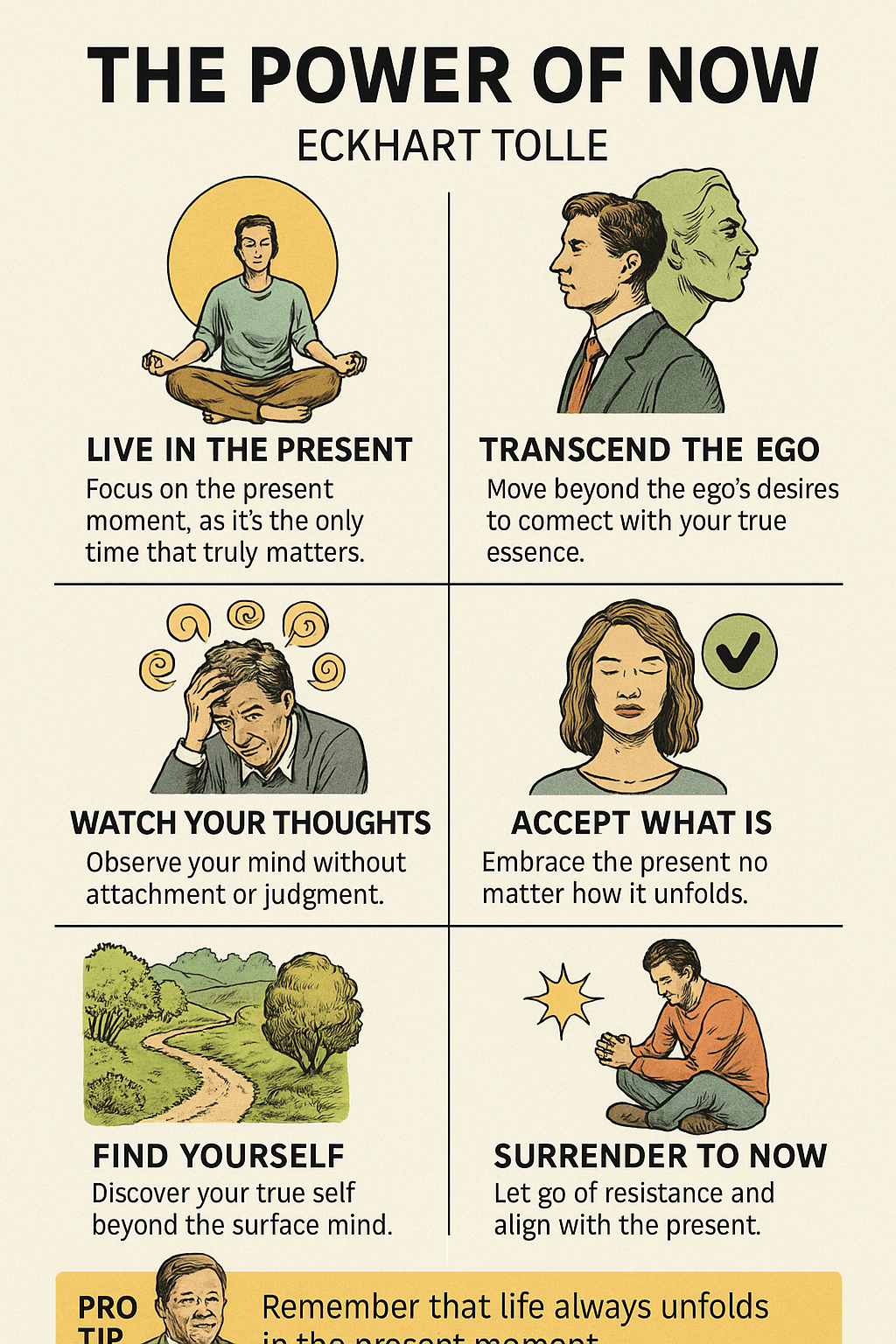
    Eckhart Tolle’s The Power of Now is a guide to spiritual awakening and mindfulness. It teaches that the only reality is the present moment, and that self-reflection and awareness of “now” can free us from anxiety about past or future . The book mixes spiritual traditions to show how identifying too much with thoughts leads to suffering, while anchoring in the present brings peace . Tolle even offers simple practices—like mindfulness exercises and slowing down—to help readers embed presence into daily life

    Focusing on the present moment grounds us in reality. Living in the Present: Tolle reminds us that “only the present moment is real and only the present moment matters” . When we fully engage in what we’re doing—whether it’s breathing, eating, or walking—we experience life without the burden of past regrets or future worries. Practical takeaway: Choose one routine task (like washing dishes or drinking tea) and commit to doing it with full attention. Notice sights, sounds, and sensations to anchor yourself in now.

    Transcending the Ego

    Tolle teaches that much of our pain comes from the ego: the mind’s voice that identifies with stories of “me” and “mine” . This egoic self constantly compares, fears, and seeks control, keeping us trapped in anxiety. By recognizing that our true self is separate from this running commentary, we weaken the ego’s grip. Practical takeaway: When a thought or label (“I am stressed,” “I am not smart,” etc.) arises, notice it with curiosity instead of judgment. Remind yourself, “I am not my thoughts.” This simple shift chips away at the ego’s illusions over time.

    Watching Thoughts

    One of Tolle’s core practices is to observe your thoughts instead of being swept away by them . He suggests watching the mind as if you were listening to a radio in the background—acknowledge thoughts without getting caught up in their drama. This conscious observation creates space between “you” and your mind, making negative patterns lose power. Practical takeaway: Try a 3-minute mental check-in. Sit quietly and count your breaths. When thoughts appear, label them briefly (“thinking,” “worrying,” etc.) and return to the breath. This trains your awareness to be the observer.

    Accepting What Is

    Resistance to the present moment causes unnecessary suffering. Tolle emphasizes acceptance: allowing life to be as it is, without automatically calling experiences “good” or “bad” . Paradoxically, accepting what is doesn’t mean passivity; it means engaging with life from a clear, centered place. When we stop fighting reality, we find calm and clarity. Practical takeaway: The next time something frustrating happens (a traffic jam, a mistake, bad news), pause and say to yourself, “It is what it is.” Take a few deep breaths, then respond calmly. Over time, this small practice lowers stress.

    Finding Your True Self

    Underneath the constant stream of thoughts, Tolle says, lies our true self: the awareness or “being” that is always present . This deeper identity is loving, whole, and constant, beyond ego and mental labels. It’s accessible whenever thoughts subside. Practical takeaway: Spend 1 minute scanning your body and noticing the space around you. You’ll discover a still, silent presence under the surface. Remember this sense of “being” – it’s your true self, always available in the present moment.

    Surrendering to Now

    Tolle describes surrender as the art of letting go of resistance to the present. In the book’s introduction he recalls hearing “resist nothing,” and how that realization ended his fear . When we stop insisting on control and accept what the moment brings, we experience flow and inner freedom. Practical takeaway: In any stressful situation today, try this mantra: “I accept what is.” Repeat it softly, especially if anxiety rises. Notice how surrendering a little helps you respond more wisely, step by step.

    1% Better Daily Challenge

    Commit to one small step of presence today. For example: Before you check your phone in the morning, take two deep breaths and feel your feet on the ground. Notice one new thing in your room. This tiny pause gives your mind a 1% reset toward awareness. Over time, these daily micro-steps add up to major growth.

  • Thinking, Fast and Slow – Mastering Your Mind for Better Decisions

    Thinking, Fast and Slow – Mastering Your Mind for Better Decisions

    Thinking, Fast and Slow by Daniel Kahneman is a modern classic on how our minds work. Kahneman’s main thesis is that we have two modes of thought: “System 1”, which is fast, instinctive and emotional, and “System 2”, which is slower, deliberate and logical . The book shows how these two systems shape our daily judgments: often we rely on quick gut reactions (System 1) and only occasionally engage careful analysis (System 2). Along the way, Kahneman catalogs dozens of cognitive biases – systematic thinking errors – that subtly distort our perception of reality . In short, Thinking, Fast and Slow is a deep dive into the “why” behind our decision habits and how to become more aware of them.

    System 1 vs System 2

    Our brain runs on dual tracks . System 1 is the autopilot: it works automatically and quickly with little effort or awareness . It handles routine tasks (like reading simple sentences or recognizing faces) in a snap. System 2 is the pilot that kicks in when things get hard: it allocates attention to effortful mental activities, like solving a math problem or learning a new skill . Most of the time we glide on System 1 without noticing.

    Takeaway: Recognize when you’re on autopilot. For important decisions or complex problems, slow down and engage System 2 (e.g. pause, gather more info, or run through a quick cost/benefit list) to avoid simple mistakes .

    Cognitive Biases

    Cognitive biases are hidden shortcuts in our thinking that skew judgments . They arise because our brain tries to simplify decisions by filling gaps with intuition. For example, we might favor information that’s easy to recall or ignore contradictory data. Kahneman and Tversky introduced this idea by showing we systematically deviate from rationality . In practice, this means even smart people can confidently hold flawed beliefs because they feel familiar or coherent.

    Takeaway: Be aware of bias traps. When you catch yourself jumping to conclusions, ask: “Could I be biased here?” For big decisions, list assumptions and seek diverse opinions to spot any unconscious bias.

    Anchoring

    Anchoring is a common bias where the first piece of information we hear sets the tone. Kahneman explains that people tend to rely heavily on the initial number or fact (the “anchor”), even if it’s irrelevant . For example, seeing a high “original” price tag makes a sale price feel like a great deal, even if the sale price is still overpriced.

    Takeaway: Before buying or deciding, try resetting the anchor. Consciously ignore any first number or reference, and consider a broader range of information. Pause and ask: “Is my judgment being skewed by the first value I saw?”

    Loss Aversion

    Loss aversion describes how losses hurt more than equivalent gains please . In Kahneman’s words, “losses loom larger than gains.” For example, losing $50 feels more painful than the joy of finding $50. This bias explains why we might avoid risks: we fear losing what we have far more than we value potential gains.

    Takeaway: Reframe how you think of choices. Whenever a decision feels scary, list both the potential losses and gains. Remind yourself that a missed gain isn’t as bad as you might feel. This balanced perspective can prevent over-cautious decisions driven by fear of loss.

    Overconfidence

    We tend to overestimate our abilities and the accuracy of our judgments . Kahneman shows that our confidence often comes from the easy “story” our mind tells, not from solid evidence . For instance, someone might overrate their skill at picking winning stocks or be sure a project will succeed because they underestimate hidden risks.

    Takeaway: Check your confidence with reality. When planning or forecasting, deliberately look for disconfirming evidence or run the numbers rather than relying on gut feeling. Cultivate a mindset that your first intuition might be wrong.

    Law of Least Effort

    Kahneman notes a psychological principle: a “law of least effort” . If there are multiple ways to do something, our brain will gravitate to the easiest path. We prefer routines, shortcuts and minimal mental work . This is why forming good habits is vital: once a task is automatic, it feels easy, but new or complex tasks activate System 2 and feel “hard.”

    Takeaway: Leverage this laziness for good. Design your environment so good decisions require minimal effort (e.g. lay out your gym clothes the night before). Conversely, if you want to challenge yourself, force a small additional effort step (like taking the longer route or reading the full report) to activate deeper thinking.

    1% Better Action

    Today’s 1% Challenge: Pick a decision or habit and apply one Kahneman idea. For example, next time you make a purchase, pause and ask if your mind is anchored by the first price you saw. Or before a meeting, do a 5-second check: am I running on autopilot (System 1)? If yes, take three deep breaths and set a goal to listen more actively (switch on System 2). This tiny pause builds the habit of mindful thinking, helping you grow a little bit every day.

    Key Takeaways

    System 1 vs System 2: Autopilot intuition vs. deliberate thought. Slow down for big decisions. Cognitive Bias: Mental shortcuts that skew reality. Question quick judgments. Anchoring: First info creates a mental “anchor.” Double-check if that number is biasing you. Loss Aversion: We dread losses more than we enjoy equal gains. Reframe with potential upside. Overconfidence: We often think we’re more right than we are. Seek facts and feedback to balance confidence. Law of Least Effort: The brain picks the easiest path. Make good choices effortless or add small hurdles to avoid automatic mistakes

  • Book of the Day: Mindset — The New Psychology of Success by Carol Dweck

    Book of the Day: Mindset — The New Psychology of Success by Carol Dweck

    Introduction: Why Mindset Matters

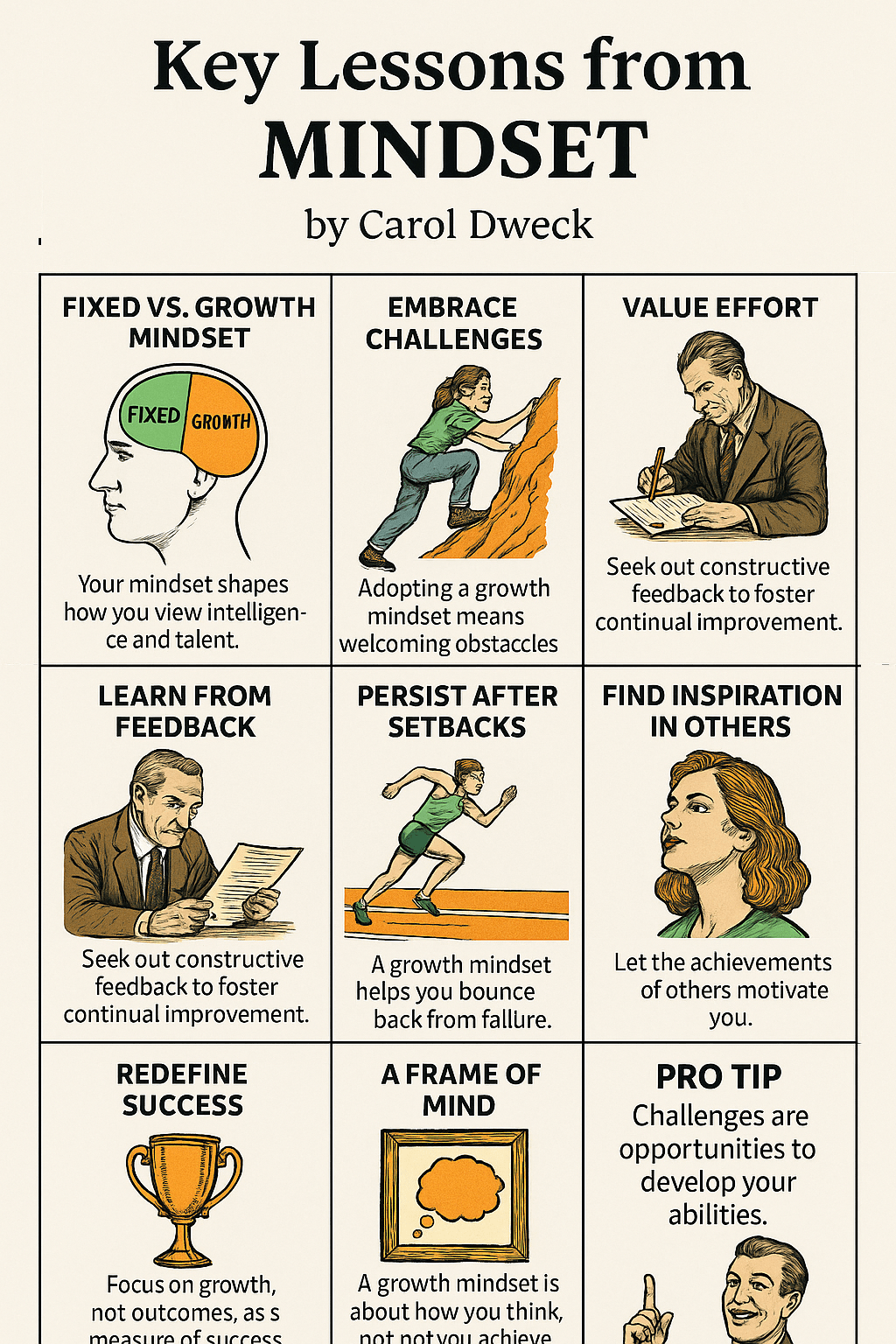
    Have you ever caught yourself thinking, “I’m just not a math person” or “I’ll never be a natural leader”? In Mindset, Stanford psychologist Carol Dweck calls out these self-defeating scripts and shows how a simple shift in mindset can change everything. She identifies two main mindsets – fixed and growth – and argues that developing a growth mindset is essential for success . In short, Mindset reveals how the way you think about talent and effort might be the single most important factor in your personal development and high performance. This isn’t just feel-good hype; it’s grounded in decades of research on achievement and learning.

    Fixed vs. Growth Mindset (The Core Idea)

    In a fixed mindset, you believe traits like intelligence or talent are set in stone. The result? You’re constantly trying to prove yourself. Challenges are scary because failing would mean you’re “not enough.” Dweck explains that if you think your qualities are unchangeable, you’ll likely avoid difficult tasks or criticism to protect your ego . Mistakes feel like personal failures.

    By contrast, a growth mindset means you see abilities as skills to be developed. Talent isn’t a fixed hand you’re dealt, but a starting point – and effort, good strategies, and help from others can grow your capabilities . A growth-minded person embraces challenges and views setbacks as feedback rather than defeat. If you struggle with something, it just means you don’t get it yet . This mindset creates a passion for learning and “stretching” yourself, even when things are tough . In fact, pushing outside your comfort zone (where real growth happens) becomes exciting instead of intimidating.

    3 Key Lessons for Skill Mastery

    Embrace Challenges & Failures: Don’t shy away from challenges – run toward them. People with growth mindsets don’t just accept challenges, they thrive on them . Each tough problem or even failure is actually a chance to learn. Instead of thinking “I failed – I’m no good,” ask “What can I learn from this?” When you treat failures as valuable feedback, you build resilience and bounce back stronger (growth-minded folks see setbacks as a motivating wake-up call ).

    Focus on Effort & Process, Not Talent: Under a fixed mindset, we might assume “If I’m not instantly good, I’ll never be.” Mindset flips that script. Effort is the path to mastery. Dweck’s research found that even geniuses have to work hard – natural talent only takes you so far. It’s consistent effort, practice, and effective strategies that turn potential into accomplishment . In other words, systems and habits beat raw smarts. So celebrate effort and persistence. By focusing on the process (the daily 1% improvements, the habits, the practice sessions), you’ll inevitably get better over time.

    Adopt a “Learner” Identity: Changing your results starts with changing how you see yourself. If you’ve been telling yourself “I’m just bad at ___,” start telling yourself “I’m learning ___.” Dweck often cites sociologist Benjamin Barber: “I don’t divide the world into the weak and the strong… I divide the world into the learners and nonlearners.” Be a learner. This identity-level shift keeps you curious, humble, and willing to try new things. When you identify as someone who is always learning and improving, challenges become part of your mission. You’ll seek out mentors, feedback, and routines that reinforce that identity (this is the essence of the Skill Stacker approach: continuously stacking new skills). Over time, those tiny 1% gains compound into major expertise.

    Daily Kaizen: Flip “Not Yet” into Action

    Today’s 1% improvement: Identify one “fixed mindset” thought you’ve had recently (“I’m just no good at this…”) and add one word to it: “yet.” Then take a small action in that direction. For example, if you’ve been thinking “I can’t speak in public,” tell yourself “I can’t do it yet,” then practice a 2-minute talk in front of a mirror or friend. Embrace the initial discomfort – that’s your growth in progress. This tiny exercise is your 1% better challenge for today.

    Key Takeaways (Infographic-Friendly)

    Fixed Mindset: Believes talent is fixed; often avoids challenges to avoid failure . Growth Mindset: Believes skills can be improved; embraces challenges to learn and grow . Effort Unlocks Ability: No matter your starting talent, effort and practice ignite ability into achievement . Failure = Feedback: Mistakes and setbacks aren’t the end – they’re lessons that guide you toward improvement . Learner Identity: See yourself as a work-in-progress. Choose to be a learner, not a non-learner , and you’ll keep evolving. 1% Better Daily: Small daily improvements compound to massive gains – 1% better each day makes you ~37x better in a year .

  • Book of the Day: Deep Work by Cal Newport

    Book of the Day: Deep Work by Cal Newport

    In an age of endless distractions, Deep Work shows that the ultimate productivity hack is the ability to focus relentlessly on what truly matters.

    1. Deep Work Is Your Superpower

    “The ability to perform deep work is becoming increasingly rare at exactly the same time it is becoming increasingly valuable in our economy. As a consequence, the few who cultivate this skill, and then make it the core of their working life, will thrive.”

    Summary: In today’s noisy world, deep work – the act of focusing without distraction on a demanding task – is like a superpower. Cal Newport argues that while shallow tasks and quick online hits are common, the capacity for sustained focus has become rare and highly valuable . Mastering this skill helps you learn hard things faster and produce higher-quality results. In short, deep focus on the wildly important tasks is what sets top performers apart from the constantly busy majority. High-performers consciously reject the modern obsession with multitasking and social media grazing, choosing instead to prioritize the work that truly moves the needle.

    Practical Takeaway: Make undistracted focus your daily priority. Identify your highest-value activity each day and give it a dedicated block of distraction-free time. By treating your attention as your most precious asset, you’ll quickly gain an edge and thrive in a world of shallow busyness .

    2. Quality Over Quantity – Intensity Beats Time

    “High-Quality Work Produced = (Time Spent) x (Intensity of Focus)”

    Summary: Simply clocking more hours doesn’t guarantee output – what counts is how intensely you work during those hours. Newport reminds us that an hour of pure, undistracted concentration can produce more progress than a day full of task-switching . Studies even suggest that novice deep workers max out at ~1 hour per day, while experts top out around 4 hours of true deep work in a day . Pushing beyond this limit leads to fatigue and diminishing returns. This is why “when you work, work hard. When you’re done, be done.” Top creators often budget just a few golden hours for critical work, guarding their intensity and then fully disengaging to recharge. By working in focused sprints and avoiding the trap of endless pseudo-work, you actually accomplish more in less time.

    Practical Takeaway: Work in focused bursts and honor quitting times. Schedule deep work sessions of 60–90 minutes for your most important tasks, working with full intensity and no interruptions. Then disconnect completely – no after-hours “just checking email” . This rhythm of intense focus and deliberate rest will skyrocket your productivity and prevent burnout.

    3. Build Rituals & Routines (Willpower Is Limited)

    “The key to developing a deep work habit is to move beyond good intentions and add routines and rituals to your working life designed to minimize the amount of your limited willpower necessary to transition into and maintain a state of unbroken concentration.”

    Summary: Don’t rely on willpower alone to dive into deep work – systemize it. Newport emphasizes that human willpower is a finite resource, more like a tired muscle than an unlimited well . The solution is to make deep focus a habit through rituals. This could mean starting work at the same early hour with noise-cancelling headphones on, or having a strict pre-work routine (like a cup of coffee, shutting the door, and putting your phone on airplane mode). By scheduling deep work blocks on your calendar and creating a set routine (time, place, duration, and rules for your session), you eliminate the mental effort of deciding when or how to focus . Over time, this discipline becomes part of your identity – you are someone who shows up consistently for deep sessions, no motivation needed.

    Practical Takeaway: Turn deep work into a daily ritual. Carve out a regular window for intense focus (e.g. every morning 8–10 AM) and protect it fiercely. Use supportive habits – a tidy workspace, a set start time, a “focus” playlist – to cue your brain that it’s time to go deep. By reducing reliance on willpower and sticking to a routine, you’ll embed deep work into your lifestyle and get more done with less mental strain.

    4. Embrace Boredom & Resist Distractions

    “You’ll struggle to achieve the deepest levels of concentration if you spend the rest of your time fleeing the slightest hint of boredom.”

    Summary: The ability to focus is like a muscle – and constant distraction is junk food. Newport delivers a hard truth: if you grab your phone at every idle moment and never allow yourself to be bored, you’ll find it nearly impossible to tolerate the boredom of deep work . Our brains adapt to the quick dopamine hits of social media, notifications, and entertainment-on-demand, leaving us chronically distracted . To undo this, we must practice being bored. Embrace activities that don’t give instant gratification – take a walk without your phone, let your mind wander, single-task on a mundane chore. This “boredom training” toughens your focus muscle. When you can sit with a problem without itching to check email or Instagram, you can reach the kind of deep concentration where real breakthroughs happen. Remember: focus is a skill you cultivate, not just a switch you flip when you need it.

    Practical Takeaway: Disconnect and train your attention span. Institute phone-free times in your day and resist the urge to seek stimuli during every lull. For example, set a rule that you won’t check any apps during the first hour of your morning, or practice doing nothing while waiting in line. By being comfortable with boredom, you’ll actually regain control of your mind and be ready to dive into deep work when it’s time .

    5. Quit the Shallows – Limit Social Media & Busyness

    “For many, there’s a comfort in the artificial busyness of rapid e-mail messaging and social media posturing, while the deep life demands that you leave much of that behind.”

    Summary: Shallow work – like incessant emails, meetings, and social media – can chew up your day and create the illusion of productivity. Cal Newport argues that to unlock your best work, you must “drain the shallows,” meaning aggressively minimize non-essential tasks and distractions. This might mean quitting or curtailing social media usage, reducing pointless meetings, and saying “no” more often. He suggests evaluating each tool (Facebook, Twitter, etc.) by whether it significantly supports your professional or personal values – if not, eliminate it. Remember, being busy is not the same as being productive. Multitasking and trying to do it all leads to mediocrity. As Newport puts it, clarity about what matters provides clarity about what does not. Focus on a few meaningful goals and let go of the rest . By leaving behind the comfort of busyness, you free up time and energy for work that truly counts.

    Practical Takeaway: Cut the shallow distractions mercilessly. Simplify your digital life – try a 30-day social media fast or limit checking news/email to a couple of short windows a day. Batch routine tasks (emails, admin work) to the afternoon so your mornings are free for creation. Prioritize deep work over reactive busywork. It might feel uncomfortable at first, but guarding your attention from the shallow stuff will give you hours of your day back and empower you to produce exceptional results instead of average output.

    6. Deep Work = Meaningful Work (Flow and Fulfillment)

    “To build your working life around the experience of flow produced by deep work is a proven path to deep satisfaction.”

    Summary: Deep Work isn’t just about getting more done – it’s about building a life centered on meaningful achievement rather than mindless activity. Newport draws on the psychology of “flow,” the state of total immersion in a challenging task, which is often deeply rewarding. When you routinely engage in deep work, you invite more of these satisfying flow states into your day. You also treat your work as a craft to be honed, which gives a sense of purpose and pride in whatever you do . This focus on depth over distraction leads to a more fulfilling professional life. Instead of ending the day wondering if you actually accomplished anything real, you experience the quiet joy of meaningful progress. In short, a deep life is a good life – one where you can end each day knowing you spent your time on things that matter.

    Practical Takeaway: Seek depth for greater fulfillment. Approach your work as a craft and allocate time to get into flow on important projects. By reducing shallow distractions and immersing yourself fully in worthwhile challenges, you’ll not only get more done – you’ll feel more satisfied and purposeful in your day-to-day life.

    Key Takeaways from Deep Work:

    Focus is a force multiplier: Deep, undistracted work on important tasks produces far more value than scattered effort. Intensity trumps hours: Four hours of deep work beats  eight hours of busywork. Work with full focus, then rest to recharge. Habits over willpower: Build rituals and routines to make deep focus a natural part of your day – don’t wait for inspiration, systemize it. Embrace boredom, ignore glitter: Strengthen your attention by resisting constant distraction. A bit of boredom builds mental muscle for sustained concentration. Drain the shallows: Be ruthless in cutting out low-value activities (excessive social media, needless tasks). Prioritize depth over busyness to create meaningful output.

    Final Challenge: Starting tomorrow, schedule a deep work session (even 30 minutes to start) for a project that matters to you – no distractions, no interruptions. Protect that time like a meeting with your future self. As Cal Newport would challenge us, step away from the shallow noise and dive deep – you’ll be amazed at the progress and satisfaction that follow. Good luck, and happy focusing!

  • Book of the Day: The War of Art by Steven Pressfield

    Book of the Day: The War of Art by Steven Pressfield

    Core Message in a Nutshell

    The War of Art is a battle plan for creators and entrepreneurs to defeat the inner enemy that keeps them from doing their work. The core message: our greatest barriers to high performance are not external, but internal. Pressfield names this invisible opponent “Resistance” – the force of self-sabotage that manifests as procrastination, fear, self-doubt, excuses, and anything that stops you from doing what you need to do . According to Pressfield, Resistance stands between the life you live now and the “unlived” life of your highest potential . The War of Art teaches that by adopting a professional, disciplined mindset, we can conquer this Resistance and unleash our creative potential .

    Key Lessons for High-Performance Creators

    Know Your Enemy: Resistance. The first step is recognizing the enemy within. Pressfield defines Resistance as a universal internal force that “opposes any act that might lead to personal growth or creativity,” often disguising itself as rational excuses . Have you ever decided to start a project or a healthy habit, only to find yourself procrastinating or rationalizing it away? That’s Resistance at work . It’s not personal weakness – everyone faces Resistance when trying to do something worthwhile. In fact, the more important a goal is to your soul or growth, the more Resistance you’ll feel toward it . Pressfield even calls Resistance “the most toxic force on the planet,” responsible for more unhappiness than poverty or illness . Actionable Insight: Expect Resistance daily and don’t take it as a sign to quit – take it as a sign that what you’re attempting truly matters. Commit to fighting it by starting your important work each day no matter what .

    Turn Pro – Embrace Discipline and Consistency.

    Pressfield’s antidote to Resistance is to “turn pro.” This means treat your passion like a professional job, not a hobby. High performers show up every day, no matter what – whether they feel inspired or not . Turning pro is a mindset shift: you commit for the long haul, set a schedule, and do the work rain or shine . Professionals don’t make excuses or wait for motivation; they punch the clock and get it done. As Pressfield notes, the amateur is at the mercy of moods, but the pro “focuses on mastering the craft,” knowing that success (and inspiration) is a by-product of consistent effort . Actionable Insight: Adopt a workman-like ethos in your creative life. Schedule daily time for your craft and stick to it religiously – same time, same place, like it’s your job. By showing up consistently, you build momentum and signal to yourself (and others) that you take your calling seriously .

    Use Fear as Fuel.

    Rather than avoiding fear, Pressfield boldly argues that fear is a compass pointing you toward the work that matters most. “Are you paralyzed with fear? That’s a good sign,” he writes – it means you’re doing something important . In The War of Art, fear and Resistance are two sides of the same coin: the more scared you are of a creative endeavor or risky goal, the more sure you can be that you need to pursue it . Fear is an indicator of potential growth. High-achievers feel fear but move forward anyway, using it as adrenaline rather than a brake. If a project makes you anxious – launching that business, writing that book, stepping on that stage – that’s probably the very thing you must tackle . Actionable Insight: Don’t shy away from what scares you. Identify one task that excites you and terrifies you – then take action on it precisely because it scares you. As Pressfield puts it, “Fear tells us what we have to do” , so let it guide you toward the work that will make the biggest impact.

    Love the Process, Not the Outcome.

    One hallmark of the professional mindset is focusing on the work itself rather than fortune, fame, or even the final product. Pressfield insists that we must do our work for its own sake, not for applause or rewards . In high-performance terms, this is about intrinsic motivation – finding satisfaction in the process of creation and improvement. The War of Art introduces the idea of being “territorial” about your work: deriving fulfillment from the act of doing it, instead of measuring yourself by external hierarchies or validation . When you focus on the process, you free yourself from worrying about others’ opinions or perfect outcomes. Paradoxically, this leads to better results and more persistence, because you’re fueled by passion and purpose, not ego. Actionable Insight: Whatever your field, commit to the craft itself. Set aside ego and external metrics, and fall in love with the day-to-day grind of honing your skills. For example, if you’re a writer, write every day because you are a writer, not because you need a bestseller. Consistent practice and a love of the process will eventually attract the outcomes you desire .

    Play the Long Game (Patience and Persistence).

    High achievers know that meaningful success is a marathon, not a sprint. Pressfield drives home that persistence is what separates pros from amateurs. The professional is in it for the long haul – he doesn’t quit when things get hard or when accolades are delayed . There’s a powerful line in the book about the cost of slacking off: “The professional has learned better. He respects Resistance. He knows if he caves in today, he’ll be twice as likely to cave in tomorrow.” In other words, every day you skip work makes it harder to get back in the saddle the next day. So, don’t break the chain. By showing up consistently and patiently, you compound your gains. Pressfield also notes that success often comes as an unexpected by-product of dedication – when you put in the work day after day, opportunities and “luck” tend to follow . Actionable Insight: Be patiently relentless. Commit to your practice for the long term, whether or not you see immediate results. When you feel the urge to procrastinate or give up, remember that consistency is your competitive advantage – every session counts. Stick with it, especially on the days you don’t want to. Over time, your discipline will pay off in mastery and momentum.

    Memorable Quote

    “Are you paralyzed with fear? That’s a good sign. Fear is good. Like self-doubt, fear is an indicator. Fear tells us what we have to do.” – Steven Pressfield

    This fiery quote encapsulates Pressfield’s message that the emotions we often run from are actually arrows pointing us toward our true calling. Embrace the fear and do it anyway.

    Your Action Prompt for Today

    Identify one important task you’ve been avoiding due to Resistance or fear – that one thing you know would move you forward (perhaps it’s writing a page, hitting the gym, making a tough call). Commit to working on it for just 30 minutes today, no excuses. Set a timer, start right now, and fight through any Resistance. By taking action in the face of fear and discomfort, you’ll be winning your own “War of Art” today. Good luck – now get after it!