Category: Goal Setting

  • Install a Night-Before Planning Ritual

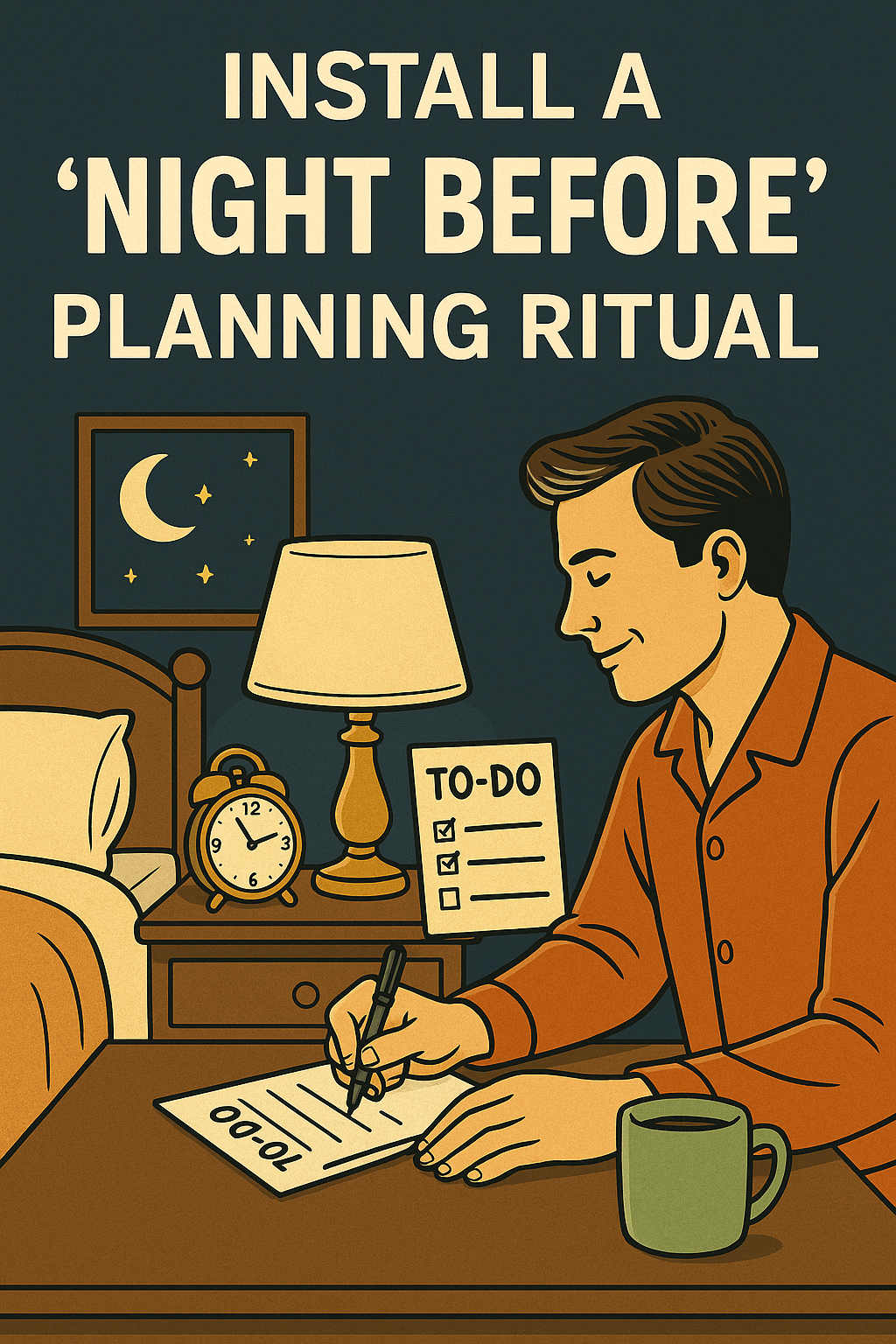
    Install a Night-Before Planning Ritual

    End your day with purpose by planning tomorrow tonight. A simple evening routine of reflecting on today’s progress and mapping out tasks for tomorrow can calm your mind, sharpen your focus, and set you up for a productive morning. Scientific studies show that writing a detailed to-do list at bedtime helps “offload” worries and speeds sleep onset . By making this a habit, you save willpower and reduce decision fatigue – instead of wasting precious morning energy deciding what to do, you wake up with a clear roadmap .

    Benefits of a Nightly Planning Ritual

    Reduced decision fatigue.  When you plan ahead, you eliminate many small morning choices (like what to wear or what task to tackle first). Decision fatigue – a state where mental energy for making choices runs low – builds up each day .  Productivity experts note that by planning the night before you “reduce decision fatigue, and preserve your willpower for your deepest most meaningful work.” . In short, having a plan means your brain isn’t drained by easy decisions, leaving more energy for what matters. Lower stress and anxiety. Jotting down unfinished tasks and worries before bed lets you offload them from your mind. Research found that participants who wrote a to-do list before sleep fell asleep about 9 minutes faster than those who journaled about completed tasks . Writing out tomorrow’s tasks (rather than mentally rehearsing them) reduces “cognitive arousal” and racing thoughts . Doctors advise “don’t take your problems to bed” – instead, schedule a worry-free planning session earlier in the evening . This practice clears your head and can improve sleep quality. Better sleep quality. A consistent bedtime routine signals to your brain that it’s time to wind down. Studies show that structured evening habits – especially a soothing ritual before sleep – are linked to better sleep habits and family well-being .  The sleep study above also found that the more specifically participants wrote their to-do lists, the faster they fell asleep . In other words, the act of detailed planning helps your brain let go of work concerns and drift off more easily. Morning momentum and clarity.  Waking up knowing exactly what to do first creates immediate focus and momentum. As one productivity writer notes, planning your day the night before means you’ll “get more done in less time” and experience “more flow” in the morning . By reviewing your priorities tonight, you remove guesswork from tomorrow’s morning – you know which tasks are top priority, so you can dive in confidently. A clear game plan built the night before means you start each day already moving forward.

    How to Build Your Nightly Planning Ritual

    Reflect on Today.  Spend a few minutes reviewing what you accomplished and what’s pending. Check off completed tasks and celebrate small wins. Noting down what went well (and what didn’t) helps you learn and ensures nothing important slips through the cracks. This reflection closes out the day and makes it easier to move on. Set Tomorrow’s Priorities.  Write a concise to-do list or pick the 3–5 most important things for tomorrow.  The classic Ivy Lee method suggests listing your top tasks before bed and tackling them first thing. Be specific: the sleep research found that detailed to-do lists offload more mental stress . Focus on high-impact goals that align with your bigger objectives. Jotting down these items (on paper, in a planner, or an app) gives your mind permission to rest, knowing you won’t forget them. Prepare Your Space.  Lay out anything you’ll need in the morning: clothes, tools, documents, or even a pre-set coffee mug.  For example, one schedule recommends “prepare for the next day: pack your stuff, choose your outfit” before bed .  Setting out tomorrow’s outfit on the bed (and packing your bag or work supplies) eliminates a key morning decision.  Another habit-stack is setting out your coffee mug or brewing supplies – James Clear points out a simple nighttime stack: after cleaning up, set out your coffee mug for tomorrow morning . These small cues make your morning routine run effortlessly. Wind Down Mindfully.  Turn off work and screens at least 30 minutes before bed. Do a relaxing activity like reading, gentle stretching, or deep breathing. A calming ritual signals it’s time to sleep .  You might also write a brief journal entry – either a gratitude log or a “worry list” – to further clear your mind (many therapists use worry lists to calm anxious thoughts). By separating your planning from active problem-solving, you give your brain the cue that the workday is done and it’s time to rest. Keep a Consistent Schedule.  Try to do this planning ritual at the same time each evening. Habits form best when they’re tied to a routine . For example, plan right after dinner or immediately after your evening shower. Over time, this consistency will make evening planning second nature. The more automatic it is, the easier it is to maintain – soon, writing tomorrow’s list will feel like a normal part of winding down.

    Examples of Effective Nightly Rituals

    One powerful nightly habit is to lay out tomorrow’s essentials before bed.  For example, prepare your outfit and work bag ahead of time – a schedule note advises “prepare for the next day: pack your stuff, choose your outfit” before sleep .  Even small cues help: setting out your coffee mug and ingredients can streamline your morning (as one habit example notes, “After I wipe down the counter, I will set out my coffee mug for tomorrow morning.” ).

    Review Big Goals and Wins.  Take 1–2 minutes to look over your long-term goals or project milestones. Celebrate any progress today and adjust tomorrow’s tasks if needed. This keeps your nightly plan aligned with the big picture. Write a To-Do List.  Handwrite or type the top tasks for tomorrow. Be clear and action-oriented. (Remember: researchers found that a detailed pre-sleep to-do list can actually help you fall asleep faster , so don’t skimp on specifics!) Check Tomorrow’s Calendar.  Scan your schedule for upcoming meetings or deadlines. Confirm any appointments and note what preparations you need. This ensures you wake up mentally prepared for events, not scrambling. Lay Out Clothes or Gear.  Decide what you’ll wear and put it out, or pack your gym/laptop bag. This removes a “morning decision” and can save precious time. Prep Breakfast or Lunch.  If you bring lunch or make morning coffee at home, prepare the night before. Fill the coffee maker, pack ingredients, or set out dishes. These tiny steps can make your morning smoother. Write a Worry List.  Quickly jot down any nagging worries or tasks that are on your mind. Just writing them down can quiet anxious thoughts (a Cognitive Behavioral Therapy technique ), making it easier to relax into sleep. Prep Your Technology.  Charge your phone and laptop so they’re ready. Set your phone to Do Not Disturb or put it away from the bed. Fewer notifications in the morning means a calmer start.

    Each of these simple rituals takes only a few minutes but can have a big payoff. Over time, they add up into a powerful habit loop that makes every morning easier. As one productivity coach puts it, giving yourself a framework for the next day “means there’s no guesswork as to what you’ll be doing when you sit down to work in the morning.”

    Conclusion: Try It Tonight

    Installing a night-before planning ritual is a small step that can transform your days. Imagine waking up calm and confident, with all your priorities lined up. Tonight, before bed, give it a try: spend five minutes jotting down your top goals for tomorrow and set out one item you’ll need (like your outfit or coffee mug). Notice how this clears your mind and jumpstarts your productivity. You might be surprised by how much more focused and energized you feel in the morning. Experiment with this ritual tonight and see the difference tomorrow .

    Give yourself one night to start – your tomorrow will thank you.
  • Define Your Vision of Success

    Define Your Vision of Success

    Have you ever climbed and climbed toward a goal, only to feel lost or unsatisfied at the top? Stephen Covey put it succinctly: “It is incredibly easy to work harder and harder at climbing the ladder of success only to realize that it’s leaning against the wrong wall” . This isn’t a failure of effort – it’s a failure of vision. Defining your own vision of success is the essential first step in any personal development journey. As Forbes writer Renee Goyeneche notes, creating a personal vision “helps you focus on what truly matters and provides clear direction for your life” . In other words, a clear vision acts as a compass, aligning your goals and daily actions with the life you really want.

    Studies back this up. Research in motivation psychology shows that vividly imagining a desired future can boost your positive emotions and commitment to goals . Psychology Today explains that “imagining a positive future is a helpful way to increase positive emotions and optimism,” and these positive feelings “often create opportunities and increase the chances of success” .  In practical terms, when you define a vision, you’re channeling this positive energy into purposeful action. In one organizational study, employees with clearer goals performed significantly better: higher “performance goal clarity” led to measurably higher individual performance . Clarity is power, both in the mind and on the scoreboard.

    A well-defined vision also grounds you in your core values and identity. If goals don’t match what truly matters to you, checking them off can feel hollow . That’s why Covey’s famous Habit 2 – “Begin with the End in Mind” – is all about imagining the kind of person you want to become and the principles you live by .  Similarly, James Clear (author of Atomic Habits) urges people to start “by focusing on who we wish to become” rather than only on outcomes . In other words, define your mission and character first, and let that shape your goals and habits.

    The Science of Vision and Motivation

    Personal vision isn’t just wishful thinking – it’s grounded in performance science.  Vivid “visions” or mental images of a desired future have been shown to mobilize and motivate goal-directed behavior .  A 2024 study in Current Psychology found that rich, image-based visions create positive emotions, which in turn “spill over” onto the specific goals derived from that vision – boosting commitment and progress .  In short, seeing your success in your mind charges your goals with emotion and makes you more likely to pursue them.

    Likewise, goal-setting research confirms that clarity fuels effort. Goals that are specific, aligned with your values, and framed as concrete outcomes drive motivation better than vague wishes. In public-sector studies, for example, employees who “clearly understand the performance goals” consistently outperform others .  And one meta-level summary reminds us: if we don’t consciously visualize who we want to be and what we want in life, we empower other people and circumstances to shape us instead .  In other words, without your own vision, outside forces define success for you – a recipe for stress and burnout.

    At the same time, psychologists warn against empty fantasizing.  The trick is to pair your vision with values and action.  Vision-building tools (like vision boards) are debated, but their core benefits come from clarifying values and goals. Psychology Today advises: “if your goals are not aligned with your personal values, achieving these goals won’t provide the sense of satisfaction… you’re seeking. Ask yourself: What really matters to you? Who do you want to be?” .  That self-reflection is exactly what sharpens your vision.

    Key Prompts to Define Your Success

    Use the following prompts and dimensions to shape your own vision of success. Reflect deeply and take notes – writing this down makes it concrete. (As James Clear says, identify the type of person you want to be, then prove it with small wins .)

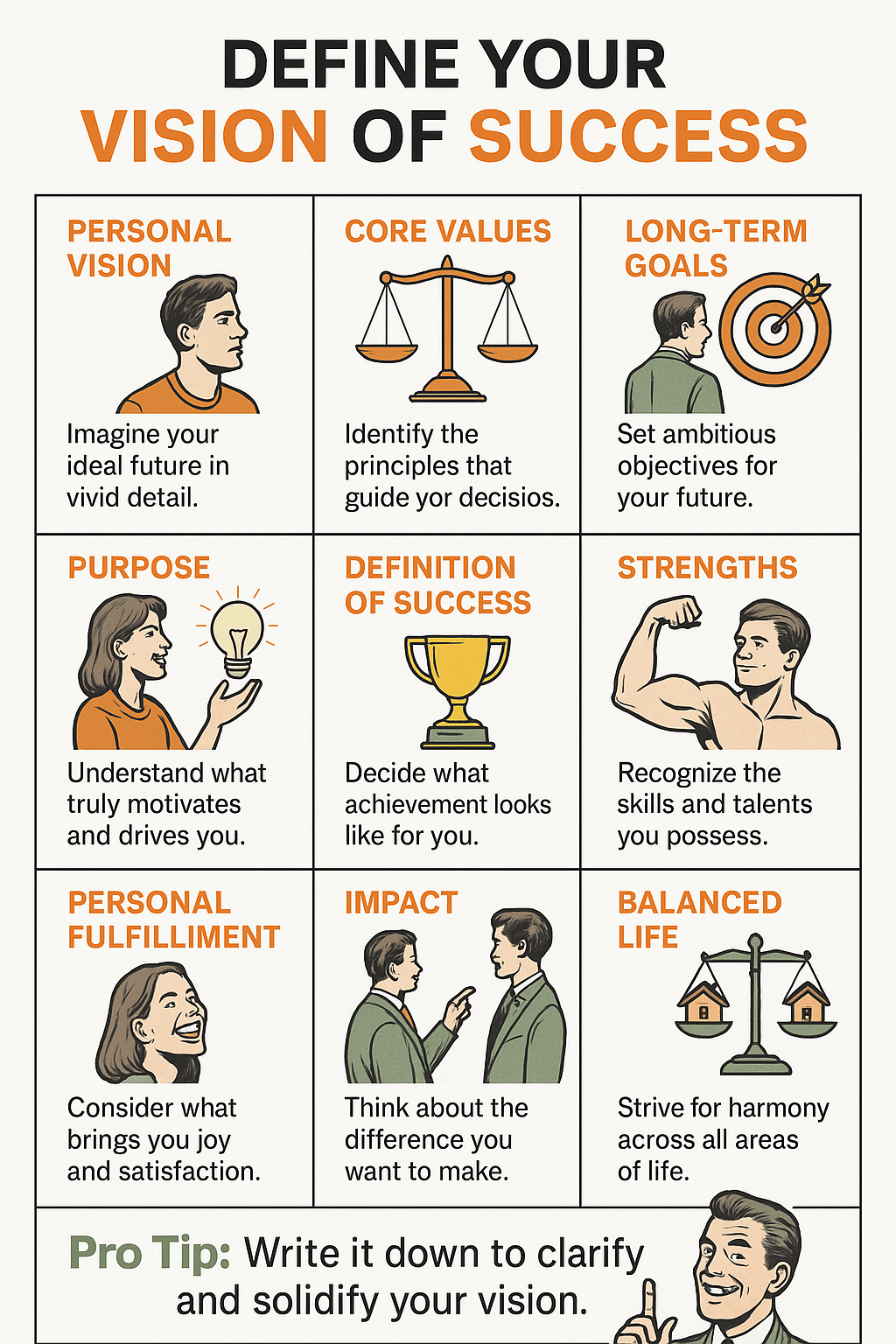
    Core Values & Purpose:  Start by listing your fundamental values and purpose. Ask: “What principles and causes are most important to me?” (Integrity? Creativity? Learning? Service?) If you achieve a goal that conflicts with your values, the win won’t feel like a win. As one expert puts it, a vision “ensures your actions align with your core values” .  Jot down 3–5 values (e.g. honesty, growth, family, health) and consider: how would success look if it honored those values? Identity & Mission:  Who do you want to be, regardless of metrics? Covey calls this “beginning with the end in mind” – visualizing the person you wish to become . James Clear similarly advises focusing on the identity you want (“Who is the type of person that could get the outcome I want?”) . Think beyond titles or bank balances: maybe you want to be “a wise leader, a caring parent, an adventurous learner,” etc. Write a brief statement of the person you want to become. Vivid Future Vision:  Close your eyes and imagine a scene from your ideal life – in detail. Where are you? What are you doing? How do you feel? Research suggests that these vivid mental images stir positive emotions and make you more motivated . For example, picture a typical morning ten years from now: your surroundings, your work, your routines. Make it as concrete as possible – this clarity will guide your decisions today. Key Life Areas: Success is multidimensional. Define the main areas (dimensions) of your life: career/work, relationships/family, health, learning, finances, contribution to others, etc. For each area, write what success means. (A clear overall vision “aligns your personal and professional paths” so they support each other .) For instance, in health: “I want to run a half-marathon and feel strong.” In career: “I will lead a team that solves important problems.” Ensure your vision covers the areas you care about, so you build a balanced life. Impact & Contribution:  What difference do you want to make? Reflect on how your success could help others or the world. Many visionaries include a contribution goal: mentoring others, innovating in their field, or supporting community. The Forbes example gave this concrete hint: “If you want to be a leader in your field… you might set goals to study and implement techniques used by people you admire.” . In your vision, ask: “What legacy or positive impact do I want to leave?” Motivating Habits & Routines:  Envision the daily habits that your future self would naturally follow. James Clear reminds us: “You do not rise to the level of your goals. You fall to the level of your systems.” Your vision should imply certain habits (e.g. daily writing, morning exercise, evening reflection). Identify 2–3 core habits that align with your vision. For example, if your vision involves learning, a habit might be reading 30 minutes each day. Starting now, outline a simple system or routine to build those habits – this will make your vision feel achievable. Work-Life Balance & Well-Being:  Finally, define how you want to feel day-to-day. Success without balance leads to burnout. Reflect on your ideal schedule: how much time for work, family, rest, and fun. The Forbes writer points out that if your vision includes “a healthy work-life balance,” you would explicitly schedule family time and breaks . Ask yourself: “What boundaries and rhythms will keep me energized and fulfilled?” including exercise, hobbies, or social life. A vision that accounts for health and relationships is more sustainable and satisfying.

    Summary and Next Step

    Defining your vision of success is a transformative foundation. It turns vague striving into a structured path, aligns your goals with what you value most, and taps into the brain’s love of clear goals and stories. A vision gives you permission to say no to distractions, because every choice can be filtered: “Does this get me closer to my vision?” As you’ve seen, experts from Covey to Clear agree: start by clarifying who you want to become and what truly matters. This clarity will fuel your motivation and shape your daily habits (remember, we fall to our systems ).

    Exercise: Now write your Vision Statement. In one sentence, capture your biggest picture of success. For example, “I live a balanced life where I am a respected leader, a loving family member, and a lifelong learner.” Keep it personal and inspiring. Display it somewhere you can see daily. This sentence will serve as your beacon — the first step on your 100-step journey. Review and refine it often. As Covey said, your personal mission is like “writing our own constitution” : it puts your goals in focus and keeps you climbing the right ladder.

    By defining your vision of success today, you lay the groundwork for every step that follows. Keep this vision in mind as you plan each next step, and you’ll move forward with confidence and purpose.

    Sources: Research on goal-setting and vision: Covey’s 7 Habits ; James Clear’s Atomic Habits ; motivational psychology studies ; Forbes/psychology articles on vision and values . All support the power of a clear personal vision.