Category: Mindset

  • 🧹 Daily Kaizen #5: Do One Chore You’ve Been Ignoring for 5+ Days

    🧹 Daily Kaizen #5: Do One Chore You’ve Been Ignoring for 5+ Days

    Small mess. Big drain.

    We all have one chore that’s been quietly haunting us.

    The overflowing laundry basket.

    The bin that needs emptying.

    That one dish that’s somehow avoided the sink all week.

    Here’s your Kaizen today:

    Do one chore you’ve been ignoring for 5+ days.

    Just one. The one that keeps whispering “later” every time you walk by.

    Because it’s not about being spotless — it’s about reclaiming your environment, one small victory at a time.

    🧠 Why this works:

    ✅ You clear the visual noise that subtly increases stress

    ✅ You disrupt the procrastination cycle (which bleeds into everything else)

    ✅ You earn a fast win that builds self-respect and momentum

    And when you complete it, something shifts:

    You move differently.

    Think more clearly.

    Feel more in control.

    🛠️ Try this:

    Set a 5-minute timer Pick the task you least want to do Don’t aim for perfection — just forward motion

    That one act becomes a ripple.

    And ripples become waves.

    ⚡ Final thought:

    If you can conquer a small thing you hate,

    you’re on your way to conquering bigger things that matter.

    So stop scrolling —

    and go dominate the dish, the drawer, or the damn laundry.

    You got this.

  • Daily Kaizen #2 – How Mental Forgiveness Frees Your Energy for What Matters

    Daily Kaizen #2 – How Mental Forgiveness Frees Your Energy for What Matters

    🧠 The Problem

    You’re not “over it” — you’re just carrying it quietly.

    We often think forgiveness is something we give to others.

    But the truth is: we forgive to free ourselves.

    The longer we carry resentment, the heavier our day becomes — even if we never say it out loud.

    🪞 My Story

    I used to tell myself I was “fine.”

    That what someone said or did didn’t bother me.

    But my body always knew better. Tension. Stress. Emotional weight I couldn’t explain.

    Then one day I whispered to myself:

    “I forgive them. Just for now.”

    Not forever.

    Not fully.

    Just for this moment — so I could stop replaying the tape and get back to living.

    It didn’t fix everything.

    But it lightened everything.

    🔨 Daily Kaizen #2:

    Forgive someone mentally — even if it’s just for now.

    You don’t have to text them.

    You don’t have to agree with them.

    You don’t have to forget what happened.

    Just choose — silently — to let it go for this moment.

    💡 Why It Works

    Forgiveness isn’t weakness.

    It’s emotional weightlifting.

    By mentally forgiving, you take back your attention, your calm, and your power.

    And even if the feeling creeps back later, you’ll know what to do:

    Forgive again. For now.

    🎯 The 1% Advantage

    You don’t have to forgive forever.

    Just enough to move forward with a lighter heart — and a clearer mind.

  • Daily Kaizen #1 – How Celebrating One Tiny Win Each Day Boosts Discipline

    Daily Kaizen #1 – How Celebrating One Tiny Win Each Day Boosts Discipline

    🧠 The Problem

    Most people sprint through their day, chasing productivity but rarely acknowledging progress.
    They believe only big wins deserve recognition — and in doing so, they miss the small moments that build real discipline.


    🪞 My Story

    I used to do everything “right”: eat clean, train, write, stay on track…
    But I’d still go to bed feeling like I hadn’t done enough.
    No satisfaction. Just another checkbox ticked.

    Then I tried something strange:
    I started celebrating the smallest wins — out loud.

    “I published my post.”
    “I trained even though I didn’t feel like it.”
    “I turned down a distraction.”

    It felt silly at first.
    But over time, it rewired how I saw myself.


    🔨 Daily Kaizen #1:

    Celebrate one tiny win out loud.

    • Say it.
    • Whisper it.
    • Write it down.
    • Tell someone.

    Just make it real.


    💡 Why It Works

    Your brain responds to what you reinforce.
    When you celebrate a tiny win, you tell your nervous system:

    “This matters. Let’s do more of this.”

    Tiny wins compound. But only if you notice them.
    This is how you build momentum from the inside out.


    🎯 The 1% Advantage

    You don’t need a perfect day to feel progress.
    You just need to honor one moment of self-respect.

    Start small.
    Say it out loud.
    Stack it tomorrow.


    📬 Want More Like This?

    I’m building a 100-Step Personal Development System – Coming Soon…

  • Master Your Self-Image and Performance Mindset with Maxwell Maltz’s Psycho-Cybernetics

    Master Your Self-Image and Performance Mindset with Maxwell Maltz’s Psycho-Cybernetics

    Ever feel stuck by self-doubt or a nagging inner critic? Imagine waking up believing you can hit your goals – every day. According to Maxwell Maltz’s classic Psycho-Cybernetics, your mind works like a goal-seeking machine, and the only limits it obeys are the ones in your self-image. In other words, what you truly believe about yourself shapes everything you do. If your mental picture is small or negative, it caps your success; but if you rewrite that picture, you can transform your identity and unleash a new performance mindset. This isn’t just wishful thinking. Maltz observed that “we act and feel in accordance with what we imagine to be true about ourselves” . By changing that inner vision – through visualization, positive self-talk, and trusting your subconscious (your “success mechanism”) – you literally reprogram your mind for success.

    Your Inner Self-Image: The Blueprint of Success

    Your self-image is the mental blueprint of who you think you are – built from every success, failure, and remark you’ve experienced. Maltz insisted this self-image is “cornerstone of all personal development,” because it sets the limits of what you can achieve . In practice, this means if you subconsciously see yourself as “not a leader” or “not creative,” you’ll unconsciously behave that way. He famously noted, “You can’t outperform your self-image” . In other words, until you upgrade your self-image, no amount of external training will break the ceiling.

    So how is your self-image formed? Often from childhood messages and past failures. Psycho-Cybernetics teaches that you internalize these beliefs early on – so a negative offhand comment can become a limiting program. But here’s the empowering flip side: beliefs can be changed. Maltz shows that by deliberately building a new, positive self-image, you redirect your “servo-mechanism” (your goal-seeking brain) to support the person you want to become . In fact, “your beliefs about yourself set the limits for what you can achieve” . Entrepreneurs and creators take note: anyone who wants an identity change first defines who they intend to be. The good news? You already have the toolkit inside you.

    Visualization & Mental Programming: Rewriting Your Inner Script

    What does it take to change that mental blueprint? Maltz’s answer: imagination and repetition. The subconscious mind can’t tell the difference between real experiences and vividly imagined ones . By regularly picturing yourself succeeding – in crystal-clear detail – you create a “blueprint” your brain will work to fulfill. In Psycho-Cybernetics, this is called the “Theatre of the Mind.” Athletes, performers, and high achievers use these same techniques: they mentally rehearse winning the game or nailing the presentation before they actually do it.

    Imagine it: spend just a few minutes each day visualizing your next big win – sensing the sights, sounds, and emotions as if it’s happening now. Maltz wrote that your nervous system “reacts appropriately to what [you] think or imagine to be true” . In practice, this means a daily habit of positive visualization reprograms your identity. Over time, the image you’ve repeatedly fed your mind takes over, guiding your behavior. Coupled with affirmations – simple positive statements like “I am confident and capable” – you overwrite old doubts. Maltz highlighted the power of self-talk, urging readers to replace “self-defeating thoughts with constructive affirmations” . This mental programming trains your subconscious for success.

    The Cybernetic Success Loop: Goals, Feedback, and Motivation

    Think of your brain as a cybernetic guidance system (like a heat-seeking missile) that constantly adjusts course toward a target. Maltz explains that once you feed your success mechanism a clear goal or self-image, it automatically works toward it . This is the essence of the “performance mindset” – you set the aim and trust the process. Importantly, in this loop every mistake is feedback, not failure. Maltz encourages us to “make mistakes” because each one acts like an autocorrect, nudging you closer to the goal . After learning from the misstep, you simply let it go and focus on the target.

    To harness this, focus on positive, successful memories as fuel. Maltz advised emphasizing times you were “in the zone” or “in your element” and consciously forgetting past failures . Reliving a past win can shift your self-image into one of capability and strength. Then, set a vivid goal and relax into it – don’t overthink. As one teaching puts it, once your goals are set you should “concentrate upon these rather than on what you do not want” , trusting your mind to fill in the path. This relaxed trust is key: resist micromanaging every step. Your success mechanism will find the way, using feedback to keep you on course .

    Key Takeaways & Action Steps

    Define your ideal self-image. List the traits of who you want to become (e.g. confident leader, healthy athlete, creative entrepreneur). Picture this identity clearly. Remember: your beliefs set your limits , so build them big. Visualize daily. Spend 5–10 minutes each day in your “Theatre of the Mind,” vividly imagining yourself achieving a specific goal. Feel the emotions of success. This mental rehearsal programs your mind for reality . Use positive self-talk. Notice any negative inner dialogue and flip it. Create empowering affirmations that reinforce your new self-image (for example, “I am a bold and creative problem-solver”). Repeat them often – your subconscious will start to believe them . Set clear, worthy goals. Write down one or two stretch goals aligned with your new identity. Keep them visible. Your brain needs a target for its guidance system . Focus on the end result, not micromanaging each move. Embrace mistakes as feedback. When you stumble, ask, “What’s this teaching me?” Maltz reminds us errors are “data points that refine your trajectory” . Learn, adjust, and move on—don’t dwell. This keeps your self-image growing stronger, not weakened. Celebrate wins and strengths. Frequently remind yourself of past successes (“I nailed that presentation,” “I solved that tough problem”). These memories reinforce a powerful self-image . Relax and trust the process. Over-control can block your creative mechanism. Practice relaxation (deep breathing, short meditation) to let subconscious insights surface. After preparation, let your automatic success mechanism work its magic .

    Conclusion: Embrace the Transformation

    Psycho-Cybernetics shows that the biggest change often comes from within. By deliberately changing your self-image through visualization and positive programming, you unlock a performance mindset that drives real-world results. Imagine the impact: an entrepreneur who truly sees herself as a leader will naturally act more confidently in pitches; a creative who pictures success will find inspiration and solutions more easily. You have the power to transform your identity – and with it, your life.

    Now it’s your turn: try a simple exercise today. Close your eyes for a minute and vividly imagine accomplishing a goal you care about. Notice how you feel. If this post resonated, share it with friends or comment below with your biggest insight. Even better, pick one tip (visualization, affirmation, or goal-setting) and apply it this week. Watch as psycho-cybernetic magic gradually shifts your reality. Comment, share, or start practicing – your future self will thank you!

    Sources: Core ideas are drawn from Maxwell Maltz’s Psycho-Cybernetics (via analyses and summaries) . These confirm that your self-image governs your results, and show how visualization and feedback loops can rewire your mind for success.

  • The Subtle Art of Not Giving a Fck*: 6 Bold Lessons on Values and Resilience

    The Subtle Art of Not Giving a Fck*: 6 Bold Lessons on Values and Resilience

    Mark Manson’s The Subtle Art of Not Giving a Fck* (2016) cuts through fluffy positivity with a blunt promise: life sucks, so pick which parts suck less.  In a frank, often funny voice, Manson argues that we all have limited “f*cks” to give – so we must focus on what really matters.  He insists that happiness comes not from avoiding pain, but from solving meaningful problems.  In fact, researchers note that “happiness is more than simply feeling pleasure and avoiding pain… it is about having experiences that are meaningful and valuable” .  Manson’s gritty advice resonates with people who want practical self-awareness, value-driven decisions, and stronger emotional resilience.

    6 Key Insights (with Takeaways)

    1. Choose Your Struggles

    Explanation: Manson reminds us that problems are inevitable.  We can’t avoid pain, but we can choose which pain to bear .  Instead of fretting over every tiny annoyance, decide what’s truly worth your effort.  Consciously pick challenges that align with your goals and values.  As one summary puts it, “Problems are inevitable. What is important is what problems we choose to care about” .  Struggle is part of life; make it count.

    Practical Takeaway: Next time you’re stressed, ask: Is this problem one I chose? If not, refocus on one you did choose (or can choose) – the problems tied to your values.  Jot down one annoying task or worry, then reframe it as a chosen project or let it go.  You’ll feel more empowered by owning your struggles.

    2. Break the Feedback Loop from Hell

    Explanation: Ever feel bad about feeling bad?  Manson calls this trap the “Feedback Loop from Hell.”  It’s anxiety stacked on top of anxiety – e.g. “I’m anxious about being anxious” .  Overthinking your emotions only fuels them.  Ironically, trying to suppress stress or negative feelings usually intensifies them .  Studies confirm that resisting negative emotions worsens anxiety, while acceptance improves coping .  The antidote is to notice feelings without self-judgment.  This breaks the loop and builds resilience.

    Practical Takeaway: When a negative emotion hits, name it (e.g. “This is anxiety.”) without beating yourself up.  Pause and breathe.  Remind yourself it’s okay to feel this way.  You don’t have to ‘fix’ the feeling right away – acceptance is part of moving forward.  This simple mindfulness step stops the spiral and clears your head.

    3. Value What You Can Control

    Explanation: Manson stresses that good values are internal and controllable, whereas bad values depend on externals .  For example, good values include honesty, creativity, and persistence – things you shape by your actions.  Bad values might be seeking status, wealth, or other people’s approval – since these depend on external factors and short-term highs.  Investing your worth in what you can’t control sets you up for frustration.  Focus on values you can act on (kindness, learning, hard work), and base decisions on those .  This makes you more self-aware and keeps external drama from derailing you.

    Practical Takeaway: Identify one core value you choose (say, integrity or kindness).  Then ask: Is my current problem related to that value or to something outside my control?  If it’s external, shift focus to something you can do.  For example, instead of fretting about others’ opinions (external), ask “How can I do my best work (internal)?” and act on that.

    4. The Truth About Happiness

    Explanation: Manson flips the usual idea of happiness on its head: he claims that happiness comes from problems, not avoidance of them .  In other words, solving challenges is what makes life satisfying.  Chasing only pleasure actually creates a “want more” loop, which is itself negative .  This aligns with research showing that people find lasting happiness through meaningful experiences and growth, not constant comfort .  Accepting this means choosing struggles that stretch you – that’s where fulfillment lies.

    Practical Takeaway: Reframe a current stress as an opportunity.  If your work or relationship is hard, ask yourself: What problem is here, and what could I learn by solving it?  Embrace the struggle as the price of progress.  Celebrating small wins over challenges will boost your mood more than avoiding any discomfort.

    5. You Are Not Special (And That’s Okay)

    Explanation: Manson shakes us out of entitlement by insisting we’re not uniquely blessed, and that’s fine .  Comparing yourself to unrealistic ideals creates anxiety and resentment.  Instead, accept that the “ordinary” is normal – and that’s where real life happens.  This humility keeps expectations in check.  Manson notes that obsessing over being special or perfect just feeds the negative feedback loop .  Letting go of entitlement makes you more grounded and content.

    Practical Takeaway: The next time you catch yourself envying someone’s life or performance, remind yourself: They have problems I don’t see.  Focus on your own path and values.  Practice gratitude for your ordinary strengths.  This shift from “me vs. the ideal” to “me with my own challenges” eases pressure and builds resilience.

    6. Responsibility ≠ Fault

    Explanation: A key insight is separating responsibility from fault.  Manson argues that, regardless of who’s to blame, you are responsible for dealing with what happens.  Taking responsibility means focusing on your power to act, rather than on excuses .  For example, you may not be at fault for a setback (someone else’s mistake, bad luck, etc.), but you are responsible for your response and choices.  Accepting this gives you agency and emotional control.  In Manson’s words, when we believe we’re responsible, we harness the power to shape our lives .

    Practical Takeaway: Pick one frustrating situation (a work error, a conflict, etc.).  Acknowledge any causes (fault), then immediately ask: What can I do about it?  Write down one constructive action you can take today, and focus on that.  By shifting from blame to action, you reclaim control and resilience.

    1% Better Challenge

    Pick one of these insights and apply it now.  For example, try the Feedback Loop tactic today: when you feel stress or anxiety, stop and name that feeling without judging it.  Breathe, and accept the emotion instead of fighting it.  Notice what changes – even a tiny difference counts.  Small, consistent tweaks like this build big self-awareness and resilience over time.

  • 😴 Daily Kaizen: Add a Pre-Sleep Gratitude Loop

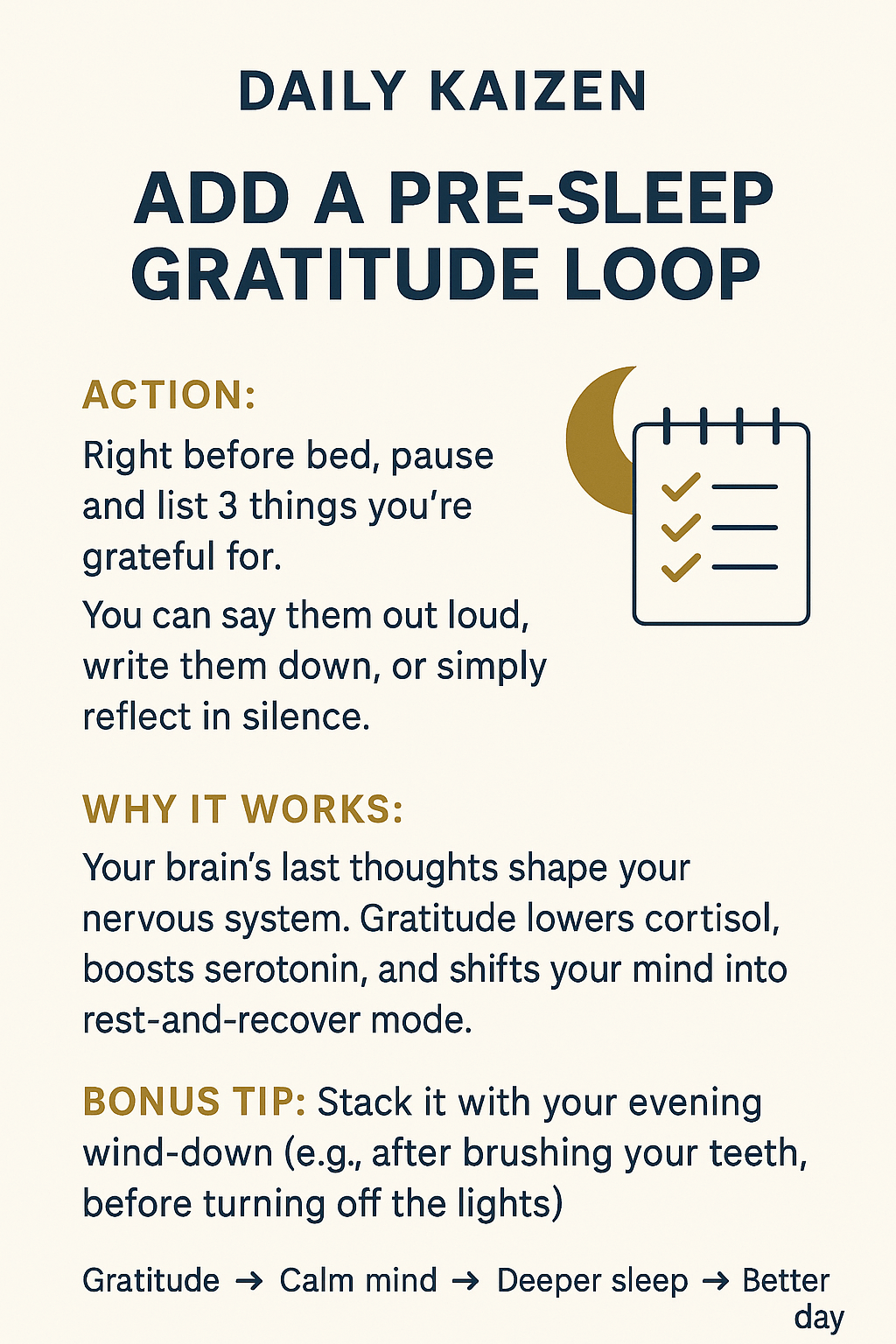
    😴 Daily Kaizen: Add a Pre-Sleep Gratitude Loop

    Action:

    Right before bed, pause and list 3 things you’re grateful for.

    You can say them out loud, write them down, or simply reflect in silence.

    Why it works:

    Your brain’s last thoughts shape your nervous system.

    Gratitude lowers cortisol, boosts serotonin, and shifts your mind into rest-and-recover mode.

    🧠 Bonus tip:

    Stack it with your evening wind-down (e.g., after brushing your teeth, before turning off the lights).

    🪜 Kaizen Stack:

    Gratitude → Calm mind → Deeper sleep → Better next day

  • 🧠 Daily Kaizen: Add a “Why Am I Doing This?” Check

    🧠 Daily Kaizen: Add a “Why Am I Doing This?” Check

    Daily Kaizen – 1% Better Through Intentionality

    We live in a world wired for autopilot. Notifications, habits, and muscle memory often guide our actions more than conscious choice.

    But today’s Kaizen is simple and powerful:

    Before you do anything, pause for 3 seconds and ask yourself:

    “Why am I doing this right now?”

    ❓ What It Looks Like in Practice:

    You’re about to open Instagram… → “Why am I doing this right now?” → You realize you’re bored — not intentional — and choose to move instead. You’re halfway through rewriting the same sentence… → “Why am I doing this right now?” → You realize it’s procrastination in disguise. Hit publish. You start cleaning your inbox at peak creative time… → “Why am I doing this right now?” → You pause, close Gmail, and dive into deep work.

    💥 Why It Works:

    This one-second mental circuit breaker does two things:

    Interrupts automatic behavior Replaces it with intention

    You won’t always make the perfect decision. But you will start making conscious ones. And those compound.

    🪜 Kaizen Stack:

    Ask “Why am I doing this?” → Interrupt autopilot → Align with purpose → Stack wins that matter

    Try it once today. You’ll notice how often your time and energy try to drift off-course.

    This one habit pulls them back in.

  • Book of the Day: The Obstacle Is the Way by Ryan Holiday

    Book of the Day: The Obstacle Is the Way by Ryan Holiday

    The Obstacle Is the Way by Ryan Holiday is a modern manifesto for turning adversity into advantage. A cult classic embraced by athletes, entrepreneurs, and leaders, it offers a framework for overcoming the obstacles life inevitably throws at us . The core idea, drawn from ancient Stoic wisdom, is that how we respond to challenges defines us . As Marcus Aurelius wrote, “The impediment to action advances action. What stands in the way becomes the way.” Instead of seeing roadblocks as setbacks, Holiday shows that each obstacle can become an opportunity to practice virtue, build strength, and move forward .

    Key Takeaways: Stoic Strategies for Overcoming Obstacles

    Holiday’s method centers on three interrelated disciplines—Perception, Action, and Will —forming a reliable approach to any challenge. Here are five powerful ways to apply these principles immediately:

    Reframe Your Perspective: When faced with a problem, choose to see it objectively rather than with fear or frustration. Our perceptions can be a source of strength or weakness—there is no good or bad until we assign meaning to events . By staying calm and seeing things as they are (without exaggeration or panic), you can spot the opportunity hidden in each obstacle instead of feeling defeated .

    Focus on What You Can Control: Direct your energy only toward what you can change, and let go of the rest. Stoics teach that zeroing in on your own actions and attitudes (and not obsessing over external factors) greatly magnifies your power and effectiveness . When you stop wasting effort worrying about things outside your control, you free up mental bandwidth to solve the problem at hand more creatively and efficiently .

    Take Decisive Action: No amount of worry or theory will remove an obstacle—only deliberate action will . Holiday emphasizes directed, persistent effort: tackle the issue step by step, using ingenuity and courage rather than brute force . Even small wins build momentum. Don’t wait for perfect conditions or permission to start; as Holiday bluntly advises, stop waiting for a miracle and start looking for angles to make progress . In short, action is the antidote—boldly do what you can, and do it right now.

    See Failure as Feedback: Every setback is a lesson in disguise. “Failure shows us the way—by showing us what isn’t the way,” Holiday writes . Instead of interpreting failure as a permanent defeat, view it as valuable feedback. Each unsuccessful attempt reveals what to adjust or avoid next time (recall Thomas Edison’s 10,000 “ways that won’t work”). Adopting this attitude turns failures into data points on the path to success, keeping you resilient and motivated to try new approaches until you triumph .

    Build Inner Resilience (Will): Some challenges can’t be changed; they can only be endured and met with character. Holiday encourages building an “Inner Citadel” of strength that no external adversity can break . This means preparing yourself mentally to handle hard times and choosing to find meaning in hardship rather than despair. For example, Abraham Lincoln endured lifelong bouts of depression yet used that suffering to develop profound patience, humility, and compassion in service of a cause greater than himself . By cultivating quiet endurance, humility, and faith that “this too shall pass,” you fortify your will . With a resilient mindset, even the worst trials become fuel for growth.

    Embrace the Obstacle – Closing Thoughts

    In essence, The Obstacle Is the Way reframes life’s difficulties as the raw material for greatness. Obstacles are not roadblocks to success—they are the path to success. Every challenge provides a chance to practice excellence and strengthen yourself . As Holiday summarizes: “See things for what they are. Do what we can. Endure and bear what we must.” Adopt this mindset, and the obstacles that once intimidated you will become stepping stones on your journey of self-mastery.

  • 🧠 Motivation Is a Trap – Here’s What Actually Keeps You Going

    🧠 Motivation Is a Trap – Here’s What Actually Keeps You Going

    Motivation is a liar.
    It shows up when it feels like it—and disappears the moment things get inconvenient.

    Everyone talks about “getting motivated.”
    But the truth?
    Motivation is the worst thing to rely on if you want long-term success.


    🔥 Why Motivation Fails

    • It’s based on emotion.
    • It’s influenced by sleep, food, mood, weather, and a hundred other things.
    • It disappears when you’re tired, discouraged, or overwhelmed.
    • It turns goals into “someday” fantasies, not daily disciplines.

    You don’t need motivation.
    You need a system that moves even when you don’t want to.


    🛠️ What Works Instead

    1. Rituals > Routines

    Make your habits sacred. The same way a soldier doesn’t think about brushing boots or packing gear—you don’t think, you just do.

    “No debate. No negotiation. Just action.”


    2. Environment Design

    You don’t rise to your goals—you fall to your environment.
    Make it harder to fail than to succeed.

    • Gym clothes ready the night before
    • Water bottle at your desk
    • No junk food in the house

    3. Identity-Based Habits

    Don’t ask, “What should I do today?”
    Ask: “What would a disciplined person do right now?”

    Become the type of person who trains daily, eats clean, and follows through—no matter how they feel.


    4. Momentum Over Heroics

    A perfect day is rare. A good-enough day is enough.
    String together enough “C+” days and you’ll crush 99% of the population.


    🎯 The Truth

    Motivation is a spark.
    Discipline is the engine.
    Systems are the fuel.

    You want progress? Stop waiting to feel like it.
    Act now. The feeling will catch up.

  • Daily Kaizen: One Breath, One Grounding Moment

    Daily Kaizen: One Breath, One Grounding Moment

    “In the middle of chaos, choose calm.”

    Today’s micro-improvement: Take a conscious breath before entering any room or conversation.

    Whether it’s a meeting, a difficult chat, or just walking through your front door—pause, inhale deeply through your nose, exhale slowly through your mouth. One breath. That’s it.

    This tiny moment creates a gap between reaction and intention—and that’s where better choices live.

    💬 Try it once today. Where will you choose calm over autopilot?