Category: Mindset and Motivation

  • Define Your Vision of Success

    Define Your Vision of Success

    Have you ever climbed and climbed toward a goal, only to feel lost or unsatisfied at the top? Stephen Covey put it succinctly: “It is incredibly easy to work harder and harder at climbing the ladder of success only to realize that it’s leaning against the wrong wall” . This isn’t a failure of effort – it’s a failure of vision. Defining your own vision of success is the essential first step in any personal development journey. As Forbes writer Renee Goyeneche notes, creating a personal vision “helps you focus on what truly matters and provides clear direction for your life” . In other words, a clear vision acts as a compass, aligning your goals and daily actions with the life you really want.

    Studies back this up. Research in motivation psychology shows that vividly imagining a desired future can boost your positive emotions and commitment to goals . Psychology Today explains that “imagining a positive future is a helpful way to increase positive emotions and optimism,” and these positive feelings “often create opportunities and increase the chances of success” .  In practical terms, when you define a vision, you’re channeling this positive energy into purposeful action. In one organizational study, employees with clearer goals performed significantly better: higher “performance goal clarity” led to measurably higher individual performance . Clarity is power, both in the mind and on the scoreboard.

    A well-defined vision also grounds you in your core values and identity. If goals don’t match what truly matters to you, checking them off can feel hollow . That’s why Covey’s famous Habit 2 – “Begin with the End in Mind” – is all about imagining the kind of person you want to become and the principles you live by .  Similarly, James Clear (author of Atomic Habits) urges people to start “by focusing on who we wish to become” rather than only on outcomes . In other words, define your mission and character first, and let that shape your goals and habits.

    The Science of Vision and Motivation

    Personal vision isn’t just wishful thinking – it’s grounded in performance science.  Vivid “visions” or mental images of a desired future have been shown to mobilize and motivate goal-directed behavior .  A 2024 study in Current Psychology found that rich, image-based visions create positive emotions, which in turn “spill over” onto the specific goals derived from that vision – boosting commitment and progress .  In short, seeing your success in your mind charges your goals with emotion and makes you more likely to pursue them.

    Likewise, goal-setting research confirms that clarity fuels effort. Goals that are specific, aligned with your values, and framed as concrete outcomes drive motivation better than vague wishes. In public-sector studies, for example, employees who “clearly understand the performance goals” consistently outperform others .  And one meta-level summary reminds us: if we don’t consciously visualize who we want to be and what we want in life, we empower other people and circumstances to shape us instead .  In other words, without your own vision, outside forces define success for you – a recipe for stress and burnout.

    At the same time, psychologists warn against empty fantasizing.  The trick is to pair your vision with values and action.  Vision-building tools (like vision boards) are debated, but their core benefits come from clarifying values and goals. Psychology Today advises: “if your goals are not aligned with your personal values, achieving these goals won’t provide the sense of satisfaction… you’re seeking. Ask yourself: What really matters to you? Who do you want to be?” .  That self-reflection is exactly what sharpens your vision.

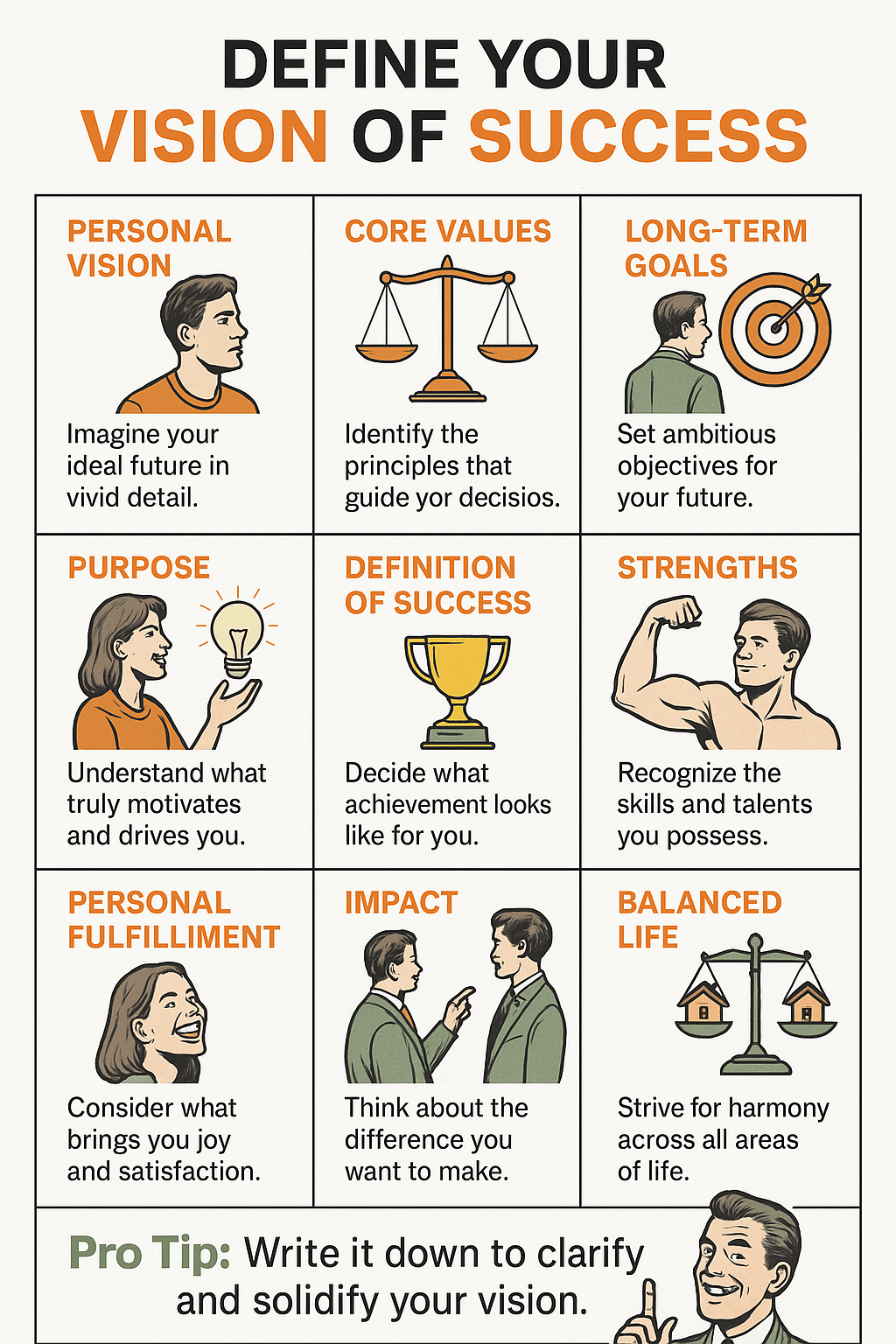
    Key Prompts to Define Your Success

    Use the following prompts and dimensions to shape your own vision of success. Reflect deeply and take notes – writing this down makes it concrete. (As James Clear says, identify the type of person you want to be, then prove it with small wins .)

    Core Values & Purpose:  Start by listing your fundamental values and purpose. Ask: “What principles and causes are most important to me?” (Integrity? Creativity? Learning? Service?) If you achieve a goal that conflicts with your values, the win won’t feel like a win. As one expert puts it, a vision “ensures your actions align with your core values” .  Jot down 3–5 values (e.g. honesty, growth, family, health) and consider: how would success look if it honored those values? Identity & Mission:  Who do you want to be, regardless of metrics? Covey calls this “beginning with the end in mind” – visualizing the person you wish to become . James Clear similarly advises focusing on the identity you want (“Who is the type of person that could get the outcome I want?”) . Think beyond titles or bank balances: maybe you want to be “a wise leader, a caring parent, an adventurous learner,” etc. Write a brief statement of the person you want to become. Vivid Future Vision:  Close your eyes and imagine a scene from your ideal life – in detail. Where are you? What are you doing? How do you feel? Research suggests that these vivid mental images stir positive emotions and make you more motivated . For example, picture a typical morning ten years from now: your surroundings, your work, your routines. Make it as concrete as possible – this clarity will guide your decisions today. Key Life Areas: Success is multidimensional. Define the main areas (dimensions) of your life: career/work, relationships/family, health, learning, finances, contribution to others, etc. For each area, write what success means. (A clear overall vision “aligns your personal and professional paths” so they support each other .) For instance, in health: “I want to run a half-marathon and feel strong.” In career: “I will lead a team that solves important problems.” Ensure your vision covers the areas you care about, so you build a balanced life. Impact & Contribution:  What difference do you want to make? Reflect on how your success could help others or the world. Many visionaries include a contribution goal: mentoring others, innovating in their field, or supporting community. The Forbes example gave this concrete hint: “If you want to be a leader in your field… you might set goals to study and implement techniques used by people you admire.” . In your vision, ask: “What legacy or positive impact do I want to leave?” Motivating Habits & Routines:  Envision the daily habits that your future self would naturally follow. James Clear reminds us: “You do not rise to the level of your goals. You fall to the level of your systems.” Your vision should imply certain habits (e.g. daily writing, morning exercise, evening reflection). Identify 2–3 core habits that align with your vision. For example, if your vision involves learning, a habit might be reading 30 minutes each day. Starting now, outline a simple system or routine to build those habits – this will make your vision feel achievable. Work-Life Balance & Well-Being:  Finally, define how you want to feel day-to-day. Success without balance leads to burnout. Reflect on your ideal schedule: how much time for work, family, rest, and fun. The Forbes writer points out that if your vision includes “a healthy work-life balance,” you would explicitly schedule family time and breaks . Ask yourself: “What boundaries and rhythms will keep me energized and fulfilled?” including exercise, hobbies, or social life. A vision that accounts for health and relationships is more sustainable and satisfying.

    Summary and Next Step

    Defining your vision of success is a transformative foundation. It turns vague striving into a structured path, aligns your goals with what you value most, and taps into the brain’s love of clear goals and stories. A vision gives you permission to say no to distractions, because every choice can be filtered: “Does this get me closer to my vision?” As you’ve seen, experts from Covey to Clear agree: start by clarifying who you want to become and what truly matters. This clarity will fuel your motivation and shape your daily habits (remember, we fall to our systems ).

    Exercise: Now write your Vision Statement. In one sentence, capture your biggest picture of success. For example, “I live a balanced life where I am a respected leader, a loving family member, and a lifelong learner.” Keep it personal and inspiring. Display it somewhere you can see daily. This sentence will serve as your beacon — the first step on your 100-step journey. Review and refine it often. As Covey said, your personal mission is like “writing our own constitution” : it puts your goals in focus and keeps you climbing the right ladder.

    By defining your vision of success today, you lay the groundwork for every step that follows. Keep this vision in mind as you plan each next step, and you’ll move forward with confidence and purpose.

    Sources: Research on goal-setting and vision: Covey’s 7 Habits ; James Clear’s Atomic Habits ; motivational psychology studies ; Forbes/psychology articles on vision and values . All support the power of a clear personal vision.

  • ✅ Skill of the Day: How to Keep a ‘Done’ List (Not Just a To-Do List)

    ✅ Skill of the Day: How to Keep a ‘Done’ List (Not Just a To-Do List)

    You’re not unproductive.

    You’re just forgetting what you actually got done.

    We obsess over what’s left — but we rarely track what we’ve already conquered.

    That’s where the ‘Done’ List comes in.

    🔁 How It Works:

    At the end of the day, write down everything you finished, no matter how small: Sent that message Did the workout Read 5 pages Didn’t check Instagram during work Drank more water than usual

    🧠 Why It Works:

    Shifts your focus from incomplete to accomplished Builds confidence through proof Reinforces the identity of someone who executes

    🧱 Pro Tip:

    Start with just 3 wins a day.

    You’ll be shocked how much you’re actually doing.

    📘 Don’t just plan your progress — record your proof.

  • 🧠 Skill of the Day: How to Be Consistent Without Motivation

    🧠 Skill of the Day: How to Be Consistent Without Motivation

    Motivation is a lie.

    Consistency only comes when you stop relying on feelings — and start relying on systems.

    Here’s how I built consistency I can trust:

    Identity first. I stopped trying to “get motivated.” I asked: What would a disciplined person do today? Design friction. I deleted distractions. No motivation needed when there’s nothing tempting me to stop. Daily 1% wins. No heroic efforts. Just one brick every day — no matter what. Pre-decide your actions. If you have to think about it, you’ll find a reason not to. Pre-decide. Execute. Done. Make your system unmissable. My routine is easier to do than to avoid. That’s by design.

    Motivation fades. But systems keep showing up.

    🧱 Discipline is a system — not a feeling.

  • Discipline Equals Freedom: Field Manual – Key Lessons

    Discipline Equals Freedom: Field Manual – Key Lessons

    Jocko Willink, a retired Navy SEAL commander and leadership expert, learned firsthand that success is never about taking shortcutsechelonfront.com. In Discipline Equals Freedom, he distills decades of hard-earned military experience into a no-nonsense roadmap: real freedom – in fitness, work, and life – comes only through relentless disciplineechelonfront.comsistasofstrength.com. As Jocko himself puts it, “Discipline equals freedom…if you want more freedom, get more discipline”sistasofstrength.comechelonfront.com. Forget quick fixes or empty motivation – this book is a blunt call to action to own your routines, outwork your former self, and earn the life you want.

    Wake Up Early

    Jocko’s day starts in the pre-dawn hours – and so should yours. Every chapter reminds us that discipline starts with waking up earlygrahammann.net. In fact, waking just one hour earlier gives about 15 extra days per yearentrepreneur.com. Use that quiet morning time for yourself: hit the gym or go for a run (boosting fitness and mental toughness), then map out your priorities for the day. With no distractions, you think sharper and take control (productivity and leadership gain). In short: own your mornings to own your life.

    • Rise Before the World: Jocko posts his watch on Twitter daily at 4:30am to prove the pointthetrustydingo.com. Science backs it up: early risers report better focus and more uninterrupted time to plan and actentrepreneur.com.
    • Morning Routine: A quick workout or stretch at dawn kicks off endorphins and sets a winning tone (fitness). Then use the quiet to journal or review goals (mindset) and tackle your hardest work first (productivity).
    • Lead by Example: When a leader shows up early, teams take note. Your discipline inspires others and builds trust – the kind of leadership Jocko embodiesechelonfront.comechelonfront.com.

    Get It Done – No Excuses

    Procrastination is the enemy. Jocko’s answer is brutal simplicity: start right nowgrahammann.net. He doesn’t wait for motivation – he goes anyway. “Even when I’m not feeling it,” he says, “I GO ANYWAY. I GET IT DONE”grahammann.net. This isn’t empty talk: it’s a command. In practice, that means lace up for the workout even when tired (fitness gains), write that report or call that client even when tempted to put it off (productivity wins), and tackle the tough conversation even when fear bites (mindset growth, leadership credibility).

    • Action Over “Feelings”: As Jocko says, “Don’t count on motivation. Count on Discipline”grahammann.net. On days when energy or willpower dip, remind yourself: I go, I do, I finish.
    • Short Wins: Small victories matter. Commit to one push-up if that’s all you can muster – then do more. Ticking off tasks (even tiny ones) builds momentum.

    Compete with Yourself

    Every day, Jocko asks: Are you a little better than yesterday? The book stresses “competing against your former self to continually improve”echelonfront.com. This principle applies from the squat rack to the boardroom. In the gym, aim to lift a bit more or run a bit longer each session. In work, refine yesterday’s presentation or code by 1% today. In mindset, challenge yesterday’s negative thought with a positive action. Leaders too: coach your team by outperforming your own past standards, then expect the same grit from them.

    • Track Progress: Keep a log of workouts, tasks, or habits. Beat those numbers bit by bit – the act of improvement is its own reward (fitness & productivity).
    • Daily Challenge: Make yesterday your rival, not anyone else. Get a little faster, stronger, wiser today. Over time that compounding edge becomes huge freedom.

    No Shortcuts – Take the Long Road

    Jocko reminds us bluntly that the only way to shortcut success is to follow the hard, disciplined pathechelonfront.com. There are no hacks in this book. Quick fixes and hacks just delay failure. The field manual preaches putting in the work: drilling fundamentals in training, mastering your craft patiently at the office, and drilling morning habits day after day. This means embracing routines that feel “too long” today (like a strict diet or a brutal practice schedule) because they build real strength and results tomorrow. Ultimately, each step on the long road cements habits that keep you winning and free.

    • Eat the Frog: Do your hardest or most important task first. It’s not glamorous, but it’s discipline. Each small grind earns massive freedom later (less scrambling, more control).
    • Consistency Over Intensity: Jocko’s workouts are methodical – push, pull, lift, squat – done every weekthetrustydingo.com. Apply the same to your work: small daily bets on yourself win big in the future.

    Discipline Over Motivation

    In Jocko’s world, habits beat moods every time. The book warns that waiting for motivation is a trap – feelings come and gograhammann.net. Instead, build unbreakable routines. “Discipline starts with waking up early,” Jocko writes – but it doesn’t end theregrahammann.net. It’s hitting the gym every day, eating to fuel your goals, controlling emotions, and even “doing the tasks you don’t want to do”grahammann.net. Over time, these choices flip your mindset: the right thing becomes automatic because the wrong thing isn’t an option.

    • Systemize Your Day: Schedule workouts and work blocks like unmissable meetings. Habitual action kills indecision and frees mental energy (productivity & mindset).
    • Fuel and Focus: Discipline your diet as you would your schedule. Nutrition isn’t a cheat day hack – it’s a daily discipline that keeps your body and brain ready (fitness gains, stamina).

    Embrace the Grind

    Jocko’s mantra is that “stress is generally caused by what you can’t control,” but if you can’t control it you mustgrahammann.net. When life (or training) sucks, lean in. If an obstacle is unchangeable, turn it into fuel. The book teaches: “If the stress is something you can’t control: Embrace it. Use it to make yourself sharper and more effective”grahammann.net. In practice, this means letting setbacks sharpen you instead of stop you. Push through the exhaustion in late reps; learn from feedback instead of shrinking from it. A disciplined mind treats every difficulty as a chance to get tougher – and that outlook frees you from excuses and fear.

    • Turn Pain to Power: A tough training day or a hard critique isn’t a stop sign but a training tool. Grow from it.
    • Lead with Calm: In chaos, stay cool. Your composure under pressure signals strength to others (leadership credibility). As Jocko says, refuse to “exhale and set your weapon down” even for a momentgrahammann.net – stay attacking.

    Applying Discipline: Fitness, Mindset, Productivity, Leadership

    Jocko’s principles aren’t abstract. In the gym, they mean showing up when soreness bites and smashing one more rep – because consistent work builds freedom in strength and healthgrahammann.net. In mindset, they mean “I go anyway” even on low days (discipline wins over fleeting motivationgrahammann.net). For productivity, it means early starts and action: planning, focus hours and beating yesterday’s outputentrepreneur.com. As a leader, it means leading by example – putting in the hard miles and setting the bar for your teamechelonfront.comechelonfront.com. Jocko built a decorated SEAL team on this ethos, and he insists it works just as well in business or any goal-driven life.

    Take Ownership – Now!

    No filler here: every excuse you have can be crushed by discipline. Jocko’s playbook shows that true freedom starts the day you own your actions – from the alarm clock to the attitude. You’ve got the blueprint: wake up early, do the work, beat your old self, and never bow to shortcuts. The time is now: don’t talk about it, just get after it.

    Get up, get moving, and stay relentless. Your future depends on it.

  • Kaizen for Busy Professionals: 3 Micro-Habits You Can Start Today

    Kaizen for Busy Professionals: 3 Micro-Habits You Can Start Today


    In a world where productivity feels like a never-ending sprint, the Japanese philosophy of Kaizen offers a refreshing, sustainable approach. Kaizen emphasizes continuous improvement through small, consistent actions. Instead of massive overhauls or overwhelming changes, Kaizen invites us to focus on tiny steps that, over time, lead to significant personal and professional growth.

    For busy professionals, this is game-changing. Time is often scarce, but progress doesn’t have to wait. Today, I’ll show you three micro-habits you can start today—each taking just a few minutes but offering compounding benefits over time.


    🔑 1. The 2-Minute Rule: Tackle Small Tasks Immediately

    We’ve all faced the creeping anxiety of a to-do list that grows faster than it shrinks. Enter the 2-Minute Rule, a simple principle that says:
    If a task takes two minutes or less, do it immediately.

    This approach, popularized by productivity expert David Allen, helps eliminate the mental load of tiny tasks that pile up and weigh on your mind.

    Examples You Can Apply Today:

    • Respond to a short email or message.
    • File that one document cluttering your desk.
    • Empty your recycling bin.
    • Stretch your legs or do a few neck rolls.
    • Prep a healthy snack for later.

    By completing these micro-tasks as they arise, you reduce clutter—both physical and mental—and maintain a sense of control throughout the day. It’s a small act that creates a ripple effect of productivity and calm.

    💡 Kaizen twist: Even if you’re swamped, taking these mini-actions reinforces a “can-do” mindset and builds positive momentum.


    🔑 2. Morning Movement: Jumpstart Your Day with Energy

    How often do you reach for your phone before you even get out of bed? Let’s flip the script. Instead of scrolling, use those first few minutes to invest in yourself.

    A 5-minute morning movement ritual can set a powerful tone for your day. It doesn’t have to be a full workout. Simple stretching, a few push-ups, or a brisk walk can be enough to wake up your body and focus your mind.

    Quick Routine to Try:

    • 30 seconds neck and shoulder rolls to release tension.
    • 5–10 push-ups to get your blood pumping.
    • 1-minute forward fold to stretch your hamstrings and back.
    • A short walk around your home or outside to energize.

    Why It Works:

    • Activates your body’s systems for focus and clarity.
    • Reduces morning stress and sets a proactive tone.
    • Builds confidence—if you can conquer movement first thing, you can handle whatever the day throws at you.

    💡 Kaizen twist: Start with just one exercise for a few days. Once it feels natural, layer on another. The key is sustainability, not intensity.


    🔑 3. Evening Reflection: Learn, Acknowledge, and Reset

    The end of the day often feels like a blur. But what if you took just one minute to pause, reflect, and reset? This micro-habit helps you track progress, identify areas for improvement, and prime your mind for tomorrow.

    How to Practice Evening Reflection:

    • Grab a sticky note, journal, or your phone’s notes app.
    • Ask yourself:
      • What’s one thing I did well today?
      • What’s one thing I can improve tomorrow?
    • Write it down. That’s it.

    Benefits:

    • Reinforces a sense of achievement, no matter how small.
    • Encourages continuous growth through daily reflection.
    • Clears mental clutter and improves sleep quality.

    💡 Kaizen twist: Don’t aim for perfection. Some days your “win” might be as simple as remembering to take a deep breath during a stressful moment. Celebrate it.


    🌿 Bringing It All Together

    The beauty of Kaizen is its simplicity and sustainability. You don’t need hours of free time or an elaborate system. You just need the willingness to start small and the discipline to keep going.

    These three micro-habits—tackling 2-minute tasks, morning movement, and evening reflection—are your stepping stones. They’re flexible, adaptable, and powerful when practiced consistently.

    🚀 Your Kaizen Challenge

    Pick one of these micro-habits and commit to it for the next seven days. Notice how even the smallest shifts create positive momentum in your life.

    Comment below: Which micro-habit are you starting today? Let’s inspire each other to embrace continuous improvement!