Category: self-improvement

  • Use Identity-Based Habit Formation

    Use Identity-Based Habit Formation

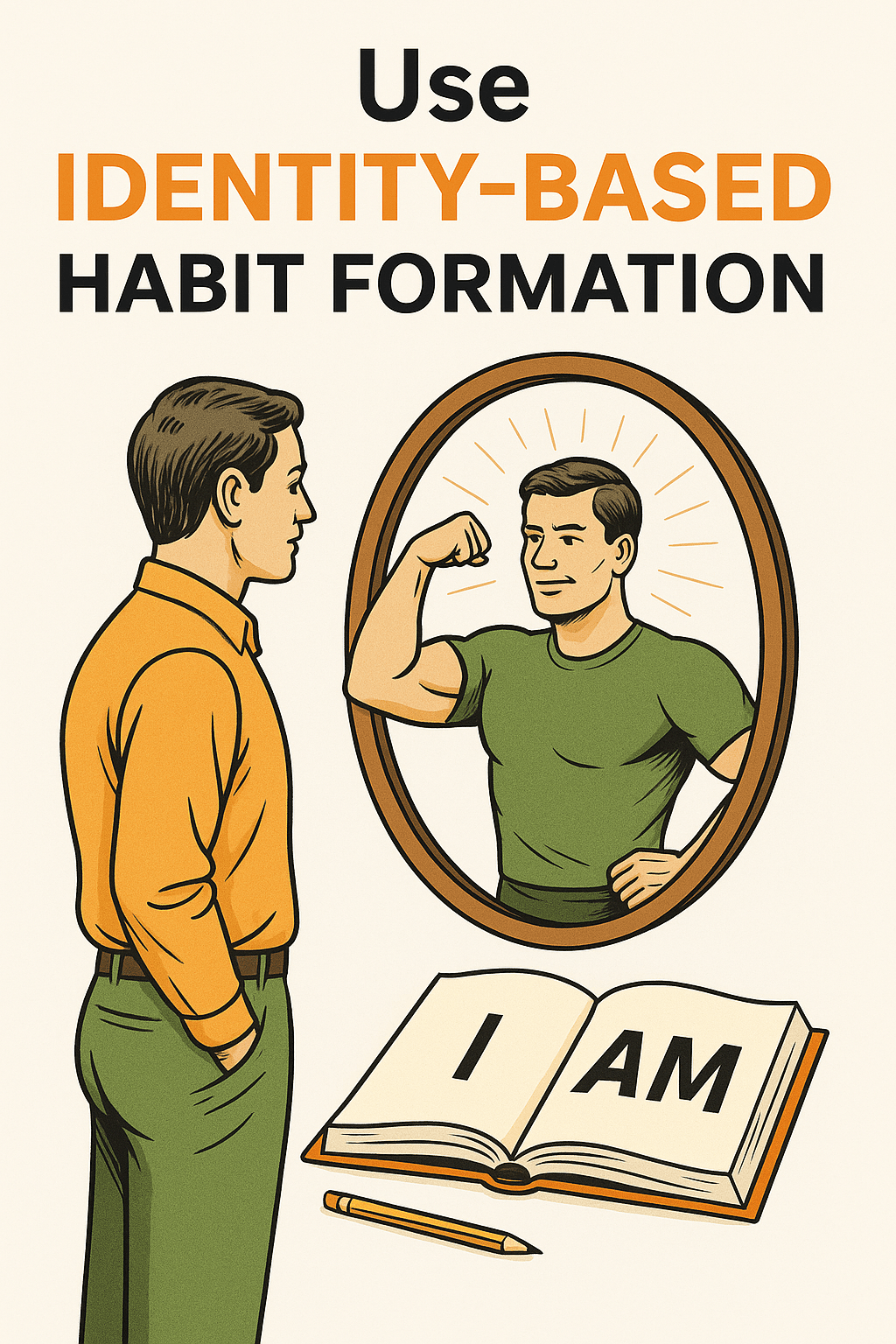
    Every new year or major goal season, we’ve all been there: fired up one day, and weeks later frustrated that the habit still didn’t stick. The problem may not be what you want to achieve, but who you think you are. Instead of focusing on outcome-driven goals, imagine shifting your mindset: “I am the type of person who [lets X happen].” This simple switch – an identity-based habit – can make habits far easier to form and sustain. As habits expert James Clear explains in Atomic Habits, “your current behaviors are simply a reflection of the type of person you believe that you are” . In other words, true habit change starts by creating a new self-image first.

    Outcome vs. Identity: Two Approaches to Habit Change

    Many people set goals like “I want to run a marathon” or “I want to lose 20 pounds.” These are outcome-based habits: the focus is on a result, not on the person you become. It’s no wonder they often fizzle out; once the goal is reached (or missed), motivation vanishes. In contrast, identity-based habits start by asking: Who do I want to become? For example: instead of “I want to run a marathon,” an identity-based thinker says, “I am a runner.”  When you see yourself as a runner, every action you take (training, eating right, getting enough sleep) feels like an expression of that identity – not just a means to an end .

    This identity-first mindset flips traditional habits on its head. As one habits coach puts it, “Who do I want to become?” replaces “What do I want to achieve?” . Seeing your habits as reflections of your self-image is powerful. For instance, if you identify as a healthy person, you’re naturally more likely to choose salad over fries. This happens because our actions follow our beliefs . If your inner story is “I am disciplined and fit,” you won’t struggle as much to eat well or exercise. In fact, psychologists find that when habits are tied to identity (especially core values), people integrate them more deeply and stick with them long-term .

    Why Identity-Based Habits Are More Powerful

    Identity-based habits build internal motivation and make lasting change more likely.  As one recent guide explains, “Identity-based habits work differently” – they “start with the question: ‘Who do I want to become?’ rather than ‘What do I want to achieve?’” . This creates three big advantages:

    Internal Motivation: When a habit is part of who you believe you are, it feels natural and purposeful. For example, if you think “I’m the kind of person who always exercises,” going to the gym isn’t a chore but an expression of you. This alignment boosts motivation – you’re not just chasing a number on a scale, you’re living your identity . Less Inner Conflict: Trying to quit a bad habit by force often creates internal war (“I should be healthy, but I really want junk food!”). With identity-based thinking, you eliminate that conflict. It’s easier to say “I am not a smoker” than “I’m trying to quit smoking” . There’s no battle between “should” and “want,” because your chosen identity has already won. Sustainable Change: Goals are by nature temporary, but identities endure. When your habits align with how you see yourself, they become part of your lifestyle, not just things to tick off. Research confirms that linking habits to identity helps new behaviors stick and leads to more effective behavior change . In short, identity-based habits turn once-a-day efforts into years-long routines, making personal growth feel more automatic than an uphill struggle.

    This identity-first approach is at the heart of James Clear’s bestselling strategy. In Atomic Habits (25+ million copies sold), Clear stresses that lasting change happens when “creating a new identity” comes before chasing results . When you internalize “I am X,” every choice reinforces that label. Even small victories (“I ate a healthy lunch today”) become proof that this new identity is real and powerful.

    Real-Life Examples: Turning Goals into Identities

    Let’s make this concrete with a few examples. Instead of saying “I want to lose weight,” reframe it as “I’m someone who moves my body every day.” You might start with tiny steps like a 5-minute walk after dinner. Each day you follow through, you prove to yourself “I am a person who stays active,” and that identity propels you further. For instance, James Clear shares a story: after his wife memorized all 30 names in a new class, she thought, “I’m the type of person who is good at remembering names.” From then on, she effortlessly remembered names everywhere she went . That shift in identity – from “I try to remember names” to “I do remember names” – turned a one-time success into a permanent habit.

    Here are a few more identity-based habits in action (adapted from habit experts):

    “I am a learner.” Action: Read 10 pages of a book or listen to an educational podcast each day . Over time, that micro-habit becomes a learning routine. “I am an organized person.” Action: Keep a daily to-do list and tidy your workspace at the end of each day . Small steps like these reinforce the belief that you’re naturally organized. “I am an early riser.” Action: Set a consistent bedtime and wake up 15 minutes earlier tomorrow. Repeat until this new schedule feels normal . Now mornings align with your identity, not just an alarm clock. “I am a writer.” Action: Write one paragraph or journal entry each morning. No pressure for brilliance – just ink a tiny bit and prove you’re “a writer” by writing.

    The key is consistency. Each small action – even a glass of water each morning if you aim to be healthy – serves as “evidence” for your self-image. Celebrate these wins! Every time you live up to your identity (by going on a run, preparing a healthy meal, writing a page), take a moment to acknowledge it. Studies show that reflecting on progress and celebrating identity-aligned actions not only feels good, but cements the new identity even further .

    How to Build Identity-Based Habits: Practical Steps

    Define Your New Identity.  Start by asking yourself, “Who do I want to be?” Pick a clear identity that matches your goals. It could be “the kind of person who reads daily,” “someone who values fitness,” or “a skilled communicator.” Be as specific as possible . For example, instead of just “I’m athletic,” try “I am a runner” or “I am the kind of person who never skips leg day.” Choose Tiny Habit Actions.  Identify one small habit that person would naturally do. If your identity is “I am a fit, healthy person,” you might start with 50 jumping jacks every evening or one extra serving of vegetables at dinner. The goal is to make the habit so easy that it requires no willpower – say, just 1% effort each day . These micro-wins accumulate and reinforce your identity. Attach Habits to Your Identity.  Whenever you perform the habit, mentally note “I am doing this because I am [identity].” For example, tell yourself “I’m having an apple snack because I am a healthy eater.” This mental link turns the action into a statement about you. According to experts, consciously proving your identity to yourself (even in tiny ways) is what makes the new identity stick . Track and Celebrate Wins.  Keep a simple log or journal of your habit actions. Every time you follow through, give yourself a quick pat on the back. This positive reinforcement is like flexing your identity muscle. Remember the birder in James Clear’s story: once she saw a proof (“I remembered that name!”), it confirmed her belief. You can do the same – a 10-minute workout or writing a paragraph is proof of the identity you claim. As researchers note, acknowledging these wins builds self-esteem and strengthens the new habits . Iterate and Deepen the Identity.  As these small habits become routine, you’ll notice your mindset shifting. Keep expanding: increase your habit slightly (walk 5 more minutes, write one more sentence) to continue proving your identity. Over time, “I am a runner” will feel completely natural, and skipping workouts will start to feel like stepping outside who you are.

    By following these steps, you’re literally becoming the person who lives the habits you want, rather than just chasing abstract goals. Each tiny act stacks up to make that identity undeniable.

    The Impact: Personal Growth That Lasts

    Imagine seeing yourself transform: tasks that once felt like chores now feel like parts of your character. That’s the power of identity-based habits. In Skill Stacker’s Personal Development System, we emphasize this approach because it aligns behavior change with personal growth. As you adapt your self-image, you’ll often find that other good habits naturally follow. A tidier desk might lead to clearer thinking, a consistent workout routine could boost your productivity at work, and so on. It becomes a virtuous cycle.

    Hundreds of thousands of people have seen this mindset shift work wonders. Authors, entrepreneurs, and athletes often report that telling themselves “I am the person who [practice X]” fundamentally changed their results. (Olympic runner Eliud Kipchoge, featured in Atomic Habits, is one high-profile example of mastering this mindset .) When you stop fighting your nature and instead transform your self-image, the change is profound.

    Join the Personal Growth Journey

    Ready to give identity-based habits a try? Start small this week: pick one new identity statement (like “I am a writer”) and one tiny action (even just one paragraph) to prove it. Stick to it consistently, celebrate each win, and watch how your behavior naturally shifts.

    Part 7 of our Personal Development System series shows that who you believe you are matters more than any goal. For more strategies on behavior change and personal growth, stay tuned to the Skill Stacker blog and follow our series. And don’t forget to grab our free Personal Development System workbook – it’s packed with practical exercises to help you apply identity-based habit formation and more. Your best self is waiting; become that person one habit at a time!

    Sources: Habit science and expert insights from James Clear’s Atomic Habits , modern habit coaching resources , and psychology research on habit-identity links . (Read more to see how identity-driven habits create lasting change!)

  • Build a Morning Routine That Works on Autopilot

    Build a Morning Routine That Works on Autopilot

    Starting your day with structure and clarity sets you up for success.  A consistent morning routine eliminates decision overload and jumpstarts your energy, focus and positivity.  As productivity experts note, tiny “pre-game” habits – like drinking a glass of water or opening the blinds – cue your brain that the day has begun .  By anchoring new habits to stable cues (a strategy James Clear calls habit stacking ), you’ll build a morning routine that feels automatic and effortless.  In this post we’ll break down six core morning habits – from waking at the same time every day to planning your day’s goals – explaining why each works and how to implement it for maximum impact.

    1. Wake Up at the Same Time Every Day

    A reliable wake-up time is the cornerstone of any successful morning routine.  When you rise at (nearly) the same hour each day, you synchronize your body’s circadian rhythm – the internal clock that regulates sleep, hormone release and metabolism .  This regularity makes it easier to fall asleep at night and feel alert in the morning.  For example, sleep experts at Michigan Medicine note that waking up at the same time “anchors” the circadian clock and can improve sleep quality and daytime energy .  To implement this habit, set a consistent alarm (yes, even on weekends!) and resist the snooze button.  Go to bed at a reasonable hour so you can wake up refreshed.  Opening the curtains or getting morning sunlight right away also helps signal your brain that it’s time to be awake .  Over time, your body will adapt and this consistent wake-up cue will kick on autopilot alertness each morning.

    2. Rehydrate and Fuel Your Body

    A reliable wake-up time is the cornerstone of any successful morning routine.  When you rise at (nearly) the same hour each day, you synchronize your body’s circadian rhythm – the internal clock that regulates sleep, hormone release and metabolism .  This regularity makes it easier to fall asleep at night and feel alert in the morning.  For example, sleep experts at Michigan Medicine note that waking up at the same time “anchors” the circadian clock and can improve sleep quality and daytime energy .  To implement this habit, set a consistent alarm (yes, even on weekends!) and resist the snooze button.  Go to bed at a reasonable hour so you can wake up refreshed.  Opening the curtains or getting morning sunlight right away also helps signal your brain that it’s time to be awake .  Over time, your body will adapt and this consistent wake-up cue will kick on autopilot alertness each morning.

    2. Rehydrate and Fuel Your Body

    Get your blood flowing to really wake up!  Even a brief bout of exercise first thing – whether it’s stretching, yoga, walking or a quick home workout – releases energy-boosting hormones.  Regular exercise “is excellent for boosting energy and reducing fatigue,” one medical source explains, because it pumps oxygen and nutrients to your heart, lungs and muscles .  Morning movement also triggers feel-good neurotransmitters: during exercise your brain produces extra endorphins, natural “happy” chemicals that reduce stress and boost mood .  A 2019 study even found that morning workouts sharpen attention and decision-making for hours afterward .  To implement: start small (even 5–10 minutes of stretching or a brisk walk around the block).  Build consistency first, then gradually add a few more minutes or new moves.  Lay out your workout clothes the night before (habit stacking: for example, “After I brush my teeth, I will put on my sneakers” ) to make moving in the morning automatic.  Physical movement in the AM not only wakes your body but also builds confidence and momentum that carries through the day.

    4. Mindful Practice (Meditation, Journaling or Breathing)

    Spend a few quiet minutes grounding yourself with mindfulness.  This could be a short meditation, deep breathing, or journaling about your priorities and feelings.  Science shows that morning mindfulness has powerful benefits: it calms the mind, reduces anxiety and sets a positive tone.  As one expert writes, practicing meditation in the morning has “beneficial effects on your brain, heart, immune system, and hormones,” which last throughout the day and improve focus, attitude, decision-making and energy .  Journaling can similarly clear mental clutter.  Writing down thoughts or to-dos in a journal helps organize your mind: people who journal often report feeling more relaxed and prepared, with improved productivity .  To implement, find a quiet spot (even your kitchen table or bedside) and spend just 5–10 minutes.  Sit comfortably, close your eyes and focus on your breath, or write three things you’re grateful for.  Many people find “simple affirmations can create a positive mindset” and reduce stress .  Apps like Headspace or Calm can guide a quick meditation, or simply jot a few bullet points in a notebook.  This mindful pause acts like a mental “reset button,” helping you approach the day with clarity and calm.

    5. Cultivate Gratitude and Positivity

    Starting the day with gratitude shifts your focus to the positive.  Take a moment to note two or three things you’re grateful for (your health, family, a new opportunity, etc.) or repeat a positive affirmation.  Research shows that gratitude practices can significantly reduce stress and anxiety while increasing happiness and well-being .  You don’t need fancy words – even thinking “I’m thankful to see this new day” can prime your brain for optimism.  For example, you might write “I appreciate my health” or “I look forward to today’s challenges” on your journal page.  By consciously adopting a grateful mindset in the morning, you set an uplifting tone that colors your thoughts and actions all day.

    6. Plan Your Day’s Top Priorities

    Finally, take a few minutes to outline your most important tasks.  Writing a brief to-do list or identifying two “must-do” goals for the day puts structure around your intentions.  As one productivity source notes, “Taking a few minutes to plan your day in the morning can set the tone for productivity.”  Jotting down tasks or appointments forces you to prioritize by importance, so you’re not scrambling later .  This doesn’t have to be a long list – even listing 3–5 items in order of priority is enough.  Many habit experts recommend habit-stacking this with your journaling or breakfast (for example, “After I make my coffee, I will write down my top three tasks”).  That way, planning becomes a natural part of the sequence.  Having a written plan clears mental space (no more trying to remember everything) and keeps you accountable.  When unexpected events arise, you can confidently adjust because you already know what truly matters for the day ahead .

    Pro Tip: Automate via Habit Stacking

    The ultimate key to an effortless routine is linking (or “stacking”) each step together.  As James Clear teaches in Atomic Habits, tie a new habit to an existing one so it triggers automatically .  For instance, “After I drink my morning water, I will do my stretches,” or “After I meditate, I will immediately review today’s tasks.”  Start with tiny actions – even just one minute – and grow gradually.  Each completed habit strengthens neural connections, making the routine easier and more ingrained over time .  Finally, prepare the night before: set out your exercise gear, journal and a glass of water.  By removing friction and using clear cues, your morning ritual will run on autopilot, leaving you energized, focused and ready to own your day.  Good morning!

    Sources: Science and expert insights on morning habits and circadian rhythm .  (Consult cited links for detailed studies and advice.)

  • Hidden Time Leaks and Productivity

    Hidden Time Leaks and Productivity

    Most of us drift through the day distracted by tiny “time leaks” – email pings, phone buzzes, random tasks – that chip away our focus.  In fact, research finds the average person is interrupted just 12 minutes into a task, and needs over 25 minutes to refocus afterward .  These fragments add up: roughly 720 work hours per year (about 18 full work weeks) are lost to distractions .  Every little interruption or idle moment – even checking a message or browsing social media – may feel harmless, but they compound into a massive productivity drain.

    Humans also tend to misjudge time.  The planning fallacy shows that we chronically underestimate how long our tasks will take .  When deadlines feel far away, Parkinson’s Law kicks in: work expands to fill the time allotted .  Give yourself two weeks for a project, and you’ll likely shuffle it for 13 days before scrambling at the end.  This combination of underestimating effort and over-allocating time means you inadvertently create more work and procrastinate, letting tasks stretch out and steal your calendar .

    Meanwhile our brains pay a heavy price for each switch of attention.  Cognitive science shows that multitasking is a myth – the brain can’t truly do two hard tasks at once.  Instead we juggle rapidly between them, burning mental energy with each switch .  As psychologist Daniel Levitin notes, bouncing between tasks spikes stress hormones and glucose burn in the brain .  Even a brief “mental block” from a switch can consume up to 40% of your productive time .  In short, little leaks like interruptions, multitasking and drifted attention slow you down, reduce work quality, and leave you exhausted – even if it feels like you’re busy.

    On top of that, digital distractions are ubiquitous.  One survey found 77% of workers feel more stressed by technology, with notifications tearing away focus .  A phone notification or an email alert doesn’t just nibble a moment – it breaks concentration and often sends you off-task for minutes.  Over a week you may face 160+ such distractions .  No wonder nearly 8 in 10 people report feeling distracted during the workday .  These hidden leaks – the “continuous partial attention” of modern life – quietly sink productivity unless we notice them and act.

    Strategies to Audit Your Time

    The good news is that awareness is the first step to plugging these leaks.  By systematically auditing how you spend each hour, you can surface hidden drains and regain control.  Try these strategies (each corresponds to a point in our infographic grid):

    1. Track Every Minute:  Keep a detailed time log for 1–2 weeks.  Write down how you spend blocks of time (work tasks, email, meetings, breaks, even browsing).  Studies show people grossly underestimate task durations .  Seeing the numbers in black and white sparks urgency: when you know you’re “on the clock,” you tend to focus more .  A log reveals surprises (e.g. how much social media or admin eats your day) and builds time awareness.  This data is the foundation of any audit. 2. Identify Your Leaks:  Analyze your time log for low-value activities.  Which “tasks” are really just buffers or distractions?  Maybe you spent half an hour each day on unnecessary meetings or gossip.  Note how often you check your phone (90% of people say phones are their biggest distraction ).  These leaks often hide in plain sight.  Categorize your activities (deep work, shallow admin, breaks, etc.) and calculate percentages – even a 5% daily leak adds up to over 100 hours a year. 3. Set Hard Time Limits:  Combat Parkinson’s Law by capping how much time a task can take.  Instead of “finish the report by Friday,” timebox it: “3 hours on Monday to outline it.”  Or use a timer/Pomodoro (e.g. 50-minute focus, 10-minute break).  When you give yourself a tight deadline or timer, you force focus and shorten drawn-out tasks.  As one guide notes, be mindful of how long you really need, not just the generous window given .  Shorter deadlines can harness urgency and prevent work from inflating. 4. Focus on One Thing:  Plan to single-task during work blocks.  Each time you try to split your attention (even music in background), you add cognitive load .  Structure your day into focused periods on one project at a time.  During each block, close unrelated tabs and resist switching.  Research shows that concentrated focus (deep work) yields higher-quality output and actually takes less time overall . 5. Batch Similar Tasks:  Group routine or shallow tasks together.  For example, schedule specific times to check email or Slack (say, twice a day) rather than letting them pop up constantly.  Batch phone calls, administrative tasks, or quick errands into dedicated slots.  This reduces the frequency of context switches (which chew time) and lets you tackle similar tasks with momentum.  Batching is especially powerful for tasks that otherwise interrupt bigger projects. 6. Tame Digital Distractions:  Silence or filter notifications.  Turn off app pings, put your phone on Do Not Disturb, or use website blockers during focus time.  The constant lure of news feeds and alerts wrecks concentration – in one survey, nearly half of workers admitted losing focus to irrelevant notifications .  By removing these digital hiccups, you stop many leaks before they start.  If needed, use “focus modes” or tools like noise-cancelling headphones to create a distraction-free zone. 7. Plan Breaks (And Earn Them):  Ironically, taking scheduled breaks can improve overall productivity.  Everyone needs downtime between intense tasks – the trick is to make it conscious, not accidental.  Build short breaks or walk-away moments into your schedule (e.g. a quick stretch every 90 minutes).  Planning breaks prevents random drift (like doomscrolling) and keeps you refreshed.  A rested brain works faster, so a 10-minute pause can save 20 minutes of frustrated effort later. 8. Review and Adjust Weekly:  At the end of each week, revisit your log and goals.  What went well? Where did new leaks appear?  Update your strategy accordingly.  For instance, if email still creeps in, tighten your batching.  If meetings dominated your time, negotiate agendas or attendee lists.  This reflection step turns data into action.  Each week’s audit sharpens your time sense (and improves future planning) .

    Implementing these strategies systematically helps you plug the silent drains on your day.  Over time you’ll channel your hours into meaningful work, not noise.

    Summary and Time-Log Exercise

    Time audit is about awareness and action.  Research tells us that productivity isn’t just harder work; it’s smarter scheduling.  By logging your time, spotting leaks, and enforcing structure (Parkinson’s Law, single-tasking, batching, etc.), you reclaim wasted hours .  Each small improvement – delaying that phone check, or finishing tasks ahead of a self-imposed deadline – compounds into big gains.

    Exercise (Optional): For one week, carry a notebook or use a time-tracking app to record your activities every 15–30 minutes.  At week’s end, break your log into categories (focus work, meetings, admin, breaks, distractions).  Calculate how much time went to priority tasks versus time leaks.  Identify the top two biggest drains (e.g. too many emails or idle social media) and apply the strategies above to fix them next week.  Repeat weekly.

    By treating time as data – measuring, analyzing, and iterating – you turn vague “busywork” into clear priorities.  In this way, you’ll plug the leaks and use every hour intentionally, boosting productivity and making progress feel tangible.

  • Define Your Vision of Success

    Define Your Vision of Success

    Have you ever climbed and climbed toward a goal, only to feel lost or unsatisfied at the top? Stephen Covey put it succinctly: “It is incredibly easy to work harder and harder at climbing the ladder of success only to realize that it’s leaning against the wrong wall” . This isn’t a failure of effort – it’s a failure of vision. Defining your own vision of success is the essential first step in any personal development journey. As Forbes writer Renee Goyeneche notes, creating a personal vision “helps you focus on what truly matters and provides clear direction for your life” . In other words, a clear vision acts as a compass, aligning your goals and daily actions with the life you really want.

    Studies back this up. Research in motivation psychology shows that vividly imagining a desired future can boost your positive emotions and commitment to goals . Psychology Today explains that “imagining a positive future is a helpful way to increase positive emotions and optimism,” and these positive feelings “often create opportunities and increase the chances of success” .  In practical terms, when you define a vision, you’re channeling this positive energy into purposeful action. In one organizational study, employees with clearer goals performed significantly better: higher “performance goal clarity” led to measurably higher individual performance . Clarity is power, both in the mind and on the scoreboard.

    A well-defined vision also grounds you in your core values and identity. If goals don’t match what truly matters to you, checking them off can feel hollow . That’s why Covey’s famous Habit 2 – “Begin with the End in Mind” – is all about imagining the kind of person you want to become and the principles you live by .  Similarly, James Clear (author of Atomic Habits) urges people to start “by focusing on who we wish to become” rather than only on outcomes . In other words, define your mission and character first, and let that shape your goals and habits.

    The Science of Vision and Motivation

    Personal vision isn’t just wishful thinking – it’s grounded in performance science.  Vivid “visions” or mental images of a desired future have been shown to mobilize and motivate goal-directed behavior .  A 2024 study in Current Psychology found that rich, image-based visions create positive emotions, which in turn “spill over” onto the specific goals derived from that vision – boosting commitment and progress .  In short, seeing your success in your mind charges your goals with emotion and makes you more likely to pursue them.

    Likewise, goal-setting research confirms that clarity fuels effort. Goals that are specific, aligned with your values, and framed as concrete outcomes drive motivation better than vague wishes. In public-sector studies, for example, employees who “clearly understand the performance goals” consistently outperform others .  And one meta-level summary reminds us: if we don’t consciously visualize who we want to be and what we want in life, we empower other people and circumstances to shape us instead .  In other words, without your own vision, outside forces define success for you – a recipe for stress and burnout.

    At the same time, psychologists warn against empty fantasizing.  The trick is to pair your vision with values and action.  Vision-building tools (like vision boards) are debated, but their core benefits come from clarifying values and goals. Psychology Today advises: “if your goals are not aligned with your personal values, achieving these goals won’t provide the sense of satisfaction… you’re seeking. Ask yourself: What really matters to you? Who do you want to be?” .  That self-reflection is exactly what sharpens your vision.

    Key Prompts to Define Your Success

    Use the following prompts and dimensions to shape your own vision of success. Reflect deeply and take notes – writing this down makes it concrete. (As James Clear says, identify the type of person you want to be, then prove it with small wins .)

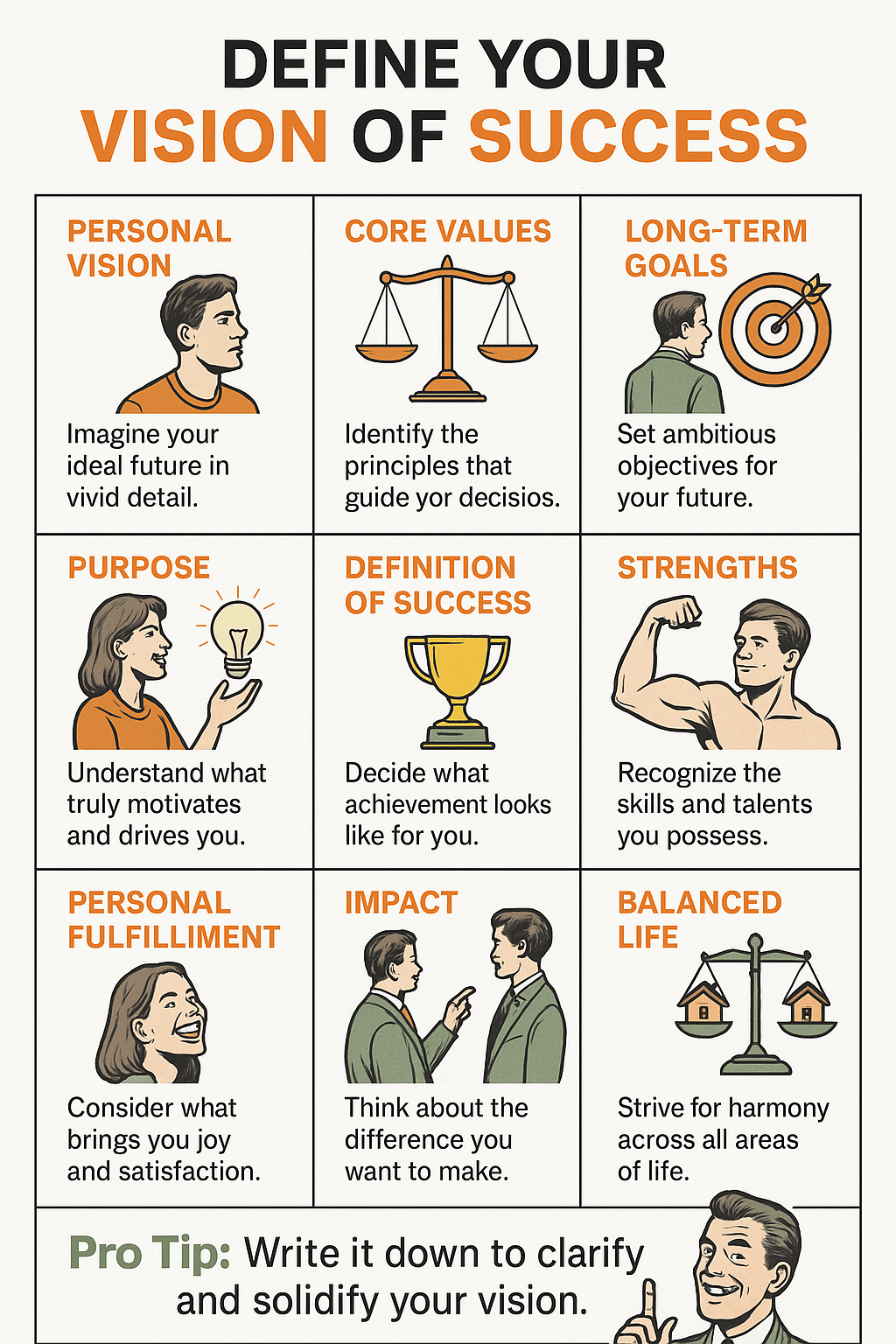
    Core Values & Purpose:  Start by listing your fundamental values and purpose. Ask: “What principles and causes are most important to me?” (Integrity? Creativity? Learning? Service?) If you achieve a goal that conflicts with your values, the win won’t feel like a win. As one expert puts it, a vision “ensures your actions align with your core values” .  Jot down 3–5 values (e.g. honesty, growth, family, health) and consider: how would success look if it honored those values? Identity & Mission:  Who do you want to be, regardless of metrics? Covey calls this “beginning with the end in mind” – visualizing the person you wish to become . James Clear similarly advises focusing on the identity you want (“Who is the type of person that could get the outcome I want?”) . Think beyond titles or bank balances: maybe you want to be “a wise leader, a caring parent, an adventurous learner,” etc. Write a brief statement of the person you want to become. Vivid Future Vision:  Close your eyes and imagine a scene from your ideal life – in detail. Where are you? What are you doing? How do you feel? Research suggests that these vivid mental images stir positive emotions and make you more motivated . For example, picture a typical morning ten years from now: your surroundings, your work, your routines. Make it as concrete as possible – this clarity will guide your decisions today. Key Life Areas: Success is multidimensional. Define the main areas (dimensions) of your life: career/work, relationships/family, health, learning, finances, contribution to others, etc. For each area, write what success means. (A clear overall vision “aligns your personal and professional paths” so they support each other .) For instance, in health: “I want to run a half-marathon and feel strong.” In career: “I will lead a team that solves important problems.” Ensure your vision covers the areas you care about, so you build a balanced life. Impact & Contribution:  What difference do you want to make? Reflect on how your success could help others or the world. Many visionaries include a contribution goal: mentoring others, innovating in their field, or supporting community. The Forbes example gave this concrete hint: “If you want to be a leader in your field… you might set goals to study and implement techniques used by people you admire.” . In your vision, ask: “What legacy or positive impact do I want to leave?” Motivating Habits & Routines:  Envision the daily habits that your future self would naturally follow. James Clear reminds us: “You do not rise to the level of your goals. You fall to the level of your systems.” Your vision should imply certain habits (e.g. daily writing, morning exercise, evening reflection). Identify 2–3 core habits that align with your vision. For example, if your vision involves learning, a habit might be reading 30 minutes each day. Starting now, outline a simple system or routine to build those habits – this will make your vision feel achievable. Work-Life Balance & Well-Being:  Finally, define how you want to feel day-to-day. Success without balance leads to burnout. Reflect on your ideal schedule: how much time for work, family, rest, and fun. The Forbes writer points out that if your vision includes “a healthy work-life balance,” you would explicitly schedule family time and breaks . Ask yourself: “What boundaries and rhythms will keep me energized and fulfilled?” including exercise, hobbies, or social life. A vision that accounts for health and relationships is more sustainable and satisfying.

    Summary and Next Step

    Defining your vision of success is a transformative foundation. It turns vague striving into a structured path, aligns your goals with what you value most, and taps into the brain’s love of clear goals and stories. A vision gives you permission to say no to distractions, because every choice can be filtered: “Does this get me closer to my vision?” As you’ve seen, experts from Covey to Clear agree: start by clarifying who you want to become and what truly matters. This clarity will fuel your motivation and shape your daily habits (remember, we fall to our systems ).

    Exercise: Now write your Vision Statement. In one sentence, capture your biggest picture of success. For example, “I live a balanced life where I am a respected leader, a loving family member, and a lifelong learner.” Keep it personal and inspiring. Display it somewhere you can see daily. This sentence will serve as your beacon — the first step on your 100-step journey. Review and refine it often. As Covey said, your personal mission is like “writing our own constitution” : it puts your goals in focus and keeps you climbing the right ladder.

    By defining your vision of success today, you lay the groundwork for every step that follows. Keep this vision in mind as you plan each next step, and you’ll move forward with confidence and purpose.

    Sources: Research on goal-setting and vision: Covey’s 7 Habits ; James Clear’s Atomic Habits ; motivational psychology studies ; Forbes/psychology articles on vision and values . All support the power of a clear personal vision.

  • 🧠 Introducing: The 100-Step Personal Development Series

    🧠 Introducing: The 100-Step Personal Development Series

    One simple step. Every day. For 100 days.

    Most people fail at self-improvement for one reason:

    It’s too vague. Too overwhelming. Too much theory, not enough traction.

    You’re told to “be better,” but nobody shows you how.

    That ends today.

    🎯 What This Is

    Over the next 100 days, I’m breaking down personal development into 100 clear, proven, and powerful micro-steps.

    Each one comes with:

    A daily graphic you can save and share. A short, actionable breakdown A practical step you can apply instantly

    These steps will cover everything from:

    Discipline and habits Focus and emotional control Communication and confidence Learning systems and mental models Energy, recovery, finance, purpose, and more

    🛠 Why I’m Doing This

    Because I believe every skill can be learned.

    And every goal becomes possible when you break it down into steps.

    This isn’t about motivation.

    It’s about building systems that work even on your worst days.

    This series is for creators, operators, athletes, leaders, and anyone committed to becoming 1% better — every damn day.

    🗓 What to Expect

    📍 Daily infographic posts on X @skillstacked 🧱

    Every 10 steps = a themed module recap on this blog 🧠

    A full flagship product at the end: The Personal Development OS (complete with visuals, explanations, exercises, and systems)

    📬 Follow Along

    You can follow the journey here on the blog.

    But to go deeper — and get early access to the full product when it drops:

    👉 Subscribe to join the list

    (No spam. Just systems that work.)

    Let’s build the system that builds you.

    – Skill Stacker