
Category: Spiritual Growth

  • 6 Transformative Lessons from The Untethered Soul by Michael A. Singer

    6 Transformative Lessons from The Untethered Soul by Michael A. Singer

    Imagine stepping out of the endless noise in your head and into a life of true freedom and joy. In The Untethered Soul, Michael A. Singer shows how you can untie yourself from fear, ego, and stress to live more fully in the present. These insights – about the inner witness, open heart, and letting go – aren’t just theory. They are practical keys to inner peace and growth. Read on for 6 life-changing lessons that make Singer’s teachings simple and inspiring, and discover how they can transform your mindset and life.

    Key Lessons from The Untethered Soul

    Lesson 1: You Are the Witness (Not Your Thoughts). Singer reminds us that you are not your inner monologue or your self-image. Instead, you are the awareness behind your thoughts – the calm observer of your mind . When you realize you’re watching thoughts (rather than being them), anxiety and self-doubt lose their grip. This shift is powerful: instead of being swept away by a negative thought (“I’m a failure”), you simply notice it and let it pass. In practice, this means pausing when stress hits and asking, “Is this really me, or just a thought I’m watching?” – a simple step that brings clarity and calm to your day. Lesson 2: Keep Your Heart Open (Let Energy Flow). Singer teaches that a healthy heart is always open, allowing energy, love, and inspiration to flow through . Every time we “close” our hearts – by clinging to anger, fear or past hurts – we block that positive energy. Personal growth and productivity skyrocket when we consciously choose openness instead. For example, after a tough day, you might practice relaxing your heart with a deep breath. Over time, this gentle habit “heals” emotional wounds and fills your life with greater compassion and creativity. As Singer says, an open heart is “the instrument of the heart as it was meant to be” – a source of unending love and openness . Lesson 3: Release and Surrender (Letting Go). The path to lasting peace comes from constant letting go of inner baggage. Singer emphasizes that every time you let go of anger, jealousy or pain, you fall “back into an ocean of energy” and inner light . In other words, surrender and acceptance are practical skills, not weakness. For busy professionals and emotionally aware people, this means noticing triggers (like criticism or a deadline panic) and deciding not to give them power. As Singer writes, “Deep inner release is… the path of nonresistance, the path of acceptance, the path of surrender” . Practicing this daily – pausing, breathing, and relaxing your grip on the thought – transforms stress into peace. Lesson 4: Commit to Inner Work (Find Liberation). True freedom comes from within. Singer says we each have the power to liberate our soul by doing the inner work of self-inquiry . He puts it bluntly: “the only price you have to pay is letting go of yourself” . In practice, that means being brutally honest with yourself about what holds you back – perfectionism, fear of rejection, the need to control outcomes – and then facing those fears head-on. This lesson resonates with anyone seeking growth: the minute you stop protecting your ego, you start to “steal freedom for your soul” . Embrace challenges (instead of avoiding them) and the reward is a lightness of being that comes from knowing you’re enough as you are. Lesson 5: Choose Unconditional Happiness. Singer argues that happiness is a choice and a practice, not a result. He encourages us to decide, right now, “you’re going to be happy from now on for the rest of your life” . That might sound simple, but it’s transformative. For example, when traffic jams or delays normally trigger frustration, tell yourself, “I choose peace right now.” This small act trains your mind. Singer calls this “the highest technique” to awakening . Personal development experts know that our mindset shapes our results – by choosing happiness (even in hard moments), you literally rewire your life toward more joy, resilience, and even creativity. Lesson 6: Live Fully (Death Teaches Life). Finally, Singer uses the mirror of mortality to inspire you to live more intensely now. He calls death “the best teacher of life” – meaning that remembering our limited time sharpens what truly matters . If you really believed life was short, what would you do today? Maybe you’d call that friend, take a risk, or let go of old grudges. This lesson is powerful: it invites you to fill every moment with presence and gratitude. As Singer puts it, if you live each experience fully, “death doesn’t take anything from you” . It’s a reminder to stop postponing happiness. You are alive now – so make every breath count.

    Your Next Step: Reflect and Act

    Now that you’ve seen these core ideas, it’s time to put them into practice. What thought or fear will you observe instead of believing today? What tiny tension can you release with a deep breath? Singer’s message is deeply personal: the real learning happens in your heart and mind, not just on the page. Consider picking up The Untethered Soul and letting it guide you further. In the meantime, start small. Maybe set an alarm to pause and check in with yourself once a day. Remember Singer’s words: “everything will be okay as soon as you are okay with everything” . Embrace that transformation. You have the power to untether your soul – one breath, one choice, one moment at a time.

  • The Four Agreements by Don Miguel Ruiz: 4 Rules That Will Change Your Life

    The Four Agreements by Don Miguel Ruiz: 4 Rules That Will Change Your Life

    What if your life could be transformed by just four simple agreements?

    Don Miguel Ruiz’s The Four Agreements offers ancient Toltec wisdom in a modern package — and the results are radical. These aren’t fluffy affirmations. They are practical commitments to self-liberation.

    By breaking the mental “agreements” we’ve unconsciously made with fear, guilt, and conditioning, we unlock freedom, peace, and personal power.

    Let’s break down each of the Four Agreements and how to live them today.

    1️⃣ Be Impeccable with Your Word

    Your words create your world.

    Ruiz says this is the most important agreement. To be “impeccable” means to use your word with integrity — no gossip, no self-hate, no lies (especially to yourself). Speak truth. Speak life.

    🔁 Takeaway:

    Speak to yourself like someone you deeply love.

    Before speaking, ask: Is this kind, true, and necessary?

    2️⃣ Don’t Take Anything Personally

    Nothing others do is because of you — it’s a projection of their own world.

    When you take things personally, you hand your power to someone else’s emotional state. Ruiz says: “Even when a situation seems so personal, even if others insult you directly, it has nothing to do with you.”

    🔁 Takeaway:

    Someone cut you off, criticized your work, ignored your text?

    Say it to yourself: “That’s about them, not me.”

    3️⃣ Don’t Make Assumptions

    Assumptions create drama. Clarity creates peace.

    We assume people understand us. We assume we know their intentions. And then we get angry over things that aren’t even real. Ruiz urges: Ask. Clarify. Communicate.

    🔁 Takeaway:

    If something feels off, don’t spiral — ask.

    Just say: “Can I clarify something?”

    It saves relationships.

    4️⃣ Always Do Your Best

    Not perfection. Not overachievement. Just your best — and it changes daily.

    This agreement reminds us that our “best” will look different when we’re rested, stressed, or learning. But if you consistently give your honest best effort, you’ll avoid regret, shame, and self-judgment.

    🔁 Takeaway:

    Whatever you do today — training, working, resting — do it fully, with intention. That’s your best.

    💡 1% Better Challenge:

    Choose one agreement you’ve broken lately.

    Recommit to it just for today.

    Maybe it’s pausing to clarify (no assumptions) or saying something kind to yourself (impeccable word).

    One small act of integrity shifts everything.

  • The Power of Now by Eckhart Tolle: 6 Mindfulness Insights for Daily Growth

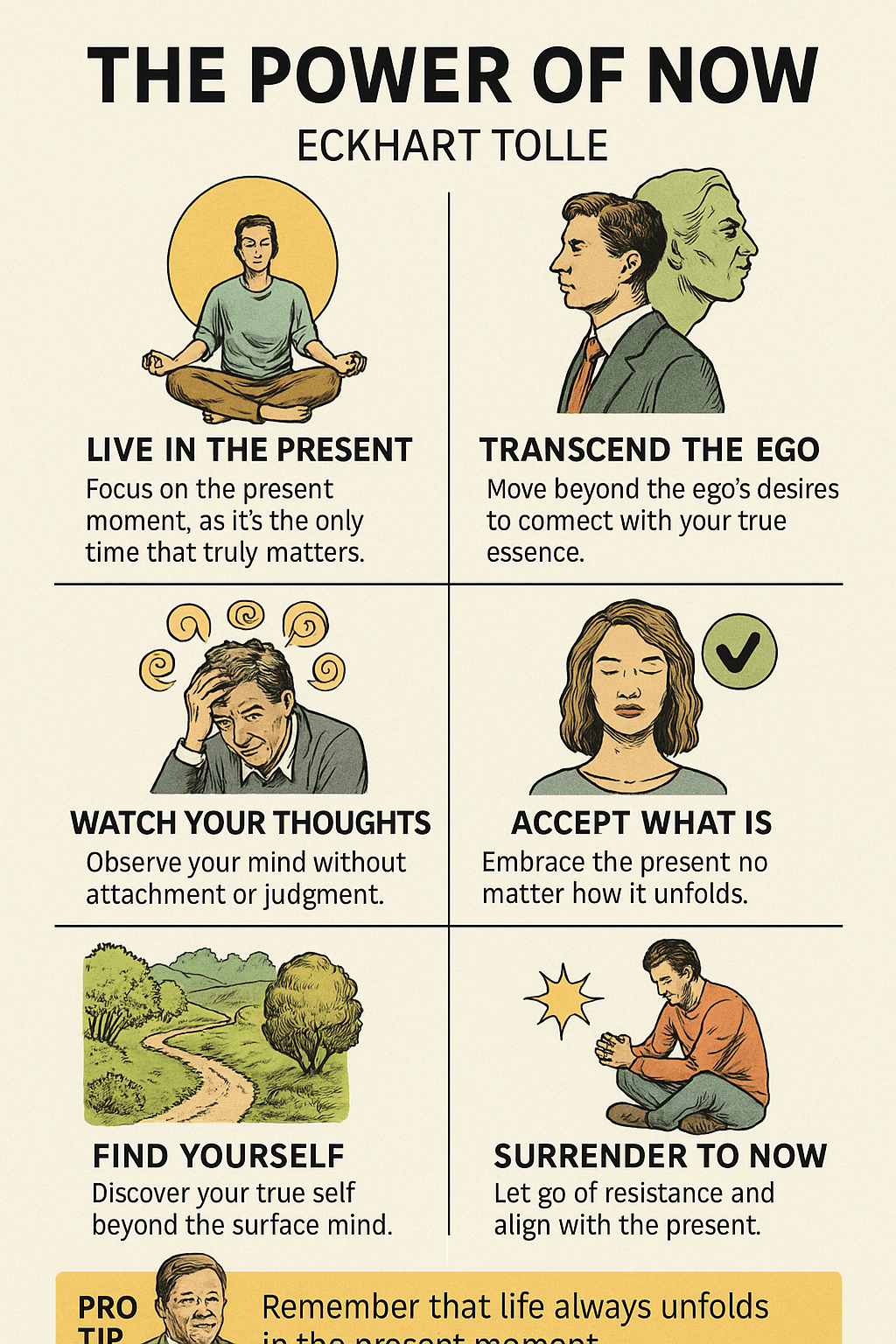
    The Power of Now by Eckhart Tolle: 6 Mindfulness Insights for Daily Growth

    Eckhart Tolle’s The Power of Now is a guide to spiritual awakening and mindfulness. It teaches that the only reality is the present moment, and that self-reflection and awareness of “now” can free us from anxiety about past or future . The book mixes spiritual traditions to show how identifying too much with thoughts leads to suffering, while anchoring in the present brings peace . Tolle even offers simple practices—like mindfulness exercises and slowing down—to help readers embed presence into daily life

    Focusing on the present moment grounds us in reality. Living in the Present: Tolle reminds us that “only the present moment is real and only the present moment matters” . When we fully engage in what we’re doing—whether it’s breathing, eating, or walking—we experience life without the burden of past regrets or future worries. Practical takeaway: Choose one routine task (like washing dishes or drinking tea) and commit to doing it with full attention. Notice sights, sounds, and sensations to anchor yourself in now.

    Transcending the Ego

    Tolle teaches that much of our pain comes from the ego: the mind’s voice that identifies with stories of “me” and “mine” . This egoic self constantly compares, fears, and seeks control, keeping us trapped in anxiety. By recognizing that our true self is separate from this running commentary, we weaken the ego’s grip. Practical takeaway: When a thought or label (“I am stressed,” “I am not smart,” etc.) arises, notice it with curiosity instead of judgment. Remind yourself, “I am not my thoughts.” This simple shift chips away at the ego’s illusions over time.

    Watching Thoughts

    One of Tolle’s core practices is to observe your thoughts instead of being swept away by them . He suggests watching the mind as if you were listening to a radio in the background—acknowledge thoughts without getting caught up in their drama. This conscious observation creates space between “you” and your mind, making negative patterns lose power. Practical takeaway: Try a 3-minute mental check-in. Sit quietly and count your breaths. When thoughts appear, label them briefly (“thinking,” “worrying,” etc.) and return to the breath. This trains your awareness to be the observer.

    Accepting What Is

    Resistance to the present moment causes unnecessary suffering. Tolle emphasizes acceptance: allowing life to be as it is, without automatically calling experiences “good” or “bad” . Paradoxically, accepting what is doesn’t mean passivity; it means engaging with life from a clear, centered place. When we stop fighting reality, we find calm and clarity. Practical takeaway: The next time something frustrating happens (a traffic jam, a mistake, bad news), pause and say to yourself, “It is what it is.” Take a few deep breaths, then respond calmly. Over time, this small practice lowers stress.

    Finding Your True Self

    Underneath the constant stream of thoughts, Tolle says, lies our true self: the awareness or “being” that is always present . This deeper identity is loving, whole, and constant, beyond ego and mental labels. It’s accessible whenever thoughts subside. Practical takeaway: Spend 1 minute scanning your body and noticing the space around you. You’ll discover a still, silent presence under the surface. Remember this sense of “being” – it’s your true self, always available in the present moment.

    Surrendering to Now

    Tolle describes surrender as the art of letting go of resistance to the present. In the book’s introduction he recalls hearing “resist nothing,” and how that realization ended his fear . When we stop insisting on control and accept what the moment brings, we experience flow and inner freedom. Practical takeaway: In any stressful situation today, try this mantra: “I accept what is.” Repeat it softly, especially if anxiety rises. Notice how surrendering a little helps you respond more wisely, step by step.

    1% Better Daily Challenge

    Commit to one small step of presence today. For example: Before you check your phone in the morning, take two deep breaths and feel your feet on the ground. Notice one new thing in your room. This tiny pause gives your mind a 1% reset toward awareness. Over time, these daily micro-steps add up to major growth.