Category: Systems thinking

  • Atomic Habits: 6 Key Insights for Building Lasting Change

    Atomic Habits: 6 Key Insights for Building Lasting Change

    James Clear’s Atomic Habits shows that tiny daily changes lead to big results.  Small routines (“atomic habits”) may seem trivial alone, but compounded over time they produce remarkable outcomes .  Clear emphasizes building sustainable systems of behavior – focusing on the type of person you want to become – rather than chasing distant goals .  In practice this means shaping your identity and environment to make good habits automatic and bad habits difficult.  The book is packed with actionable strategies for anyone who wants to improve performance, productivity, and personal growth.

    1. Identity-Based Habits

    Clear argues that true habit change starts with identity.  Instead of obsessing over outcomes (like “lose 20 pounds”), focus on who you want to become (a healthy person) .  Every habit then becomes evidence of your new identity: reading one page a day proves you’re a reader, one push-up makes you a fitness-minded person.  By aligning habits with your self-image, you build lasting change from the inside out.

    Actionable Takeaway:  Define your ideal identity (“I am an active person,” “I am a reader”) and pick one tiny habit that reflects it.  For example, if you want to be a morning person, make your bed every day first thing.  This links behavior to identity and reinforces who you want to be.

    2. 1% Improvements

    A core insight is that tiny gains compound.  Clear calculates that “if you get one percent better each day for one year, you’ll end up thirty-seven times better by the time you’re done” .  Initially a 1% improvement isn’t noticeable, but small changes accumulate – like an airplane making a 1% course correction and landing in a completely different place .  This reframes success as the result of consistent tiny wins, not sudden overhauls.

    Actionable Takeaway:  Pick one micro-improvement and stick with it daily.  For example, add just one extra push-up each workout, or read one more paragraph of a book each night.  These 1% steps keep you motivated and compound into big gains over months.

    3. Habit Stacking

    “Habit stacking” leverages your existing routines as triggers for new habits.  Clear suggests using the formula “After/Before [CURRENT HABIT], I will [NEW HABIT]” .  For instance: “After I pour my morning coffee, I will meditate for one minute.”  By attaching a new action to a well-established habit, you create an obvious cue and make the new behavior easier to remember.  Over time, these little stacks chain into powerful routines (e.g. make coffee → meditate → write a to-do list).

    Actionable Takeaway:  Identify a daily habit you already do (like brushing teeth or taking off shoes) and attach one small new action.  For example, after you sit at your desk, open a book for two minutes.  Linking habits helps momentum build naturally.

    4. Environment Design

    Clear shows that context drives behavior: people often act according to their surroundings, not just willpower .  A simple cue in your environment can trigger (or break) a habit.  For example, placing your running shoes by the door makes morning jogs easier, while hiding junk food in the pantry reduces cravings.  In other words, “structuring your environment to favor good habits significantly increases adherence” .  Design your workspace, home, and schedule so that good choices are obvious and bad ones require extra effort.

    Actionable Takeaway:  Make habit cues visible and friction low.  If you want to write each night, leave your journal on your pillow.  If you want to eat healthier, put a fruit bowl on the counter and remove sugary snacks from view.  These small tweaks “nudge” you toward success.

    5. Make It Easy

    The third law of behavior change is to reduce friction.  Clear recommends using the Two-Minute Rule: start any habit so small it takes two minutes or less to do .  For example, if you want to read more, begin by reading just one page per day.  By dramatically lowering the barrier to start, you’ll actually begin the habit; once started, it often naturally expands.  This principle turns daunting goals into manageable steps.

    Actionable Takeaway:  Break down a habit into its smallest form.  If you aim to work out, start with just one push-up or one minute of exercise.  These tiny steps are easy to do on even your busiest day, and getting started builds momentum to keep going.

    6. Habit Tracking

    Keeping a visual log of progress makes habits more motivating and satisfying.  A simple habit tracker (X-ing off days on a calendar) provides immediate feedback that you “completed your habit” and signals daily progress .  Seeing a growing streak is motivating – nobody wants to break the chain .  Tracking also keeps you honest about your behavior (we often overestimate how well we’re doing).  By regularly marking achievements, you get quick wins and a sense of accomplishment each day.

    Actionable Takeaway:  Use a calendar, app, or journal to tick off each day you perform a habit.  For example, shade one square on a calendar whenever you practice a new skill.  The visual streak will encourage you to maintain consistency.

    1% Better Challenge

    Put these ideas into practice with a “1% Better” challenge.  Choose one tiny habit and commit to improving it slightly every day for a week.  For instance, add just one minute of movement to your daily walk, or answer one extra customer support email each day.  Track it visibly (on a calendar or whiteboard) and don’t let yourself break the streak twice in a row.  Remember, small changes compound: as Clear says, daily 1% improvements will make you exponentially better over time .

    Key Insights at a Glance

    Identity-Based Habits: Become the person you want to be (focus on identity, not just outcomes) . 1% Improvements: Tiny daily gains add up dramatically . Habit Stacking: Pair a new habit with an existing routine . Environment Design: Shape your surroundings to make good habits easy and bad habits hard . Make It Easy: Use the Two-Minute Rule to keep starting simple . Habit Tracking: Log each success to build momentum and accountability .
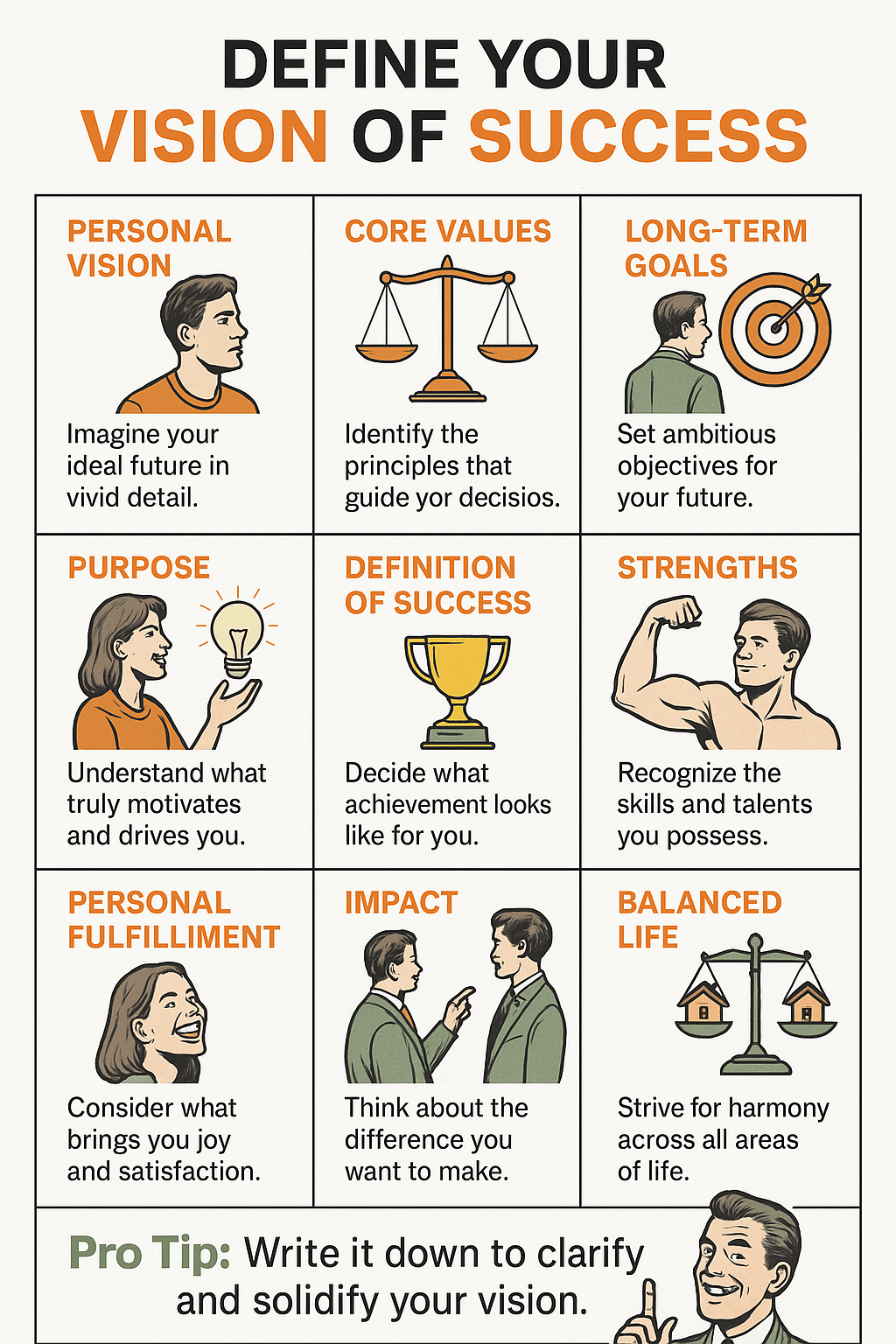
  • Define Your Vision of Success

    Define Your Vision of Success

    Have you ever climbed and climbed toward a goal, only to feel lost or unsatisfied at the top? Stephen Covey put it succinctly: “It is incredibly easy to work harder and harder at climbing the ladder of success only to realize that it’s leaning against the wrong wall” . This isn’t a failure of effort – it’s a failure of vision. Defining your own vision of success is the essential first step in any personal development journey. As Forbes writer Renee Goyeneche notes, creating a personal vision “helps you focus on what truly matters and provides clear direction for your life” . In other words, a clear vision acts as a compass, aligning your goals and daily actions with the life you really want.

    Studies back this up. Research in motivation psychology shows that vividly imagining a desired future can boost your positive emotions and commitment to goals . Psychology Today explains that “imagining a positive future is a helpful way to increase positive emotions and optimism,” and these positive feelings “often create opportunities and increase the chances of success” .  In practical terms, when you define a vision, you’re channeling this positive energy into purposeful action. In one organizational study, employees with clearer goals performed significantly better: higher “performance goal clarity” led to measurably higher individual performance . Clarity is power, both in the mind and on the scoreboard.

    A well-defined vision also grounds you in your core values and identity. If goals don’t match what truly matters to you, checking them off can feel hollow . That’s why Covey’s famous Habit 2 – “Begin with the End in Mind” – is all about imagining the kind of person you want to become and the principles you live by .  Similarly, James Clear (author of Atomic Habits) urges people to start “by focusing on who we wish to become” rather than only on outcomes . In other words, define your mission and character first, and let that shape your goals and habits.

    The Science of Vision and Motivation

    Personal vision isn’t just wishful thinking – it’s grounded in performance science.  Vivid “visions” or mental images of a desired future have been shown to mobilize and motivate goal-directed behavior .  A 2024 study in Current Psychology found that rich, image-based visions create positive emotions, which in turn “spill over” onto the specific goals derived from that vision – boosting commitment and progress .  In short, seeing your success in your mind charges your goals with emotion and makes you more likely to pursue them.

    Likewise, goal-setting research confirms that clarity fuels effort. Goals that are specific, aligned with your values, and framed as concrete outcomes drive motivation better than vague wishes. In public-sector studies, for example, employees who “clearly understand the performance goals” consistently outperform others .  And one meta-level summary reminds us: if we don’t consciously visualize who we want to be and what we want in life, we empower other people and circumstances to shape us instead .  In other words, without your own vision, outside forces define success for you – a recipe for stress and burnout.

    At the same time, psychologists warn against empty fantasizing.  The trick is to pair your vision with values and action.  Vision-building tools (like vision boards) are debated, but their core benefits come from clarifying values and goals. Psychology Today advises: “if your goals are not aligned with your personal values, achieving these goals won’t provide the sense of satisfaction… you’re seeking. Ask yourself: What really matters to you? Who do you want to be?” .  That self-reflection is exactly what sharpens your vision.

    Key Prompts to Define Your Success

    Use the following prompts and dimensions to shape your own vision of success. Reflect deeply and take notes – writing this down makes it concrete. (As James Clear says, identify the type of person you want to be, then prove it with small wins .)

    Core Values & Purpose:  Start by listing your fundamental values and purpose. Ask: “What principles and causes are most important to me?” (Integrity? Creativity? Learning? Service?) If you achieve a goal that conflicts with your values, the win won’t feel like a win. As one expert puts it, a vision “ensures your actions align with your core values” .  Jot down 3–5 values (e.g. honesty, growth, family, health) and consider: how would success look if it honored those values? Identity & Mission:  Who do you want to be, regardless of metrics? Covey calls this “beginning with the end in mind” – visualizing the person you wish to become . James Clear similarly advises focusing on the identity you want (“Who is the type of person that could get the outcome I want?”) . Think beyond titles or bank balances: maybe you want to be “a wise leader, a caring parent, an adventurous learner,” etc. Write a brief statement of the person you want to become. Vivid Future Vision:  Close your eyes and imagine a scene from your ideal life – in detail. Where are you? What are you doing? How do you feel? Research suggests that these vivid mental images stir positive emotions and make you more motivated . For example, picture a typical morning ten years from now: your surroundings, your work, your routines. Make it as concrete as possible – this clarity will guide your decisions today. Key Life Areas: Success is multidimensional. Define the main areas (dimensions) of your life: career/work, relationships/family, health, learning, finances, contribution to others, etc. For each area, write what success means. (A clear overall vision “aligns your personal and professional paths” so they support each other .) For instance, in health: “I want to run a half-marathon and feel strong.” In career: “I will lead a team that solves important problems.” Ensure your vision covers the areas you care about, so you build a balanced life. Impact & Contribution:  What difference do you want to make? Reflect on how your success could help others or the world. Many visionaries include a contribution goal: mentoring others, innovating in their field, or supporting community. The Forbes example gave this concrete hint: “If you want to be a leader in your field… you might set goals to study and implement techniques used by people you admire.” . In your vision, ask: “What legacy or positive impact do I want to leave?” Motivating Habits & Routines:  Envision the daily habits that your future self would naturally follow. James Clear reminds us: “You do not rise to the level of your goals. You fall to the level of your systems.” Your vision should imply certain habits (e.g. daily writing, morning exercise, evening reflection). Identify 2–3 core habits that align with your vision. For example, if your vision involves learning, a habit might be reading 30 minutes each day. Starting now, outline a simple system or routine to build those habits – this will make your vision feel achievable. Work-Life Balance & Well-Being:  Finally, define how you want to feel day-to-day. Success without balance leads to burnout. Reflect on your ideal schedule: how much time for work, family, rest, and fun. The Forbes writer points out that if your vision includes “a healthy work-life balance,” you would explicitly schedule family time and breaks . Ask yourself: “What boundaries and rhythms will keep me energized and fulfilled?” including exercise, hobbies, or social life. A vision that accounts for health and relationships is more sustainable and satisfying.

    Summary and Next Step

    Defining your vision of success is a transformative foundation. It turns vague striving into a structured path, aligns your goals with what you value most, and taps into the brain’s love of clear goals and stories. A vision gives you permission to say no to distractions, because every choice can be filtered: “Does this get me closer to my vision?” As you’ve seen, experts from Covey to Clear agree: start by clarifying who you want to become and what truly matters. This clarity will fuel your motivation and shape your daily habits (remember, we fall to our systems ).

    Exercise: Now write your Vision Statement. In one sentence, capture your biggest picture of success. For example, “I live a balanced life where I am a respected leader, a loving family member, and a lifelong learner.” Keep it personal and inspiring. Display it somewhere you can see daily. This sentence will serve as your beacon — the first step on your 100-step journey. Review and refine it often. As Covey said, your personal mission is like “writing our own constitution” : it puts your goals in focus and keeps you climbing the right ladder.

    By defining your vision of success today, you lay the groundwork for every step that follows. Keep this vision in mind as you plan each next step, and you’ll move forward with confidence and purpose.

    Sources: Research on goal-setting and vision: Covey’s 7 Habits ; James Clear’s Atomic Habits ; motivational psychology studies ; Forbes/psychology articles on vision and values . All support the power of a clear personal vision.

  • 🧠 Introducing: The 100-Step Personal Development Series

    🧠 Introducing: The 100-Step Personal Development Series

    One simple step. Every day. For 100 days.

    Most people fail at self-improvement for one reason:

    It’s too vague. Too overwhelming. Too much theory, not enough traction.

    You’re told to “be better,” but nobody shows you how.

    That ends today.

    🎯 What This Is

    Over the next 100 days, I’m breaking down personal development into 100 clear, proven, and powerful micro-steps.

    Each one comes with:

    A daily graphic you can save and share. A short, actionable breakdown A practical step you can apply instantly

    These steps will cover everything from:

    Discipline and habits Focus and emotional control Communication and confidence Learning systems and mental models Energy, recovery, finance, purpose, and more

    🛠 Why I’m Doing This

    Because I believe every skill can be learned.

    And every goal becomes possible when you break it down into steps.

    This isn’t about motivation.

    It’s about building systems that work even on your worst days.

    This series is for creators, operators, athletes, leaders, and anyone committed to becoming 1% better — every damn day.

    🗓 What to Expect

    📍 Daily infographic posts on X @skillstacked 🧱

    Every 10 steps = a themed module recap on this blog 🧠

    A full flagship product at the end: The Personal Development OS (complete with visuals, explanations, exercises, and systems)

    📬 Follow Along

    You can follow the journey here on the blog.

    But to go deeper — and get early access to the full product when it drops:

    👉 Subscribe to join the list

    (No spam. Just systems that work.)

    Let’s build the system that builds you.

    – Skill Stacker