Tag: daily practice

  • The Power of Now by Eckhart Tolle: 6 Mindfulness Insights for Daily Growth

    The Power of Now by Eckhart Tolle: 6 Mindfulness Insights for Daily Growth

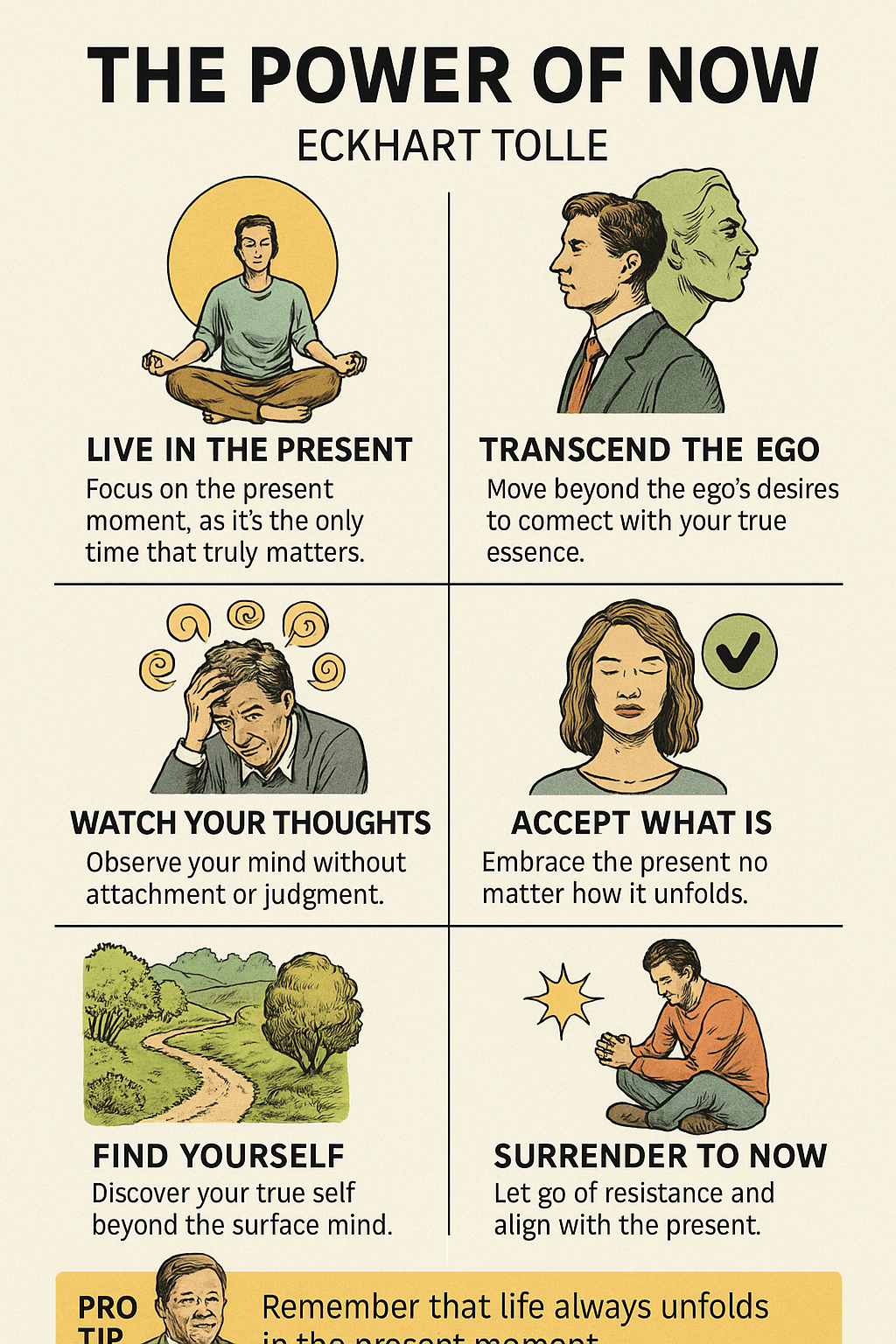
    Eckhart Tolle’s The Power of Now is a guide to spiritual awakening and mindfulness. It teaches that the only reality is the present moment, and that self-reflection and awareness of “now” can free us from anxiety about past or future . The book mixes spiritual traditions to show how identifying too much with thoughts leads to suffering, while anchoring in the present brings peace . Tolle even offers simple practices—like mindfulness exercises and slowing down—to help readers embed presence into daily life

    Focusing on the present moment grounds us in reality. Living in the Present: Tolle reminds us that “only the present moment is real and only the present moment matters” . When we fully engage in what we’re doing—whether it’s breathing, eating, or walking—we experience life without the burden of past regrets or future worries. Practical takeaway: Choose one routine task (like washing dishes or drinking tea) and commit to doing it with full attention. Notice sights, sounds, and sensations to anchor yourself in now.

    Transcending the Ego

    Tolle teaches that much of our pain comes from the ego: the mind’s voice that identifies with stories of “me” and “mine” . This egoic self constantly compares, fears, and seeks control, keeping us trapped in anxiety. By recognizing that our true self is separate from this running commentary, we weaken the ego’s grip. Practical takeaway: When a thought or label (“I am stressed,” “I am not smart,” etc.) arises, notice it with curiosity instead of judgment. Remind yourself, “I am not my thoughts.” This simple shift chips away at the ego’s illusions over time.

    Watching Thoughts

    One of Tolle’s core practices is to observe your thoughts instead of being swept away by them . He suggests watching the mind as if you were listening to a radio in the background—acknowledge thoughts without getting caught up in their drama. This conscious observation creates space between “you” and your mind, making negative patterns lose power. Practical takeaway: Try a 3-minute mental check-in. Sit quietly and count your breaths. When thoughts appear, label them briefly (“thinking,” “worrying,” etc.) and return to the breath. This trains your awareness to be the observer.

    Accepting What Is

    Resistance to the present moment causes unnecessary suffering. Tolle emphasizes acceptance: allowing life to be as it is, without automatically calling experiences “good” or “bad” . Paradoxically, accepting what is doesn’t mean passivity; it means engaging with life from a clear, centered place. When we stop fighting reality, we find calm and clarity. Practical takeaway: The next time something frustrating happens (a traffic jam, a mistake, bad news), pause and say to yourself, “It is what it is.” Take a few deep breaths, then respond calmly. Over time, this small practice lowers stress.

    Finding Your True Self

    Underneath the constant stream of thoughts, Tolle says, lies our true self: the awareness or “being” that is always present . This deeper identity is loving, whole, and constant, beyond ego and mental labels. It’s accessible whenever thoughts subside. Practical takeaway: Spend 1 minute scanning your body and noticing the space around you. You’ll discover a still, silent presence under the surface. Remember this sense of “being” – it’s your true self, always available in the present moment.

    Surrendering to Now

    Tolle describes surrender as the art of letting go of resistance to the present. In the book’s introduction he recalls hearing “resist nothing,” and how that realization ended his fear . When we stop insisting on control and accept what the moment brings, we experience flow and inner freedom. Practical takeaway: In any stressful situation today, try this mantra: “I accept what is.” Repeat it softly, especially if anxiety rises. Notice how surrendering a little helps you respond more wisely, step by step.

    1% Better Daily Challenge

    Commit to one small step of presence today. For example: Before you check your phone in the morning, take two deep breaths and feel your feet on the ground. Notice one new thing in your room. This tiny pause gives your mind a 1% reset toward awareness. Over time, these daily micro-steps add up to major growth.

  • Book of the Day: Digital Minimalism by Cal Newport

    Book of the Day: Digital Minimalism by Cal Newport

    Digital Minimalism: Choosing a Focused Life in a Noisy World by Cal Newport is a guide to decluttering your digital life and reclaiming real focus. Newport – best known for Deep Work – argues that less can be more when it comes to technology. The core message is to be intentional and selective about the apps, sites, and devices you allow into your routine. In fact, Newport defines digital minimalism as “a philosophy of technology use in which you focus your online time on a small number of carefully selected and optimized activities that strongly support things you value, and then happily miss out on everything else” .

    In an age of infinite feeds and notifications, Newport reminds us that our current tech-saturated lifestyle didn’t happen by accident. “We didn’t sign up for the digital lives we now lead… [they were] crafted in boardrooms to serve the interests of a select group of technology investors,” he observes . In other words, Big Tech has designed platforms to be as addictive and all-consuming as possible. “People don’t succumb to screens because they’re lazy, but instead because billions of dollars have been invested to make this outcome inevitable,” Newport writes . The antidote, he argues, is to develop a conscious digital philosophy – using tech on your terms to support your goals, and confidently ignoring the rest.

    Key Takeaways for Digital Discipline and Focus

    Focus on What Truly Matters: Identify the handful of digital activities that genuinely add value to your work and life, and eliminate the rest. Digital minimalists focus their online time on carefully selected pursuits that support their values and happily miss out on everything else . For a creator or entrepreneur, this might mean doubling down on creating content or building your product, while saying no to endless scrolling and shiny new apps that don’t serve your mission. Perform a 30-Day Digital Declutter: Newport suggests a technology “fast” to reset your habits . Take a 30-day break from all optional online activities – social media, news feeds, streaming – that aren’t essential. Use this period to rediscover offline hobbies and real-world pleasures. After 30 days, reintroduce digital tools only if they serve a deep value or purpose in your life . Many find that after a month off, they regain control and no longer feel the urge to revert to past habits.

    Reclaim Solitude (Disconnect to Think): In a world of constant connectivity, “solitude deprivation” – never being alone with our thoughts – is a real threat . Make it a discipline to carve out tech-free time for reflection. That could mean daily walks without your phone, journaling, or simply sitting unplugged. Newport points out that great ideas and self-awareness flourish in moments of quiet, when you can actually hear yourself think. Protect these pockets of solitude to recharge your mind and boost your creativity and mental well-being.

    Prioritize Creation Over Consumption: Be a producer, not just a consumer. Instead of defaulting to passive scrolling whenever you have a free moment, direct that time toward demanding, high-value activities that sharpen your skills or create something meaningful . This might be writing a blog post, designing a new project, practicing your craft, or having a deep conversation with a friend. Newport calls this the Bennett Principle – favor the real-world and the challenging over the easy hits of digital distraction . You’ll gain far more satisfaction from building or learning than from another hour lost on a timeline.

    Use Social Media Like a Tool, Not a Crutch: For many in online business, social media is unavoidable – but use it intentionally. Treat it as a professional tool for specific outcomes, not a default pastime. Newport advises curating your digital environment: follow only high-quality accounts that inform or inspire you, and unfollow the noise . Set strict boundaries like checking messages or feeds during a designated 30-minute window, rather than sporadically all day . By scheduling your usage and sticking to purpose-driven tasks (e.g. publishing your work or engaging with your community), you prevent the platforms from hijacking your attention.

    Skill Stacker Take

    At Skill Stacker, we’re all about building online leverage through focus, clarity, and action – and Digital Minimalism is a perfect rallying cry for this mission. Newport’s insights remind us that disciplined tech use isn’t about deprivation; it’s about creating space for what matters most. When you clear out the digital clutter, you make room for deep work and creative output that moves the needle. For creators, writers, and entrepreneurs, this means more time to hone your craft and execute on your ideas, and less time fighting distractions.

    The takeaway is both inspirational and practical: your attention is your most valuable asset. By adopting digital minimalism, you reclaim that asset and direct it toward your goals. This focused intentionality is a force multiplier – it leads to clearer thinking, higher-quality work, and ultimately greater impact in your online business. Digital Minimalism challenges you to step up as the architect of your digital life. Embrace it, and you’ll find that what you choose not to do with technology is just as important as what you do, enabling you to stack your skills and build your success with unwavering focus.