Tag: Deep Work

  • Hidden Time Leaks and Productivity

    Hidden Time Leaks and Productivity

    Most of us drift through the day distracted by tiny “time leaks” – email pings, phone buzzes, random tasks – that chip away our focus.  In fact, research finds the average person is interrupted just 12 minutes into a task, and needs over 25 minutes to refocus afterward .  These fragments add up: roughly 720 work hours per year (about 18 full work weeks) are lost to distractions .  Every little interruption or idle moment – even checking a message or browsing social media – may feel harmless, but they compound into a massive productivity drain.

    Humans also tend to misjudge time.  The planning fallacy shows that we chronically underestimate how long our tasks will take .  When deadlines feel far away, Parkinson’s Law kicks in: work expands to fill the time allotted .  Give yourself two weeks for a project, and you’ll likely shuffle it for 13 days before scrambling at the end.  This combination of underestimating effort and over-allocating time means you inadvertently create more work and procrastinate, letting tasks stretch out and steal your calendar .

    Meanwhile our brains pay a heavy price for each switch of attention.  Cognitive science shows that multitasking is a myth – the brain can’t truly do two hard tasks at once.  Instead we juggle rapidly between them, burning mental energy with each switch .  As psychologist Daniel Levitin notes, bouncing between tasks spikes stress hormones and glucose burn in the brain .  Even a brief “mental block” from a switch can consume up to 40% of your productive time .  In short, little leaks like interruptions, multitasking and drifted attention slow you down, reduce work quality, and leave you exhausted – even if it feels like you’re busy.

    On top of that, digital distractions are ubiquitous.  One survey found 77% of workers feel more stressed by technology, with notifications tearing away focus .  A phone notification or an email alert doesn’t just nibble a moment – it breaks concentration and often sends you off-task for minutes.  Over a week you may face 160+ such distractions .  No wonder nearly 8 in 10 people report feeling distracted during the workday .  These hidden leaks – the “continuous partial attention” of modern life – quietly sink productivity unless we notice them and act.

    Strategies to Audit Your Time

    The good news is that awareness is the first step to plugging these leaks.  By systematically auditing how you spend each hour, you can surface hidden drains and regain control.  Try these strategies (each corresponds to a point in our infographic grid):

    1. Track Every Minute:  Keep a detailed time log for 1–2 weeks.  Write down how you spend blocks of time (work tasks, email, meetings, breaks, even browsing).  Studies show people grossly underestimate task durations .  Seeing the numbers in black and white sparks urgency: when you know you’re “on the clock,” you tend to focus more .  A log reveals surprises (e.g. how much social media or admin eats your day) and builds time awareness.  This data is the foundation of any audit. 2. Identify Your Leaks:  Analyze your time log for low-value activities.  Which “tasks” are really just buffers or distractions?  Maybe you spent half an hour each day on unnecessary meetings or gossip.  Note how often you check your phone (90% of people say phones are their biggest distraction ).  These leaks often hide in plain sight.  Categorize your activities (deep work, shallow admin, breaks, etc.) and calculate percentages – even a 5% daily leak adds up to over 100 hours a year. 3. Set Hard Time Limits:  Combat Parkinson’s Law by capping how much time a task can take.  Instead of “finish the report by Friday,” timebox it: “3 hours on Monday to outline it.”  Or use a timer/Pomodoro (e.g. 50-minute focus, 10-minute break).  When you give yourself a tight deadline or timer, you force focus and shorten drawn-out tasks.  As one guide notes, be mindful of how long you really need, not just the generous window given .  Shorter deadlines can harness urgency and prevent work from inflating. 4. Focus on One Thing:  Plan to single-task during work blocks.  Each time you try to split your attention (even music in background), you add cognitive load .  Structure your day into focused periods on one project at a time.  During each block, close unrelated tabs and resist switching.  Research shows that concentrated focus (deep work) yields higher-quality output and actually takes less time overall . 5. Batch Similar Tasks:  Group routine or shallow tasks together.  For example, schedule specific times to check email or Slack (say, twice a day) rather than letting them pop up constantly.  Batch phone calls, administrative tasks, or quick errands into dedicated slots.  This reduces the frequency of context switches (which chew time) and lets you tackle similar tasks with momentum.  Batching is especially powerful for tasks that otherwise interrupt bigger projects. 6. Tame Digital Distractions:  Silence or filter notifications.  Turn off app pings, put your phone on Do Not Disturb, or use website blockers during focus time.  The constant lure of news feeds and alerts wrecks concentration – in one survey, nearly half of workers admitted losing focus to irrelevant notifications .  By removing these digital hiccups, you stop many leaks before they start.  If needed, use “focus modes” or tools like noise-cancelling headphones to create a distraction-free zone. 7. Plan Breaks (And Earn Them):  Ironically, taking scheduled breaks can improve overall productivity.  Everyone needs downtime between intense tasks – the trick is to make it conscious, not accidental.  Build short breaks or walk-away moments into your schedule (e.g. a quick stretch every 90 minutes).  Planning breaks prevents random drift (like doomscrolling) and keeps you refreshed.  A rested brain works faster, so a 10-minute pause can save 20 minutes of frustrated effort later. 8. Review and Adjust Weekly:  At the end of each week, revisit your log and goals.  What went well? Where did new leaks appear?  Update your strategy accordingly.  For instance, if email still creeps in, tighten your batching.  If meetings dominated your time, negotiate agendas or attendee lists.  This reflection step turns data into action.  Each week’s audit sharpens your time sense (and improves future planning) .

    Implementing these strategies systematically helps you plug the silent drains on your day.  Over time you’ll channel your hours into meaningful work, not noise.

    Summary and Time-Log Exercise

    Time audit is about awareness and action.  Research tells us that productivity isn’t just harder work; it’s smarter scheduling.  By logging your time, spotting leaks, and enforcing structure (Parkinson’s Law, single-tasking, batching, etc.), you reclaim wasted hours .  Each small improvement – delaying that phone check, or finishing tasks ahead of a self-imposed deadline – compounds into big gains.

    Exercise (Optional): For one week, carry a notebook or use a time-tracking app to record your activities every 15–30 minutes.  At week’s end, break your log into categories (focus work, meetings, admin, breaks, distractions).  Calculate how much time went to priority tasks versus time leaks.  Identify the top two biggest drains (e.g. too many emails or idle social media) and apply the strategies above to fix them next week.  Repeat weekly.

    By treating time as data – measuring, analyzing, and iterating – you turn vague “busywork” into clear priorities.  In this way, you’ll plug the leaks and use every hour intentionally, boosting productivity and making progress feel tangible.
  • Why Most People Fail at Skill Building—And How to Fix It

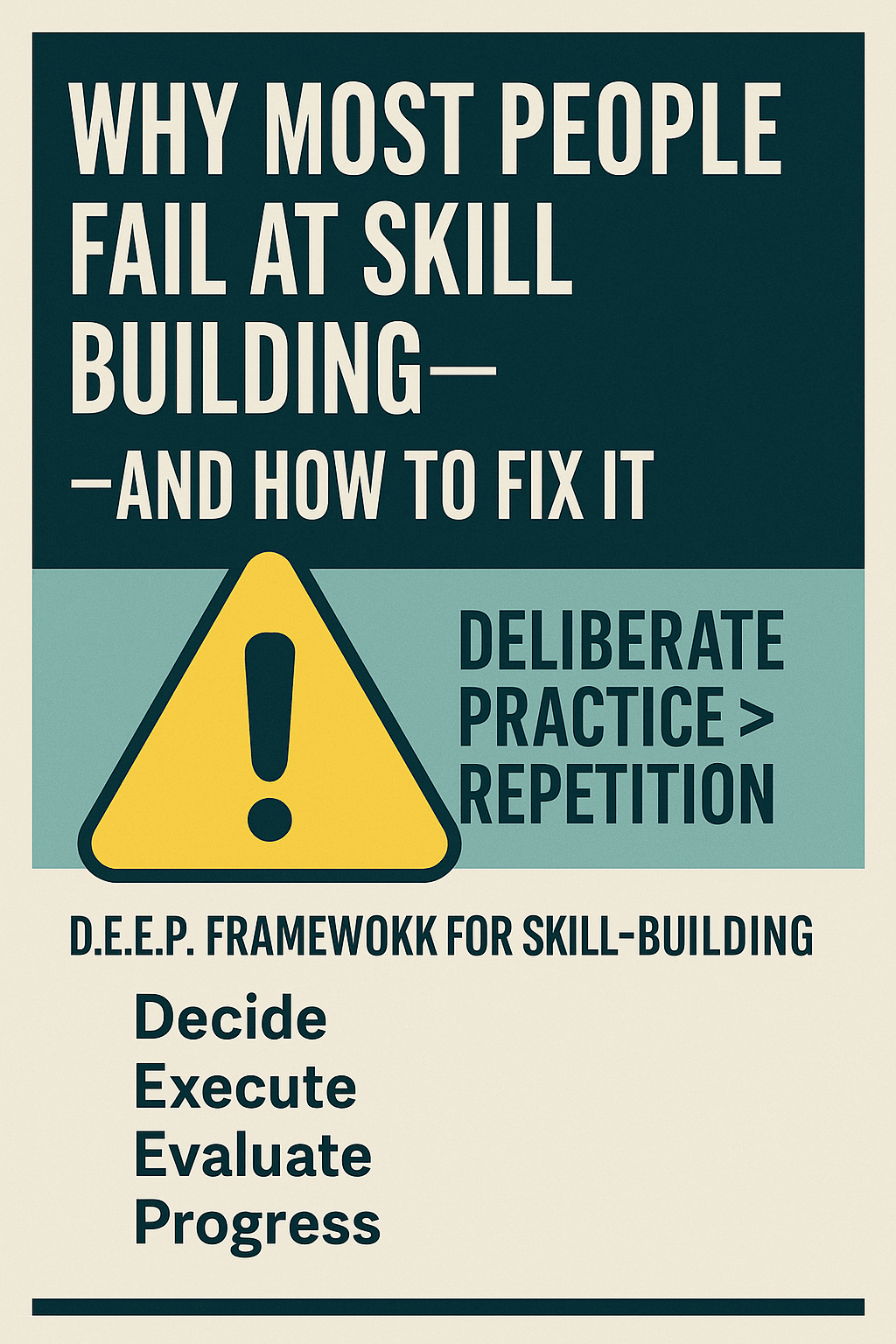
    Why Most People Fail at Skill Building—And How to Fix It

    85% of people quit learning a new skill before they ever master it . Why? Most are practicing wrong and end up discouraged.

    Common Pitfalls:

    Jumping in without clear goals (starting on impulse, then losing focus) . Mistaking passive learning for progress (watching tutorials without real practice) . Relying on mindless repetition with no feedback (reinforcing bad habits instead of improving).

    Deliberate Practice > Repetition: Not all practice is created equal. Simply grinding out hours on a skill doesn’t guarantee growth – you can repeat a bad technique 1,000 times and not get better . Deliberate practice, on the other hand, means practicing with purpose and focus. It’s about targeting specific weaknesses with full concentration and clear goals . This approach leads to real improvement, session after session. In fact, studies of top performers show their mastery was built on countless hours of deliberate practice – not just time on task .

    The D.E.E.P. Framework for Skill-Building:

    Decide: Pick one skill and set a clear, meaningful goal. Avoid vague aims or chasing every “shiny” new skill – clarity beats confusion. Execute: Commit to a consistent practice schedule. Focus on quality over quantity – each session should be purposeful. (You’re literally rewiring your brain with each focused repetition .) Evaluate: Regularly reflect and seek feedback. Identify what isn’t working and adjust. A coach, mentor, or even self-review can pinpoint weaknesses to fix . Progress: Raise the bar as you improve. Push slightly beyond your comfort zone each time – doing something a bit better or harder in every practice session ensures continuous growth .

    Mastery isn’t about how much you practice; it’s about how you practice. Practice with intention, and you’ll join the few who turn effort into real results.

  • Book of the Day: Digital Minimalism by Cal Newport

    Book of the Day: Digital Minimalism by Cal Newport

    Digital Minimalism: Choosing a Focused Life in a Noisy World by Cal Newport is a guide to decluttering your digital life and reclaiming real focus. Newport – best known for Deep Work – argues that less can be more when it comes to technology. The core message is to be intentional and selective about the apps, sites, and devices you allow into your routine. In fact, Newport defines digital minimalism as “a philosophy of technology use in which you focus your online time on a small number of carefully selected and optimized activities that strongly support things you value, and then happily miss out on everything else” .

    In an age of infinite feeds and notifications, Newport reminds us that our current tech-saturated lifestyle didn’t happen by accident. “We didn’t sign up for the digital lives we now lead… [they were] crafted in boardrooms to serve the interests of a select group of technology investors,” he observes . In other words, Big Tech has designed platforms to be as addictive and all-consuming as possible. “People don’t succumb to screens because they’re lazy, but instead because billions of dollars have been invested to make this outcome inevitable,” Newport writes . The antidote, he argues, is to develop a conscious digital philosophy – using tech on your terms to support your goals, and confidently ignoring the rest.

    Key Takeaways for Digital Discipline and Focus

    Focus on What Truly Matters: Identify the handful of digital activities that genuinely add value to your work and life, and eliminate the rest. Digital minimalists focus their online time on carefully selected pursuits that support their values and happily miss out on everything else . For a creator or entrepreneur, this might mean doubling down on creating content or building your product, while saying no to endless scrolling and shiny new apps that don’t serve your mission. Perform a 30-Day Digital Declutter: Newport suggests a technology “fast” to reset your habits . Take a 30-day break from all optional online activities – social media, news feeds, streaming – that aren’t essential. Use this period to rediscover offline hobbies and real-world pleasures. After 30 days, reintroduce digital tools only if they serve a deep value or purpose in your life . Many find that after a month off, they regain control and no longer feel the urge to revert to past habits.

    Reclaim Solitude (Disconnect to Think): In a world of constant connectivity, “solitude deprivation” – never being alone with our thoughts – is a real threat . Make it a discipline to carve out tech-free time for reflection. That could mean daily walks without your phone, journaling, or simply sitting unplugged. Newport points out that great ideas and self-awareness flourish in moments of quiet, when you can actually hear yourself think. Protect these pockets of solitude to recharge your mind and boost your creativity and mental well-being.

    Prioritize Creation Over Consumption: Be a producer, not just a consumer. Instead of defaulting to passive scrolling whenever you have a free moment, direct that time toward demanding, high-value activities that sharpen your skills or create something meaningful . This might be writing a blog post, designing a new project, practicing your craft, or having a deep conversation with a friend. Newport calls this the Bennett Principle – favor the real-world and the challenging over the easy hits of digital distraction . You’ll gain far more satisfaction from building or learning than from another hour lost on a timeline.

    Use Social Media Like a Tool, Not a Crutch: For many in online business, social media is unavoidable – but use it intentionally. Treat it as a professional tool for specific outcomes, not a default pastime. Newport advises curating your digital environment: follow only high-quality accounts that inform or inspire you, and unfollow the noise . Set strict boundaries like checking messages or feeds during a designated 30-minute window, rather than sporadically all day . By scheduling your usage and sticking to purpose-driven tasks (e.g. publishing your work or engaging with your community), you prevent the platforms from hijacking your attention.

    Skill Stacker Take

    At Skill Stacker, we’re all about building online leverage through focus, clarity, and action – and Digital Minimalism is a perfect rallying cry for this mission. Newport’s insights remind us that disciplined tech use isn’t about deprivation; it’s about creating space for what matters most. When you clear out the digital clutter, you make room for deep work and creative output that moves the needle. For creators, writers, and entrepreneurs, this means more time to hone your craft and execute on your ideas, and less time fighting distractions.

    The takeaway is both inspirational and practical: your attention is your most valuable asset. By adopting digital minimalism, you reclaim that asset and direct it toward your goals. This focused intentionality is a force multiplier – it leads to clearer thinking, higher-quality work, and ultimately greater impact in your online business. Digital Minimalism challenges you to step up as the architect of your digital life. Embrace it, and you’ll find that what you choose not to do with technology is just as important as what you do, enabling you to stack your skills and build your success with unwavering focus.

  • 🔧 Daily Kaizen: Remove Notifications, Reclaim Focus

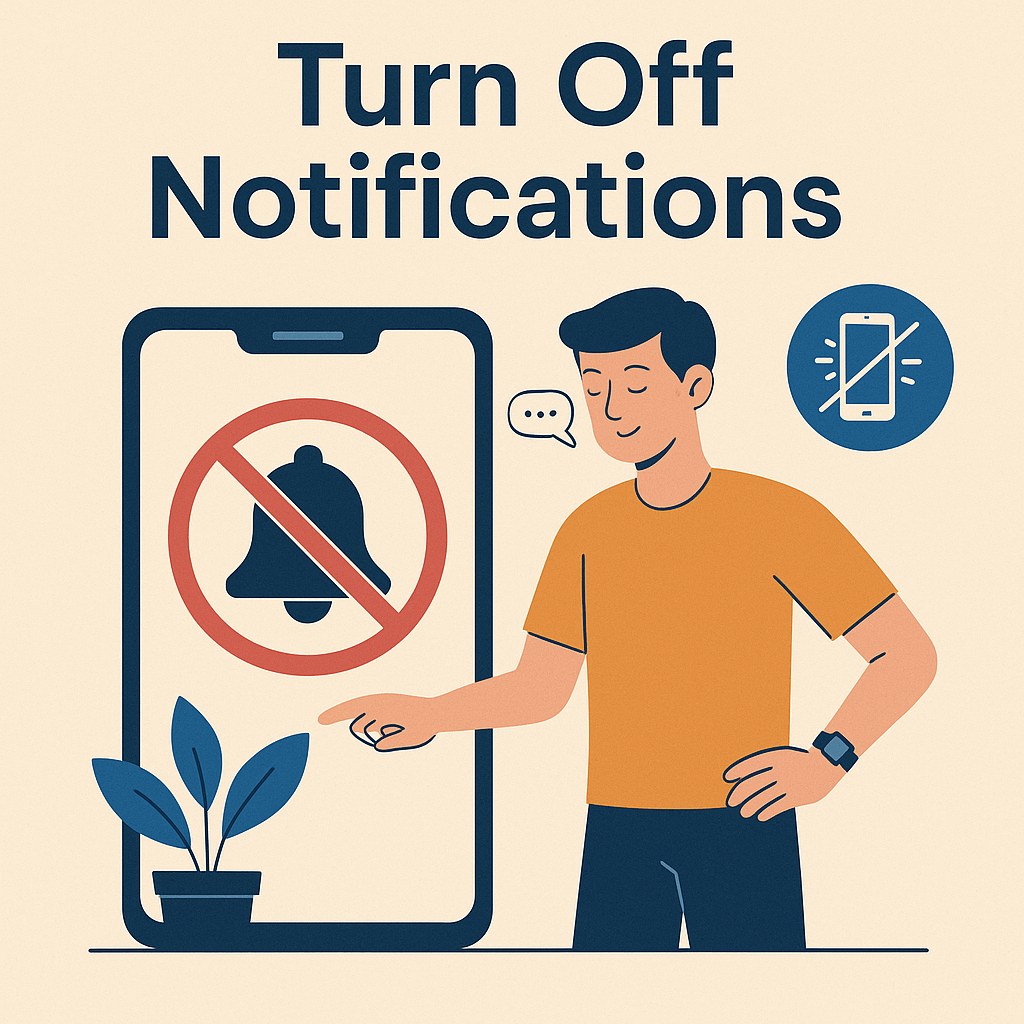
    🔧 Daily Kaizen: Remove Notifications, Reclaim Focus

    Today’s 1% improvement is simple, powerful, and totally free:

    Turn off all non-essential notifications.

    😵 Why It Matters:

    Every ping trains your brain to respond, not create.

    It breaks flow. It adds stress. It makes everyone else’s priorities louder than your own.

    🛠️ What to Do:

    Kill All Social Media Alerts – You’ll check it anyway. Mute Group Chats – 95% of it isn’t urgent. Whitelist only calls, calendar events, and your partner. Use Do Not Disturb for deep work sessions. Batch responses instead of chasing distractions.

    🧠 Bonus:

    “The less your phone controls you, the more you control your life.”

    Try this for a day. You’ll feel more clear-headed, focused, and free.

  • Mastering Time Blocking: How to Plan Your Day for Maximum Productivity

    Mastering Time Blocking: How to Plan Your Day for Maximum Productivity

    Time blocking is a simple but powerful skill that can transform your productivity. Instead of working reactively—responding to emails, messages, and distractions—you create a structured schedule where every task has its own dedicated time slot. This method helps you focus deeply, avoid procrastination, and accomplish more in less time.


    What is Time Blocking?

    Time blocking means planning your day in advance by assigning specific blocks of time to tasks or categories of tasks. For example:

    • 8:00–9:00 – Morning routine & planning
    • 9:00–11:00 – Deep work (project focus)
    • 11:00–12:00 – Meetings & emails
    • 1:00–2:00 – Lunch & movement
    • 2:00–4:00 – Creative work
    • 4:00–4:30 – Wrap-up & tomorrow’s planning

    💡 Why It Works:

    Reduces decision fatigue – You already know what to do and when.
    Limits distractions – You’re less likely to switch tasks or multitask.
    Prioritizes important work – Deep work gets a dedicated time block.
    Creates balance – You make space for breaks and personal time.


    🛠 How to Start Time Blocking Today:

    1️⃣ Plan your day the night before: Write down key tasks and assign time slots.
    2️⃣ Use a calendar or planner: Google Calendar, paper planner, or an app like Notion.
    3️⃣ Start with realistic blocks: Avoid overpacking your day; leave buffer time.
    4️⃣ Include breaks and flexibility: Short breaks between blocks help you recharge.
    5️⃣ Stick to your plan: Treat each block like an appointment.


    🔥 Kaizen Tip:

    Start small. Block just one hour tomorrow for a priority task—whether it’s deep work, a workout, or planning your supplement launch. Build the habit from there.


    🚀 Conclusion

    Time blocking isn’t about micromanaging every minute—it’s about being intentional with your time. Start small, stay consistent, and watch your productivity soar.

    💬 Which time block are you going to try tomorrow? Comment below!