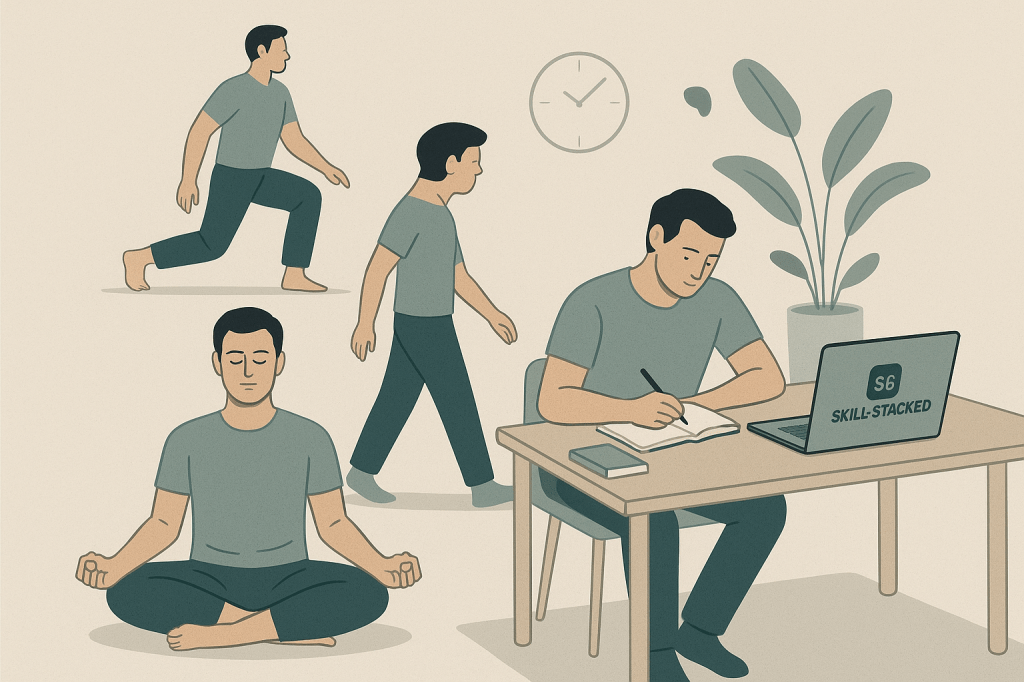
Tag: Habit Stacking

  • 🛡️ Daily Kaizen: Delay Your First Phone Check by 30 Minutes

    🛡️ Daily Kaizen: Delay Your First Phone Check by 30 Minutes

    Your brain wakes up hungry — not for dopamine, but direction.

    The first thing you feed it sets the tone for the day.

    📵 Delay your first phone check by 30 minutes.

    🧠 Use that time to move, think, write, or breathe.

    Reclaim the opening scene.

    Win the day before it begins.

  • 🧠 Daily Kaizen: Put Your Phone Away During Meals

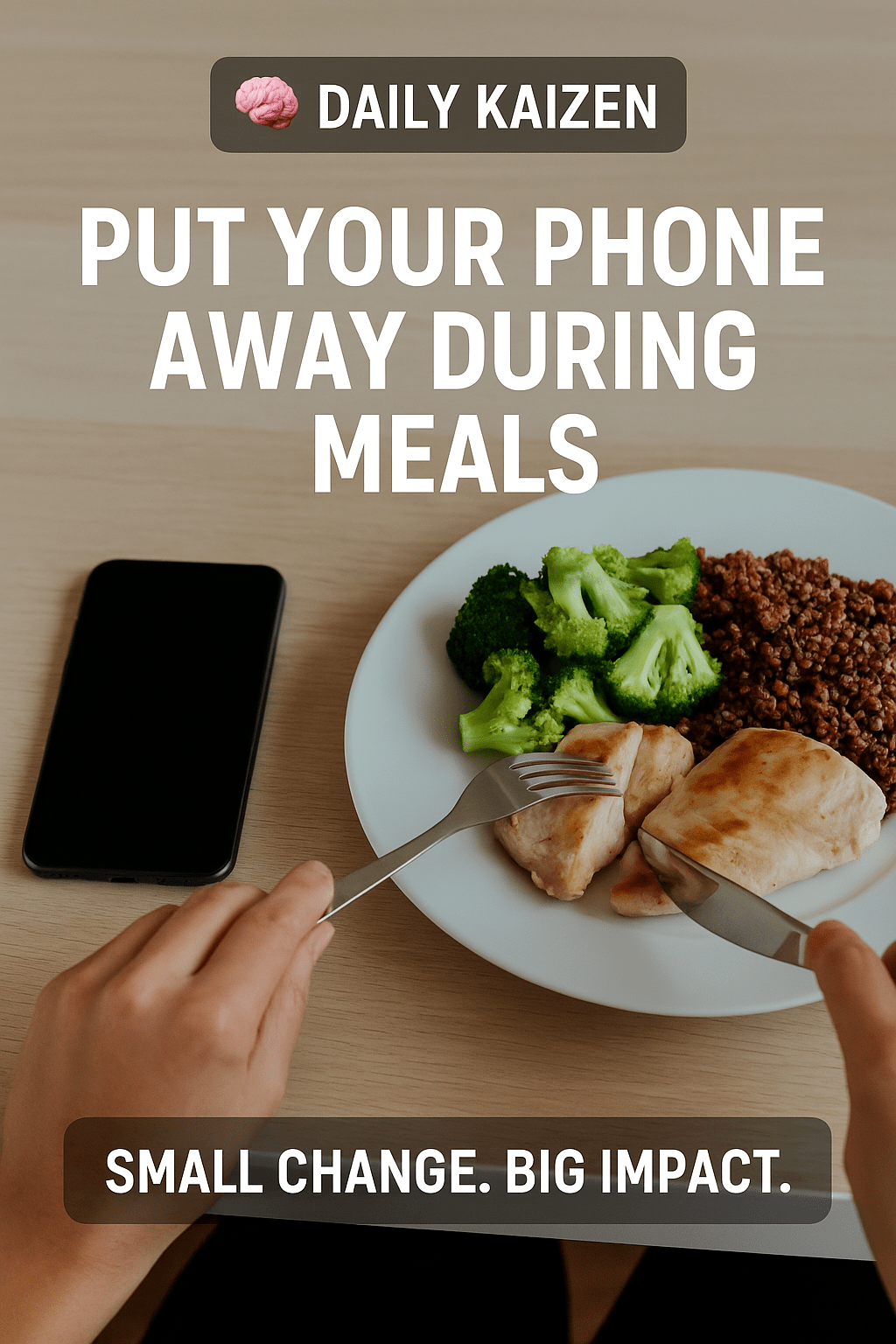
    🧠 Daily Kaizen: Put Your Phone Away During Meals

    Small change. Big impact.

    Today’s 1% improvement is simple:

    Put your phone in another room while you eat.

    You might think you’re just checking a message, watching a video, or reading something useful—but every glance at your phone pulls you out of the present moment.

    Eating while distracted lowers digestion quality, reduces nutrient absorption, and fragments your attention.

    But it’s not just about food. It’s about presence.

    When you eat with someone and leave your phone out of sight, you show respect. When you eat alone and stay unplugged, you show yourself respect.

    This tiny act rewires your brain for better attention, mindfulness, and discipline. It tells your nervous system:

    “This moment matters.”

    ✅ The 1% Better Task:

    Put your phone in another room—or at least face-down on airplane mode—during every meal today.

    Make eating a ritual, not a scroll session.

  • 5 Key Lessons from Atomic Habits (and How to Apply Them Today)

    5 Key Lessons from Atomic Habits (and How to Apply Them Today)

    https://jamesclear.com/atomic-habits-summaryAtomic Habits by James Clear has sold over 20 million copies worldwidejamesclear.com, a testament to how its practical strategies resonate with readers. This #1 New York Times bestseller carries the subtitle “Tiny Changes, Remarkable Results,” highlighting its core message: small daily habits can compound into life-changing outcomes. For busy professionals striving for self-improvement, Atomic Habits offers clear, actionable advice that fits into even the tightest schedule. Below, we summarize 5 key lessons from the book – each lesson explains what it means, why it matters, and how you can apply it in daily life to spark positive change.

    1. The 1% Rule: Small Habits, Big Results

    One of the most cited ideas from Atomic Habits is the power of tiny daily improvements. Clear famously illustrates that if you can get just 1% better each day for a year, you’ll end up 37 times better by year’s endjamesclear.com. These “tiny changes” often seem insignificant in the moment, but over time they compound into remarkable results. Instead of trying to overhaul your life overnight, focus on making small, consistent improvements. Every little habit – taking the stairs, writing a few more lines of code, tidying one shelf – adds up.

    Why does this matter? We often overestimate the impact of big moments and underestimate the power of daily routinesjamesclear.com. By embracing the 1% rule, you shift your mindset to value consistent progress over dramatic but unsustainable efforts. This is encouraging for busy professionals: you don’t need huge blocks of free time or grand gestures to improve your life. Meaningful change can start with just a few minutes a day. Habits are the compound interest of self-improvement – small deposits made daily will grow into substantial achievements. As Clear puts it, “Focus on getting 1 percent better every day.”jamesclear.com

    How to apply it:

    • Start very small: Identify one area to improve by a tiny amount. For example, send one extra thank-you email at work, read two pages of a book each night, or add one vegetable to your daily meals.
    • Be consistent, not intense: Commit to your 1% action every day (or every workday). Consistency matters more than doing a lot at once. A five-minute workout done daily beats a two-hour workout done once a month.
    • Track small wins: Keep a simple log or checklist to mark your daily habit. Seeing a chain of small wins builds momentum and shows how those micro-improvements are adding up over time. Each checkmark is a vote of confidence in your gradual growth.

    2. Focus on Systems, Not Goals

    James Clear advises: “Forget about setting goals. Focus on your system instead.” In other words, outcomes (goals) are lagging indicators of your processes (systems)jamesclear.com. While goals are useful for setting a direction, you won’t get results unless you have a reliable daily system to attain them. For example, if your goal is to write a book, your system might be waking up one hour early to write each morning. If your goal is to land more clients, your system could be reaching out to 5 prospects every day. By improving the processes you follow, you essentially create a pipeline that leads to your desired results.

    Why is this important? Clear argues that you do not rise to the level of your goals; you fall to the level of your systemsjamesclear.com. A poorly designed system will derail even the most ambitious goal. Many professionals set lofty goals (e.g. “increase sales by 20%” or “get fit this year”) but fail because they never establish habits and routines to support those goals. Focusing on systems means concentrating on what you can control daily – your habits, environment, and schedule – rather than fixating solely on the end result. The right system will carry you forward even when motivation wanes. It also turns success into a repeatable process rather than a one-time event. In short, good habits are the building blocks of success, and a good system is just a collection of good habits working together.

    How to apply it:

    • Translate goals into routines: For any goal you have, ask “What daily/weekly habit would make this achievement inevitable?” If your goal is to improve a skill, schedule a consistent practice time each day (that schedule is your system).
    • Build a workflow: Design your workday or personal routine with intentional habits. For instance, instead of a vague goal to “be more organized,” implement a system where every morning you spend 10 minutes planning your top priorities, and every evening you tidy your workspace.
    • Review and adjust: Treat your system as an ongoing project. Each week, review what’s working and where friction exists. Maybe you notice you skip workouts on busy days – a system tweak could be switching to morning workouts or preparing your gym bag ahead of time. Continuously refine your processes so they serve your objectives. Remember, the system is what delivers results, so nurture it diligently.

    3. Identity-Based Habits: Become the Person You Want to Be

    A powerful lesson in Atomic Habits is to shift your focus from outcomes to identity. Instead of asking “What goal do I want to achieve?” ask “Who do I want to become?”. Clear explains that the key to building lasting habits is to focus on creating a new identity firstjamesclear.com. Your habits will naturally align with how you see yourself. For example, if you aspire to be a more productive person, start viewing yourself as a productive person and then act accordingly. Every habit then becomes an evidence of that identity. In Clear’s words, “Your identity emerges out of your habits. Every action is a vote for the type of person you wish to become.”jamesclear.com. If you study for 30 minutes, you’re casting a vote for “I am a studious person.” If you skip dessert, you vote for “I am a healthy eater.” Over time, these votes build up and solidify your desired identity.

    Why it matters: True behavior change is identity changemedium.com. We tend to act in alignment with who we believe we are. If you simply chase goals, you might succeed temporarily (“I ran a marathon”), but if you haven’t shifted your identity (“I am a runner”), the new habit may not stick. By adopting identity-based habits, you tap into intrinsic motivation. It feels rewarding to become the kind of person you admire. This approach also helps override limiting beliefs. Instead of saying “I’m bad at networking,” you can decide to become “the kind of person who connects easily with others” and then start with one small networking habit. Busy professionals can especially benefit from this mindset shift: seeing yourself as an organized, proactive, or healthy person guides your daily choices more powerfully than any abstract goal. It turns habit change from an external effort into an internal one – essentially habits become an expression of your identity.

    How to apply it:

    • Define your desired identity: Take a moment to write down the kind of person you want to be. It could be in career (“a leader who mentors others”), health (“a person who exercises daily”), or personal life (“a patient parent”). Be specific and positive.
    • Start with small “identity votes”: Once clear on your identity, choose small wins that prove it to yourselfjamesclear.com. If you want to be “a calm person,” maybe begin a 5-minute morning meditation habit. To be “an informed person,” read the news or a book chapter each day. These habits should be tiny and manageable, especially at first – their main purpose is to reinforce your new self-image.
    • Use identity-based questions: When faced with decisions, ask “What would a <insert identity> do?” For example, if your identity is “I am a fit and energetic person,” that might answer what to eat for lunch or whether to take the stairs. This practice aligns your daily actions with the type of person you want to become.
    • Be patient and trust the process: Changing how you view yourself won’t happen overnight. Remind yourself that every action is a vote for the person you wish to becomejamesclear.com. You don’t need perfection, just a majority of positive “votes.” Over time, your identity will shift, and your habits will follow suit naturally.

    4. Make Good Habits Easy: Habit Stacking & Environment Design

    If you want to build better habits, make it as easy as possible to do the right thing. Clear’s framework (the Four Laws of Behavior Change) highlights that two effective ways to “make it obvious” and “make it easy” are through habit stacking and environment designjamesclear.coms3.amazonaws.com. Habit stacking means attaching a new habit to an existing one, so the current habit cues the new behaviorjamesclear.com. For instance, if you already have a habit of brewing coffee every morning, you can “stack” a new habit onto it: “After I brew my morning coffee, I will meditate for one minute.” The existing routine of making coffee triggers your meditation habit automatically because you’ve linked them. This technique leverages the strong neural connections of habits you already have – in essence, you’re plugging a new habit into the circuit of an old one.

    Environment design is about tweaking your surroundings to encourage good habits (and hinder bad ones). Our behaviors are often shaped by the cues around us. By designing your environment to make the cues of good habits obvious and visible, you greatly increase the chances of following throughs3.amazonaws.com. Practical example: if you want to practice guitar more often, keep the guitar on a stand in the middle of your living room (a visible cue) instead of in a closet. Conversely, if you’re trying to cut down on junk food, store sweets on a hard-to-reach shelf or remove them from your office – make the bad habit “invisible”. The goal is to reduce friction for positive behaviors and increase friction for negative ones. When your environment nudges you in the right direction, you don’t have to rely as much on willpower or memory – the good choice becomes the default choice.

    Why it matters: Both habit stacking and environment design address the reality that our brains respond to cues and convenience. Willpower is a limited resource, especially for busy professionals juggling many decisions. It’s far easier to stick to a habit if your context makes it a no-brainer. By embedding new habits into your pre-existing routine (through stacking), you create a logical trigger – you’re not adding another separate task to your day, just extending something you already dojamesclear.com. And by shaping your surroundings, you essentially set yourself up for success without having to “remember” or fight temptation in each instance. As Clear notes, “environment is the invisible hand that shapes human behavior” – a tidy desk can promote focus, a bedroom with no TV makes it easier to read before bed, a water bottle on your desk prompts you to hydrate, and so on. Small changes to your context can lead to big differences in behavior. For professionals, optimizing your workspace and schedule triggers (like a routine of starting work after a certain song or after your coffee) can dramatically improve productivity and reduce procrastination.

    How to apply it:

    • Use habit stacking: Think of an existing habit you do reliably (morning coffee, lunch break, commuting home, etc.) and choose a new habit you want to add. Form an explicit recipe: “After [CURRENT HABIT], I will [NEW HABIT].”jamesclear.com For example, after I get into the office, I’ll immediately write down my top 3 priorities for the day. Or after I brush my teeth at night, I’ll read 10 pages of a book. This pairing anchors the new behavior to an established routine, so you’re less likely to forget it.
    • Adjust your environment: Make good behaviors frictionless and obvious. If you plan to go running in the morning, lay out your running clothes and shoes by your bed the night before. If you want to eat healthier, prep cut fruits/veggies and place them at eye level in the fridgejonathanrintala.com. Simplify the path to start your desired habit. Simultaneously, add friction to bad habits: e.g., if you’re distracted by your phone, leave it in another room during work, or disable notifications. If TV consumes your evening, unplug it and put the remote in a drawer to make it less convenient.
    • Create habit-friendly zones: Designate physical spaces for certain habits. Maybe a corner of your living room becomes the “reading nook” with a comfy chair and no electronics. Or your desk at work has only work-related items during office hours. By mentally and physically associating spaces with specific behaviors, you strengthen context cues that trigger the right habit.
    • Leverage visual cues: Use reminders that you literally can’t miss. Want to floss daily? Put the floss container on top of your toothpaste. Need to remember an important task in the morning? Leave a sticky note on your computer screen. These visual prompts are part of environment design – they shout at you at the right moment, so the habit is obvious and easy to start.

    5. The Two-Minute Rule: Make New Habits Too Easy to Fail

    Whenever you’re struggling to start a new habit, James Clear recommends the Two-Minute Rule: “When you start a new habit, it should take less than two minutes to do.” In practice, this means scale down any habit to a super easy 2-minute action. Want to start jogging each morning? Make your first step “put on running shoes and step out the door” – something you can do in two minutes. Planning to read more? Begin with “read one page.” The idea is that anyone can do something for two minutesjamesclear.com, and that’s the smallest gateway to building a lasting habit. The Two-Minute Rule works because it overcomes the inertia of starting. Often, getting started is the hardest part – once you begin, it’s much easier to keep goingjamesclear.com. By making the start so simple, you essentially trick yourself into showing up. And showing up consistently is more important in the beginning than the duration or intensity of your habit.

    Why it matters: This lesson is a game-changer for busy people and procrastinators alike. Big goals or habits can feel overwhelming – “write a report” or “exercise 30 minutes” can be intimidating when you’re tired or short on time. The Two-Minute Rule eliminates the pressure. It allows you to focus on the ritual of habit, not the outcome. As Clear puts it, “a habit must be established before it can be improved… You have to standardize before you can optimize.”jamesclear.com In the beginning, volume matters more than intensity – you’re honing the skill of showing up. Even if you only do the two-minute version, you keep the habit alive and maintain momentum. Interestingly, people often end up doing more once they start (you might end up reading for 10 minutes once you’ve read one page, because you’re already comfortable). But the real trick is: even if you don’t do more, two minutes is better than nothing. You’re still casting a vote for your new identity (e.g. you did read tonight, so you are a reader)jamesclear.com. Over time, those votes and those extra minutes add up. Clear shares a striking example of a reader who used this approach to lose over 100 pounds – at first, he went to the gym each day but only allowed himself 5 minutes there. After a few weeks of simply showing up consistently, he naturally started staying longer and building intensity, once the habit of going to the gym was firmly establishedjamesclear.com. The Two-Minute Rule works because it builds confidence and automaticity first. You prove to yourself “I can do this every day,” which is a powerful foundation for scaling up later.

    How to apply it:

    • Miniaturize your new habit: Whatever habit you want to adopt, define a version that can be done in 120 seconds or less. Make it ridiculously easy. If you want to journal, start with writing just one sentence per day. If you aim to meditate, begin with two minutes of sitting and breathing. No habit is too small – if 2 minutes is too long, make it 1 minute. The goal is to make starting so easy you can’t say no.
    • Focus on the habit gateway: Treat the first two minutes as the entire habit for now. For example, your exercise habit is “put on workout clothes and do a 2-minute stretch.” Do that consistently and celebrate completion. Don’t worry that “this isn’t a real workout” – you’re mastering the first step. Once the startup ritual is strong, you can gradually do more after it becomes second nature to begin.
    • Use it for beating procrastination: The Two-Minute Rule isn’t just for lifestyle habits, it’s also great for any task you’re putting off. Commit to working on a dreaded report or email for just 2 minutes. Often, you’ll continue past two minutes once you’ve started. But even if you stop, you’ve made a little progress and reduced the intimidation factor for next time.
    • Gradually expand (after consistency): After you’ve successfully kept the 2-minute habit for, say, a few weeks, consider extending the time or effort if you feel ready. The key is your baseline habit is now ingrained. For instance, reading one page per night can become reading for 10 minutes once it feels weird not to read. Some days you might still only do the two-minute minimum (and that’s okay!), but as your capacity grows, you can build on this solid foundation.

    Conclusion & Call to Action: Tiny Steps, Big Changes

    The lessons of Atomic Habits prove that you don’t need to radically revamp your life to see meaningful improvement. Tiny steps, taken consistently, lead to big changes. By focusing on getting 1% better, building supportive systems, adopting an identity, and making habits easy and obvious, you create a positive feedback loop of continuous improvement. Remember, success is the product of daily habits—not once-in-a-lifetime transformations.

    Now it’s your turn. Choose one principle from above and put it into practice today. For example, identify one habit you want to start and shrink it down to a two-minute version – do it right now if you can. Or, decide the kind of professional you want to be and take one small action that “votes” for that identity before the day ends. If you’re feeling inspired, write down a simple system for tomorrow morning that incorporates a habit stack (e.g. “After I grab my coffee, I’ll spend 5 minutes planning my day”).

    By implementing these ideas, you’ll build momentum and confidence. Don’t underestimate the impact of these modest changes – as James Clear reminds us, meaningful change doesn’t require radical action; small habits, when repeated daily, will compound into extraordinary resultsjamesclear.com. Start today with a tiny, meaningful step, and let it grow. Your future self will thank you. Take that first small step now, and begin your journey of continuous improvement – one atomic habit at a time.jamesclear.comjamesclear.com

    (Interested in learning more? Consider reading James Clear’s Atomic Habits in full, or visit his website for additional resources and weekly habit tips. The best way to see change is to start acting on these principles – so why not start now?)

  • 5 Key Strategies for Consistent Fitness Success

    5 Key Strategies for Consistent Fitness Success

    Fitness success isn’t about grand gestures; it’s built on small, consistent habits that fit into your daily life. Have you ever started a workout plan with sky-high motivation, only to find yourself back on the couch a few weeks later? If so, you’re not alone. As a personal trainer, I’ve seen countless beginners and busy professionals struggle to stick to exercise routines despite the best intentions. The truth is, getting fit (and staying fit) isn’t simply about willpower or finding more hours in the day – it’s about avoiding common pitfalls and leveraging simple strategies from habit psychology. In this post, we’ll explore why most people fail at fitness and how to stay consistent for the long haul.

    1. The All-or-Nothing Mindset

    One of the biggest fitness traps is the all-or-nothing mentality. This is the idea that you have to be “100% all-in” with your fitness program – working out every single day, eating perfectly clean – or else you label yourself a failure. I see this often: A newbie starts strong with daily intense workouts and a strict diet. But as soon as life happens (a missed workout or an inevitable treat), they feel like they’ve blown it and throw in the towel entirely. Psychology experts note that if you live by an all-or-nothing mindset, you’re much more likely to “give up” the moment you slip upjamesclear.comjamesclear.com. In other words, the first missed workout isn’t what ruins your progress – it’s the spiral of guilt and quitting that follows.

    How to overcome it: Embrace a consistency-over-perfection approach. Fitness is a lifelong journey, not a pass/fail test. Nobody is perfect – even seasoned athletes skip workouts or indulge sometimes. The key is to be flexible, not rigid. If you miss a workout, reschedule it for tomorrow. If you eat a donut, enjoy it and plan a healthier meal next time. By prioritizing consistency and allowing small imperfections, you’ll create a sustainable routine that fits into real lifepsychologytoday.compsychologytoday.com. A helpful rule is “never miss twice” – as habit expert James Clear says, missing one workout is just an accident, but missing two in a row starts a new bad habitjamesclear.com. So you had an off day? Shrug it off and make sure the next day you’re back on track. Over time, this mindset builds resilience and keeps you moving forward instead of restarting from scratch.

    2. Unrealistic Goals and Expectations

    Another reason people give up is setting unrealistic goals. It’s great to be ambitious, but goals like “lose 20 pounds in a month” or “work out 2 hours every day” can set you up for disappointment. When results don’t come as fast as hoped, motivation crashes. I’ve had clients proudly announce extreme goals in our first session – only to feel defeated a few weeks later because they aimed for an overnight transformation. Unrealistic expectations create a vicious cycle: you push too hard too soon, burn out or get discouraged, and then quit, reinforcing the belief that you “failed.” In fact, drastic all-at-once changes often lead to overtraining and burnout rather than lasting progressthirdspace.london.

    How to overcome it: Focus on progress, not perfection. Set realistic, incremental goals that you can build on. For example, aim to work out 3 days a week (not 7), or to jog 5 minutes longer than last week rather than expecting a marathon in a month. Research shows that small, consistent improvements compound into major results over time – the classic “1% better every day” approachthirdspace.londonthirdspace.london. This principle of continuous improvement (sometimes called the Kaizen method) makes change manageable and sustainable. It’s far more motivating to hit modest milestones and celebrate those “small wins” than to constantly fall short of a lofty goalpsychologytoday.compsychologytoday.com. For instance, if you could do 5 push-ups last week and you can do 8 now, that’s a victory – recognize it! These little victories trigger a dopamine boost that keeps you motivated to continuethirdspace.london. Over time, your confidence grows as you see consistent progress, and those initially modest goals snowball into significant improvements.

    Crucially, set goals based on actions (the process), not just outcomes. Instead of “I must lose 30 lbs,” focus on habits like “I will walk 30 minutes on weekdays.” Outcome goals can be discouraging if you don’t hit the number fast, but process goals give you something achievable to do now. And as you repeat those actions, the results will follow. Remember: getting fit is a marathon, not a sprint – pace yourself so you can actually sustain it.

    3. Lack of Structure or Routine

    Many people fail at fitness simply due to a lack of routine or structure. When exercise isn’t built into your schedule or lifestyle, it’s the first thing to drop when you get busy. Think about it – if you’re always deciding “Should I work out today or not?” on the fly, you’re relying on willpower each time. And after a long work day or when motivation is low, willpower loses. Busy people especially struggle here: without a concrete plan, the day fills up with emails, meetings, family obligations – and the workout never happens.

    How to overcome it: Make fitness a scheduled part of your week – as non-negotiable as a work meeting. Planning ahead greatly increases consistencypsychologytoday.com. In fact, research has found that people who exercise at a regular time (same time of day, most days) are more likely to stick with their routine long-termmedicine.at.brown.edu. So find a realistic time slot you can commit to, whether it’s early morning before the day’s chaos, a lunch-break walk, or an evening bike ride. Treat that appointment with yourself seriously. If you put a 30-minute workout on your calendar every Monday, Wednesday, Friday at 7am, you remove the daily decision and make it a habit.

    Another powerful technique is habit stacking. This comes from Stanford behavior scientist BJ Fogg and is popularized by James Clear’s Atomic Habits. The idea is to attach a new habit to an existing habit so you have an automatic cuejamesclear.comjamesclear.com. For example, if you already brew coffee every morning, right after you pour your coffee, do 10 minutes of stretching or yoga. If you commute home from work, make it a routine that as soon as you change out of work clothes, you put on sneakers and go for a walkjamesclear.com. By linking the workout to something you already do reliably, it piggybacks on your established routine. This method makes the new behavior almost an extension of your current lifestyle rather than a disruptive addition. Studies show habit stacking works because it leverages your brain’s existing neural networks – you’re basically chaining a new link onto a well-worn chainjamesclear.com. Over time, the cue (coffee, arriving home, etc.) triggers the exercise habit automatically, no extra willpower required.

    To summarize, create structure. Plan your workouts for specific days and times, prepare your gear beforehand, and use cues (like a packed gym bag by the door or an alarm reminder) to prompt you. When fitness is woven into your routine, it becomes just “what you do” instead of a daily struggle to prioritize. As boring as routines can seem, they are the backbone of fitness consistency.

    4. Neglecting Rest and Recovery

    In the enthusiasm to get fit, people often forget that rest is part of the process. Ironically, pushing yourself too hard – never taking a day off, doing high-intensity exercise 7 days a week – can lead to burnout or injury, derailing your progress completely. I’ve met clients who insist on training intensely every single day when they start, thinking more is better. Within a few weeks, they’re exhausted, ache all over, or get hurt, and then they’re out of the game. Overtraining (too much exercise with too little recovery) backfires by overstressing your body and mind. It can sap your motivation and even suppress your immune system, making you more prone to getting sick or injuredunm.eduunm.edu. In short, no recovery = no consistency, because you’ll be forced to stop eventually.

    How to overcome it: Build recovery into your plan just like you build in workouts. Remember that fitness improvements happen during recovery – your muscles repair and grow stronger on rest days, and your mind stays fresh and motivated when it gets periodic breaks. Make sure you’re taking at least 1–2 rest days per week (more if you’re doing very intense training). Prioritize sleep as well – it’s hard to overstate how much quality sleep aids muscle recovery, hormone balance, and energy levels. If you’re a type-A person who hates the idea of resting, reframe it as “active recovery.” On off days, do gentle yoga, take a leisurely walk, or stretch. You’re still moving, but giving your system a chance to reset.

    Also, listen to your body’s signals. Consistent fatigue, lingering soreness, irritability, or declining performance are signs you might be overdoing it. Don’t ignore those red flags – back off a bit or take an extra rest day. In the long run, avoiding overtraining improves your fitness and prevents burnout and injury that could knock you off courseunm.edu. Think of recovery as investment in your next workout – it’s what allows you to come back stronger and keep going week after week. The most consistent (and successful) people in fitness are not those who go hard for a month and then flame out, but those who pace themselves and find a sustainable rhythm of effort and recovery.

    Science-Backed Strategies to Stay Consistent

    So how do you put this all together and actually stick with your fitness plan? Here are a few realistic, science-supported strategies to help you stay consistent:

    • Start Small (Tiny Habits Method): When motivation is high, it’s tempting to overhaul everything at once – but that often leads to burnout. Instead, start with ridiculously small steps. Behavior scientists like BJ Fogg recommend designing tiny habits that are so easy you can do them even on your busiest dayssuccess.com. For example, begin with 5-10 minutes of exercise or a couple of exercises like 5 push-ups or a short walk. Making it easy builds momentum. Once the tiny habit feels automatic, you can gradually increase it. The key is it should be easy enough that you can’t make excuses. On days when you’re really strapped for time, do your 5-minute mini-workout rather than nothing at all – it keeps your streak alive. And whenever you do accomplish even a small goal, celebrate it in some way (yes, Fogg literally suggests doing a little happy dance or fist pump). It might feel silly, but that positive emotion creates a reward feedback in your brain, which helps lock in the habitsuccess.comsuccess.com. Over time, those tiny steps add up to huge gains.
    • Stack New Habits onto Existing Ones: We discussed habit stacking above because it’s a game-changer for busy people. Take advantage of behaviors you already do reliably, and attach a new fitness habit to them. If you always eat lunch, walk for 10 minutes right after lunch. If you watch a TV show at night, do some light stretching or core exercises during the commercials. By pairing a new habit with an established routine, you create a built-in reminder and make it much more likely the new habit will stickjamesclear.com. Research in habit formation shows that our brains latch onto contextual cues; when you repeat a behavior in the same context (time, place, or preceding action), it starts becoming automaticjamesclear.comjamesclear.com. Use this to your advantage by consciously planning when and where you’ll exercise, and linking it to something you won’t forget. Over time, your day will have multiple “triggers” that get you moving without you even having to think about it.
    • Adopt an Identity-Based Mindset: One powerful insight from habit psychology (championed by author James Clear) is to focus on your identity rather than just your goalsjamesclear.comthirdspace.london. In other words, start thinking of yourself as someone who exercises regularly. When you consistently perform a behavior, it becomes part of how you see yourselfpsychologytoday.com. This identity shift is crucial: if you see yourself as an “active person” or “someone who doesn’t quit,” you’re more likely to show up, even on tough days. On the flip side, if you maintain the mindset of “Ugh, I’m so out of shape and lazy,” it’s easy to find evidence for that and give up. So, even if you’re just starting out, embrace the identity of a fit, active individual. Each small workout is a vote for this new identity. Over time, your brain begins to believe it: This is just who I am. This approach is backed by psychology research – consistency in actions builds self-confidence and reinforces the desire to continuepsychologytoday.com. A practical tip is to use affirmations or simple self-talk: after a workout, tell yourself “Nice work – I’m getting stronger and more resilient.” It might sound cheesy, but it helps cement a positive self-image aligned with your fitness journey.
    • Plan, Monitor, and Adjust: Lastly, make use of basic behavior-change tools: planning, tracking, and reflecting. Plan your workouts each week (what days, what times, and what you’ll do). This removes decision fatigue and sets clear intentions. Consider tracking your workouts – even if just ticking off a calendar or using a habit-tracking app – to visually see your consistency streak. Seeing a chain of completed workouts can be very motivating (you won’t want to break the chain!). And if you miss a day, remember the “never miss twice” rule and get right back at itjamesclear.comjamesclear.com. Also, regularly review your progress and how you feel. Are the workouts too hard or too easy? Is your schedule working or do you need to switch things around? Adjust as needed rather than quitting. Think of it as an ongoing experiment to find what routine sticks best for you. By staying proactive and flexible, you’ll navigate life’s curveballs (busy weeks, low-energy days, etc.) without derailing your habit completely.

    Consistency Over Time = Results

    The big secret is that consistency beats intensity. Doing moderate workouts you can sustain wins out over doing insane workouts for a month and then stopping. When you string together weeks and months of consistent exercise, that’s when you see real transformation – not only in your strength or weight, but in your confidence and mood. You’re essentially reprogramming your lifestyle and even your identity to be a healthier, fitter person.

    The best part is, consistency gets easier the longer you keep at it. Those first few weeks require effort and planning, but soon your fitness routine becomes second nature – something you actually miss if you skip! And you absolutely can reach your fitness goals by taking it step by step, day by day. As the saying goes, “Rome wasn’t built in a day, but they were laying bricks every hour.” Lay your fitness “bricks” each day, no matter how small, and trust that they’ll build something amazing over time.

    Remember, every workout counts, every healthy choice matters, and every time you get back up after a setback, you’re strengthening your consistency muscle. So keep it up – your future self will thank you.

    CTA: If you found these tips helpful, stay connected with us! Subscribe to the Skill-Stacked newsletter for more practical fitness and habit-building insights. As a bonus, you’ll get our free Skill-Stacked Daily Blueprint, a handy guide to designing your day for success (including a simple workout routine you can actually stick to). Don’t miss out on leveling up your health and habits – join the Skill-Stacked community today!

  • Transform Your Life with 5-Minute Habits

    Transform Your Life with 5-Minute Habits

    Feeling too busy to stick with healthy habits? You’re not alone. The good news is that big results can come from tiny changes. In fact, researchers and habit experts agree: consistent small habits beat occasional big efforts mindful.org. As James Clear (author of Atomic Habits) advises, scale new routines down so they take just a few minutes jamesclear.com. These 5-minute habits below transformed my fitness, mindset, and productivity – and they can do the same for you. They’re quick, science-backed, and realistic for even the busiest schedule.

    1. 5-Minute Morning Workout (Move to Boost Energy)

    Kick-start your day with just five minutes of movement. It might not sound like much, but short daily workouts can deliver surprising benefits. One study found that just 5 minutes of daily strength exercises improved participants’ muscle strength, endurance, and flexibility, and even gave a mental health boost sciencealert.comsciencealert.com. Over 80% of people in the study kept the habit going after 4 weeks – a testament to how sustainable mini-workouts can besciencealert.com.

    Real-life example: try a quick bodyweight circuit each morning. For instance, do 10 squats, 10 push-ups, and 10 jumping jacks, repeating as many rounds as you can in five minutes. Or follow a short “5-minute morning HIIT” video. The key is raising your heart rate. Even a brief burst of moderate-to-vigorous exercise can sharpen your brain for hours afterward – studies show cognitive functions like memory and focus improve with as little as five minutes of aerobic activityneurosciencenews.comneurosciencenews.com. Over time, these micro-workouts add up. They build strength and stamina, and often inspire you to be more active later. Remember, consistency matters more than length. A quick workout you actually do every day beats an hour-long session you never find time for.

    2. 5-Minute Mindfulness Meditation (Mental Clarity on the Go)

    When schedules are packed, meditation might feel impossible to fit in – but just five minutes a day can make a real difference. Research indicates that frequency is more important than duration for mindfulness benefits mindful.org. In fact, a meditation teacher in one study noted that “if you meditate five minutes a day, every day, it’s a lot better than meditating half an hour once a week.” mindful.org Short daily sessions can reduce stress and improve your mood and attention span. One experiment with busy students found those who did a brief mindfulness practice each day reported lower stress and better mental health compared to a control group mindful.org.

    How to do it? Find a comfortable spot (sitting up in bed or even in your parked car before work) and focus on your breath for five minutes. You can use a guided meditation app set to 5 minutes, or simply take slow breaths and notice sensations. Some days you might only manage 2 or 3 minutes – that’s okay. The goal is to show up daily. These mini “mindfulness breaks” train your brain to pause and center itself. Over time, you may find you’re less reactive to stress and more focused in your work. Think of it as a mental reset button you can press anytime. Consistency will compound your results, much like physical exercise: tiny daily calm moments build an overall calmer, clearer mind.

    3. 5-Minute Gratitude Journaling (Boost Your Mood and Mindset)

    Taking a few minutes to write in a journal can dramatically improve your mindset. I was skeptical at first – what can you accomplish in 5 minutes? – but it turns out even a short gratitude journal habit packs a punch. Positive psychology research shows that a 5-minute daily gratitude journal can boost long-term well-being by over 10% tetonscience.org. (For context, that’s about the same impact as doubling your income on your happiness!) Journaling helps because it forces a moment of reflection and positive focus, shifting your mind away from stresses. In one study, people who journaled about their thoughts and goals each day saw a 23% drop in stress levels and improved decision-making after two months horizonpointconsulting.com.

    To start, pick a time – morning or evening – and jot down a few prompts. Write 3 things you’re grateful for (big or small), or list a couple of wins from the day. You could also do a quick “brain dump” of anything weighing on your mind, to gain clarity. Keep it simple: bullet points or short sentences are fine. The power is in doing it regularly, not in writing an essay. For example, each night I spend five minutes writing highlights of the day and one thing I learned. This little ritual helps me go to bed on a positive note, rather than ruminating over what went wrong. Over weeks, you’ll likely notice you feel more optimistic and resilient. Your 5-minute journal is a tiny investment that yields a calmer, happier you.

    4. 5-Minute Daily Planning (Prioritize Like a Pro)

    Ever start your day feeling overwhelmed by everything on your plate? Taking five minutes to plan can change that. Whether it’s first thing in the morning or the night before, a brief planning session brings laser focus to your day. Productivity coaches often suggest writing down your top 3 priorities for tomorrow as the last task of your workday. Why? Because planning ahead reduces decision fatigue and conserves your willpower for what matters medium.com. If you already know your game plan, you won’t waste mental energy figuring out where to start each day. As one productivity expert put it, if you “plan your days the night before, you’ll not only get more done in less time, you’ll also experience more flow.” medium.commedium.com

    A simple way to implement this habit is to use a template like the Skill-Stacked Daily Blueprint. Each evening, I spend 5 minutes with my Daily Blueprint sheet: I list the top tasks or goals for the next day, any appointments, and one healthy habit (like “morning workout”) I’ll do. This quick ritual gives me a head start. When a new day begins, I can jump right into my most important work instead of reacting to random emails or feeling unsure what to do first. You can also do it in the morning if that suits you better – write down a quick agenda while having your coffee. The point is to clarify your priorities. Those few minutes of planning will pay back an hour of extra productivity during the day. Busy people swear by this habit because it creates structure amid chaos. Try it for a week and see how much more directed and in control you feel.

    5. 5-Minute Movement Breaks (Refresh Your Body and Brain)

    Sitting all day wreaks havoc on both our bodies and focus. But the antidote doesn’t have to be hour-long gym sessions – short movement breaks sprinkled through your day can dramatically improve your health and concentration. Science is now telling us that even a 5-minute walk every half-hour can offset many of the negative effects of prolonged sitting health.harvard.edu. In one study, participants who took these mini walking breaks had 58% lower blood sugar spikes and reduced blood pressure compared to those who sat all day health.harvard.edu. Fatigue went down and mood went up too with frequent short walks health.harvard.edu. In other words, moving briefly but regularly helps keep your body energized and your brain sharp.

    You can adapt this idea to your routine. If you’re working from home, try doing a quick 5-minute stretch or walk around the block between Zoom meetings. In an office, take the long route to the restroom or do a lap of the floor. Even standing up to stretch your arms, neck, and back for a few minutes is worthwhile. I set a timer on my computer to remind me to “get up and move” every hour. Those mini-breaks are great for clearing mental fog. Often when I return to my desk, I find I can concentrate better on the next task. Over time, you’ll also notice less stiffness and more daily steps adding up. The key is making it a habit: tie it to something (for example, every time you refill your water, do a 5-minute walk). By treating movement as a non-negotiable part of your schedule, you’ll feel more alert and lively each day.

    Conclusion: Small Habits, Big Results

    Each of these habits takes only a few minutes, but together they’ve had a massive impact on my fitness and focus. The secret is consistency. Five minutes today doesn’t revolutionize your life – but five minutes every day? That builds momentum. These routines are so quick and easy that it’s hard to come up with an excuse not to do them. And on tough days when motivation is low, remember BJ Fogg’s advice: make it even easier. Do one minute, or one push-up, if that’s all you can – it still counts. What matters is showing up.

    Give these 5-minute habits a try. Start with one that speaks to you, and build from there. In a few weeks, you might be amazed at the changes in your energy, mood, and productivity. Tiny habits truly compound into big improvements over time, turning into an upward spiral of wellness and success.

    Ready to take the next step? To help you stay on track, we’ve created a handy tool – the Skill-Stacked Daily Blueprint. It’s a free, printable template for your 5-minute planning ritual (with space for your habits too!). [Download your free Daily Blueprint here] and start stacking those small wins each day. You’ve got this! 🚀