Tag: mindfulness

  • 🧠 Daily Kaizen 008: Spend 5 Minutes Doing Nothing (Literally Nothing)

    🧠 Daily Kaizen 008: Spend 5 Minutes Doing Nothing (Literally Nothing)

    You don’t need another productivity hack.

    You need a moment to be a human being again.

    🛑 The Kaizen

    Spend 5 minutes doing absolutely nothing.

    No scrolling.

    No reading.

    No music.

    No “guided meditation.”

    Just sit. Breathe. Exist.

    💡 Why It Works

    We live in a world addicted to inputs:

    📱 Screens

    📢 Noise

    🧠 Dopamine hits every 7 seconds

    But your brain isn’t built to run like that.

    It needs space. Stillness. Quiet.

    Doing nothing for 5 minutes per day gives your nervous system the message:

    “You’re safe. You can rest. You don’t have to perform right now.”

    From that stillness?

    Clarity returns.

    Creativity rises.

    Self-awareness sharpens.

    🧪 What the Science Says

    Mind-wandering mode (Default Mode Network) is where deep insight, memory consolidation, and creative problem-solving happen Brief moments of intentional stillness reduce cortisol and improve focus The “do-nothing” state activates parasympathetic regulation (rest-and-digest mode)

    ✅ How to Do It

    Set a timer for 5 minutes Sit somewhere still. No goals. No breathing techniques. Just… nothing. Let your mind go wherever it wants. Just don’t act on it.

    That’s it.

    This is the opposite of hustle culture.

    It’s where your real power starts to return.

    ⚙️ How It Stacks

    This habit connects to:

    Emotional regulation Mental clarity Stress reduction Intuition Creativity Long-term discipline (because you’re not always running on fumes)

    🧠 Final Thought

    You don’t need to fill every gap in your day.

    Sometimes the most productive thing you can do…

    is nothing at all.

  • The Subtle Art of Not Giving a Fck*: 6 Bold Lessons on Values and Resilience

    The Subtle Art of Not Giving a Fck*: 6 Bold Lessons on Values and Resilience

    Mark Manson’s The Subtle Art of Not Giving a Fck* (2016) cuts through fluffy positivity with a blunt promise: life sucks, so pick which parts suck less.  In a frank, often funny voice, Manson argues that we all have limited “f*cks” to give – so we must focus on what really matters.  He insists that happiness comes not from avoiding pain, but from solving meaningful problems.  In fact, researchers note that “happiness is more than simply feeling pleasure and avoiding pain… it is about having experiences that are meaningful and valuable” .  Manson’s gritty advice resonates with people who want practical self-awareness, value-driven decisions, and stronger emotional resilience.

    6 Key Insights (with Takeaways)

    1. Choose Your Struggles

    Explanation: Manson reminds us that problems are inevitable.  We can’t avoid pain, but we can choose which pain to bear .  Instead of fretting over every tiny annoyance, decide what’s truly worth your effort.  Consciously pick challenges that align with your goals and values.  As one summary puts it, “Problems are inevitable. What is important is what problems we choose to care about” .  Struggle is part of life; make it count.

    Practical Takeaway: Next time you’re stressed, ask: Is this problem one I chose? If not, refocus on one you did choose (or can choose) – the problems tied to your values.  Jot down one annoying task or worry, then reframe it as a chosen project or let it go.  You’ll feel more empowered by owning your struggles.

    2. Break the Feedback Loop from Hell

    Explanation: Ever feel bad about feeling bad?  Manson calls this trap the “Feedback Loop from Hell.”  It’s anxiety stacked on top of anxiety – e.g. “I’m anxious about being anxious” .  Overthinking your emotions only fuels them.  Ironically, trying to suppress stress or negative feelings usually intensifies them .  Studies confirm that resisting negative emotions worsens anxiety, while acceptance improves coping .  The antidote is to notice feelings without self-judgment.  This breaks the loop and builds resilience.

    Practical Takeaway: When a negative emotion hits, name it (e.g. “This is anxiety.”) without beating yourself up.  Pause and breathe.  Remind yourself it’s okay to feel this way.  You don’t have to ‘fix’ the feeling right away – acceptance is part of moving forward.  This simple mindfulness step stops the spiral and clears your head.

    3. Value What You Can Control

    Explanation: Manson stresses that good values are internal and controllable, whereas bad values depend on externals .  For example, good values include honesty, creativity, and persistence – things you shape by your actions.  Bad values might be seeking status, wealth, or other people’s approval – since these depend on external factors and short-term highs.  Investing your worth in what you can’t control sets you up for frustration.  Focus on values you can act on (kindness, learning, hard work), and base decisions on those .  This makes you more self-aware and keeps external drama from derailing you.

    Practical Takeaway: Identify one core value you choose (say, integrity or kindness).  Then ask: Is my current problem related to that value or to something outside my control?  If it’s external, shift focus to something you can do.  For example, instead of fretting about others’ opinions (external), ask “How can I do my best work (internal)?” and act on that.

    4. The Truth About Happiness

    Explanation: Manson flips the usual idea of happiness on its head: he claims that happiness comes from problems, not avoidance of them .  In other words, solving challenges is what makes life satisfying.  Chasing only pleasure actually creates a “want more” loop, which is itself negative .  This aligns with research showing that people find lasting happiness through meaningful experiences and growth, not constant comfort .  Accepting this means choosing struggles that stretch you – that’s where fulfillment lies.

    Practical Takeaway: Reframe a current stress as an opportunity.  If your work or relationship is hard, ask yourself: What problem is here, and what could I learn by solving it?  Embrace the struggle as the price of progress.  Celebrating small wins over challenges will boost your mood more than avoiding any discomfort.

    5. You Are Not Special (And That’s Okay)

    Explanation: Manson shakes us out of entitlement by insisting we’re not uniquely blessed, and that’s fine .  Comparing yourself to unrealistic ideals creates anxiety and resentment.  Instead, accept that the “ordinary” is normal – and that’s where real life happens.  This humility keeps expectations in check.  Manson notes that obsessing over being special or perfect just feeds the negative feedback loop .  Letting go of entitlement makes you more grounded and content.

    Practical Takeaway: The next time you catch yourself envying someone’s life or performance, remind yourself: They have problems I don’t see.  Focus on your own path and values.  Practice gratitude for your ordinary strengths.  This shift from “me vs. the ideal” to “me with my own challenges” eases pressure and builds resilience.

    6. Responsibility ≠ Fault

    Explanation: A key insight is separating responsibility from fault.  Manson argues that, regardless of who’s to blame, you are responsible for dealing with what happens.  Taking responsibility means focusing on your power to act, rather than on excuses .  For example, you may not be at fault for a setback (someone else’s mistake, bad luck, etc.), but you are responsible for your response and choices.  Accepting this gives you agency and emotional control.  In Manson’s words, when we believe we’re responsible, we harness the power to shape our lives .

    Practical Takeaway: Pick one frustrating situation (a work error, a conflict, etc.).  Acknowledge any causes (fault), then immediately ask: What can I do about it?  Write down one constructive action you can take today, and focus on that.  By shifting from blame to action, you reclaim control and resilience.

    1% Better Challenge

    Pick one of these insights and apply it now.  For example, try the Feedback Loop tactic today: when you feel stress or anxiety, stop and name that feeling without judging it.  Breathe, and accept the emotion instead of fighting it.  Notice what changes – even a tiny difference counts.  Small, consistent tweaks like this build big self-awareness and resilience over time.
  • The Power of Now by Eckhart Tolle: 6 Mindfulness Insights for Daily Growth

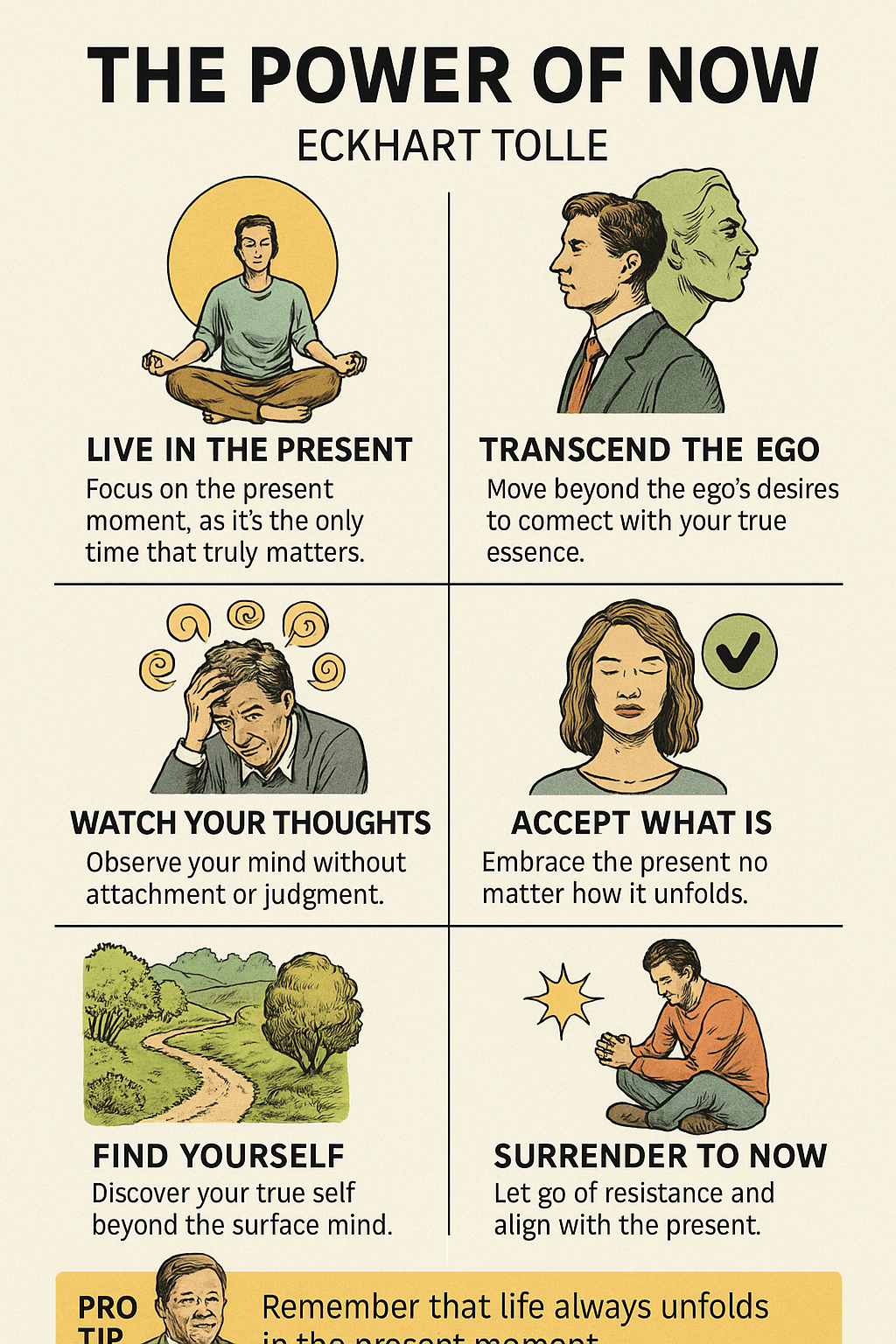
    The Power of Now by Eckhart Tolle: 6 Mindfulness Insights for Daily Growth

    Eckhart Tolle’s The Power of Now is a guide to spiritual awakening and mindfulness. It teaches that the only reality is the present moment, and that self-reflection and awareness of “now” can free us from anxiety about past or future . The book mixes spiritual traditions to show how identifying too much with thoughts leads to suffering, while anchoring in the present brings peace . Tolle even offers simple practices—like mindfulness exercises and slowing down—to help readers embed presence into daily life

    Focusing on the present moment grounds us in reality. Living in the Present: Tolle reminds us that “only the present moment is real and only the present moment matters” . When we fully engage in what we’re doing—whether it’s breathing, eating, or walking—we experience life without the burden of past regrets or future worries. Practical takeaway: Choose one routine task (like washing dishes or drinking tea) and commit to doing it with full attention. Notice sights, sounds, and sensations to anchor yourself in now.

    Transcending the Ego

    Tolle teaches that much of our pain comes from the ego: the mind’s voice that identifies with stories of “me” and “mine” . This egoic self constantly compares, fears, and seeks control, keeping us trapped in anxiety. By recognizing that our true self is separate from this running commentary, we weaken the ego’s grip. Practical takeaway: When a thought or label (“I am stressed,” “I am not smart,” etc.) arises, notice it with curiosity instead of judgment. Remind yourself, “I am not my thoughts.” This simple shift chips away at the ego’s illusions over time.

    Watching Thoughts

    One of Tolle’s core practices is to observe your thoughts instead of being swept away by them . He suggests watching the mind as if you were listening to a radio in the background—acknowledge thoughts without getting caught up in their drama. This conscious observation creates space between “you” and your mind, making negative patterns lose power. Practical takeaway: Try a 3-minute mental check-in. Sit quietly and count your breaths. When thoughts appear, label them briefly (“thinking,” “worrying,” etc.) and return to the breath. This trains your awareness to be the observer.

    Accepting What Is

    Resistance to the present moment causes unnecessary suffering. Tolle emphasizes acceptance: allowing life to be as it is, without automatically calling experiences “good” or “bad” . Paradoxically, accepting what is doesn’t mean passivity; it means engaging with life from a clear, centered place. When we stop fighting reality, we find calm and clarity. Practical takeaway: The next time something frustrating happens (a traffic jam, a mistake, bad news), pause and say to yourself, “It is what it is.” Take a few deep breaths, then respond calmly. Over time, this small practice lowers stress.

    Finding Your True Self

    Underneath the constant stream of thoughts, Tolle says, lies our true self: the awareness or “being” that is always present . This deeper identity is loving, whole, and constant, beyond ego and mental labels. It’s accessible whenever thoughts subside. Practical takeaway: Spend 1 minute scanning your body and noticing the space around you. You’ll discover a still, silent presence under the surface. Remember this sense of “being” – it’s your true self, always available in the present moment.

    Surrendering to Now

    Tolle describes surrender as the art of letting go of resistance to the present. In the book’s introduction he recalls hearing “resist nothing,” and how that realization ended his fear . When we stop insisting on control and accept what the moment brings, we experience flow and inner freedom. Practical takeaway: In any stressful situation today, try this mantra: “I accept what is.” Repeat it softly, especially if anxiety rises. Notice how surrendering a little helps you respond more wisely, step by step.

    1% Better Daily Challenge

    Commit to one small step of presence today. For example: Before you check your phone in the morning, take two deep breaths and feel your feet on the ground. Notice one new thing in your room. This tiny pause gives your mind a 1% reset toward awareness. Over time, these daily micro-steps add up to major growth.

  • Daily Kaizen: One Tiny Change

    Daily Kaizen: One Tiny Change

    “Small hinges swing big doors.”

    Today’s Kaizen is simple but powerful: Pause before you reply.

    Before your next response – whether in a meeting, a text, or a face-to-face chat – take a slow breath, count to three, and let silence fill the gap. It gives your brain time to process, shows respect to the speaker, and transforms reactive habits into intentional choices.

    Do this just once today. Feel the shift.

    💬 What one conversation will you practice this with?

  • Transform Your Life with 5-Minute Habits

    Transform Your Life with 5-Minute Habits

    Feeling too busy to stick with healthy habits? You’re not alone. The good news is that big results can come from tiny changes. In fact, researchers and habit experts agree: consistent small habits beat occasional big efforts mindful.org. As James Clear (author of Atomic Habits) advises, scale new routines down so they take just a few minutes jamesclear.com. These 5-minute habits below transformed my fitness, mindset, and productivity – and they can do the same for you. They’re quick, science-backed, and realistic for even the busiest schedule.

    1. 5-Minute Morning Workout (Move to Boost Energy)

    Kick-start your day with just five minutes of movement. It might not sound like much, but short daily workouts can deliver surprising benefits. One study found that just 5 minutes of daily strength exercises improved participants’ muscle strength, endurance, and flexibility, and even gave a mental health boost sciencealert.comsciencealert.com. Over 80% of people in the study kept the habit going after 4 weeks – a testament to how sustainable mini-workouts can besciencealert.com.

    Real-life example: try a quick bodyweight circuit each morning. For instance, do 10 squats, 10 push-ups, and 10 jumping jacks, repeating as many rounds as you can in five minutes. Or follow a short “5-minute morning HIIT” video. The key is raising your heart rate. Even a brief burst of moderate-to-vigorous exercise can sharpen your brain for hours afterward – studies show cognitive functions like memory and focus improve with as little as five minutes of aerobic activityneurosciencenews.comneurosciencenews.com. Over time, these micro-workouts add up. They build strength and stamina, and often inspire you to be more active later. Remember, consistency matters more than length. A quick workout you actually do every day beats an hour-long session you never find time for.

    2. 5-Minute Mindfulness Meditation (Mental Clarity on the Go)

    When schedules are packed, meditation might feel impossible to fit in – but just five minutes a day can make a real difference. Research indicates that frequency is more important than duration for mindfulness benefits mindful.org. In fact, a meditation teacher in one study noted that “if you meditate five minutes a day, every day, it’s a lot better than meditating half an hour once a week.” mindful.org Short daily sessions can reduce stress and improve your mood and attention span. One experiment with busy students found those who did a brief mindfulness practice each day reported lower stress and better mental health compared to a control group mindful.org.

    How to do it? Find a comfortable spot (sitting up in bed or even in your parked car before work) and focus on your breath for five minutes. You can use a guided meditation app set to 5 minutes, or simply take slow breaths and notice sensations. Some days you might only manage 2 or 3 minutes – that’s okay. The goal is to show up daily. These mini “mindfulness breaks” train your brain to pause and center itself. Over time, you may find you’re less reactive to stress and more focused in your work. Think of it as a mental reset button you can press anytime. Consistency will compound your results, much like physical exercise: tiny daily calm moments build an overall calmer, clearer mind.

    3. 5-Minute Gratitude Journaling (Boost Your Mood and Mindset)

    Taking a few minutes to write in a journal can dramatically improve your mindset. I was skeptical at first – what can you accomplish in 5 minutes? – but it turns out even a short gratitude journal habit packs a punch. Positive psychology research shows that a 5-minute daily gratitude journal can boost long-term well-being by over 10% tetonscience.org. (For context, that’s about the same impact as doubling your income on your happiness!) Journaling helps because it forces a moment of reflection and positive focus, shifting your mind away from stresses. In one study, people who journaled about their thoughts and goals each day saw a 23% drop in stress levels and improved decision-making after two months horizonpointconsulting.com.

    To start, pick a time – morning or evening – and jot down a few prompts. Write 3 things you’re grateful for (big or small), or list a couple of wins from the day. You could also do a quick “brain dump” of anything weighing on your mind, to gain clarity. Keep it simple: bullet points or short sentences are fine. The power is in doing it regularly, not in writing an essay. For example, each night I spend five minutes writing highlights of the day and one thing I learned. This little ritual helps me go to bed on a positive note, rather than ruminating over what went wrong. Over weeks, you’ll likely notice you feel more optimistic and resilient. Your 5-minute journal is a tiny investment that yields a calmer, happier you.

    4. 5-Minute Daily Planning (Prioritize Like a Pro)

    Ever start your day feeling overwhelmed by everything on your plate? Taking five minutes to plan can change that. Whether it’s first thing in the morning or the night before, a brief planning session brings laser focus to your day. Productivity coaches often suggest writing down your top 3 priorities for tomorrow as the last task of your workday. Why? Because planning ahead reduces decision fatigue and conserves your willpower for what matters medium.com. If you already know your game plan, you won’t waste mental energy figuring out where to start each day. As one productivity expert put it, if you “plan your days the night before, you’ll not only get more done in less time, you’ll also experience more flow.” medium.commedium.com

    A simple way to implement this habit is to use a template like the Skill-Stacked Daily Blueprint. Each evening, I spend 5 minutes with my Daily Blueprint sheet: I list the top tasks or goals for the next day, any appointments, and one healthy habit (like “morning workout”) I’ll do. This quick ritual gives me a head start. When a new day begins, I can jump right into my most important work instead of reacting to random emails or feeling unsure what to do first. You can also do it in the morning if that suits you better – write down a quick agenda while having your coffee. The point is to clarify your priorities. Those few minutes of planning will pay back an hour of extra productivity during the day. Busy people swear by this habit because it creates structure amid chaos. Try it for a week and see how much more directed and in control you feel.

    5. 5-Minute Movement Breaks (Refresh Your Body and Brain)

    Sitting all day wreaks havoc on both our bodies and focus. But the antidote doesn’t have to be hour-long gym sessions – short movement breaks sprinkled through your day can dramatically improve your health and concentration. Science is now telling us that even a 5-minute walk every half-hour can offset many of the negative effects of prolonged sitting health.harvard.edu. In one study, participants who took these mini walking breaks had 58% lower blood sugar spikes and reduced blood pressure compared to those who sat all day health.harvard.edu. Fatigue went down and mood went up too with frequent short walks health.harvard.edu. In other words, moving briefly but regularly helps keep your body energized and your brain sharp.

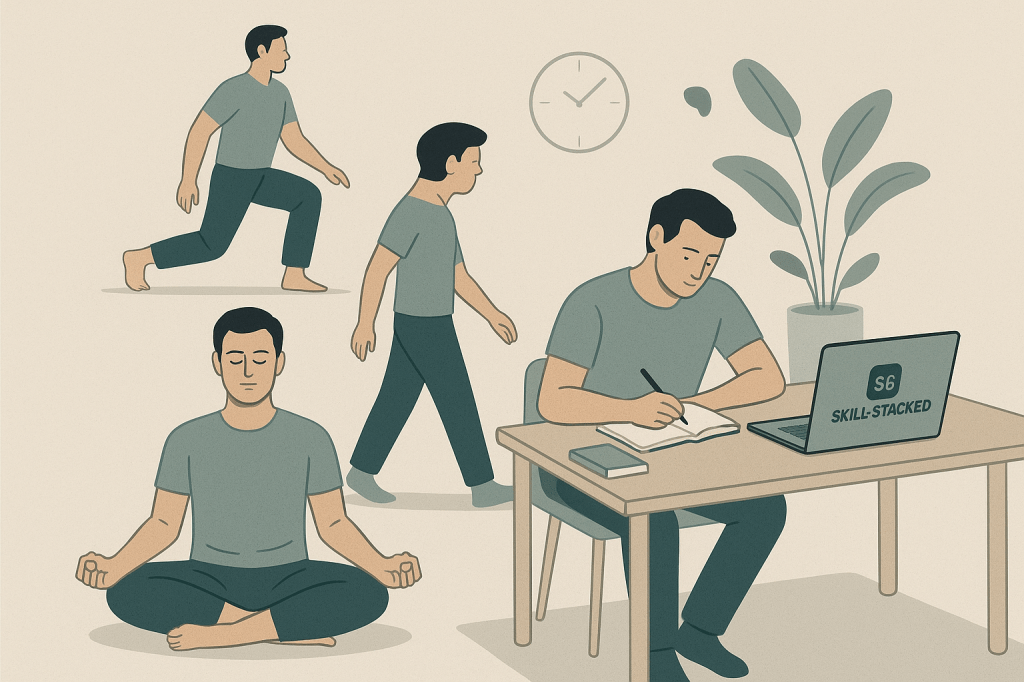
    You can adapt this idea to your routine. If you’re working from home, try doing a quick 5-minute stretch or walk around the block between Zoom meetings. In an office, take the long route to the restroom or do a lap of the floor. Even standing up to stretch your arms, neck, and back for a few minutes is worthwhile. I set a timer on my computer to remind me to “get up and move” every hour. Those mini-breaks are great for clearing mental fog. Often when I return to my desk, I find I can concentrate better on the next task. Over time, you’ll also notice less stiffness and more daily steps adding up. The key is making it a habit: tie it to something (for example, every time you refill your water, do a 5-minute walk). By treating movement as a non-negotiable part of your schedule, you’ll feel more alert and lively each day.

    Conclusion: Small Habits, Big Results

    Each of these habits takes only a few minutes, but together they’ve had a massive impact on my fitness and focus. The secret is consistency. Five minutes today doesn’t revolutionize your life – but five minutes every day? That builds momentum. These routines are so quick and easy that it’s hard to come up with an excuse not to do them. And on tough days when motivation is low, remember BJ Fogg’s advice: make it even easier. Do one minute, or one push-up, if that’s all you can – it still counts. What matters is showing up.

    Give these 5-minute habits a try. Start with one that speaks to you, and build from there. In a few weeks, you might be amazed at the changes in your energy, mood, and productivity. Tiny habits truly compound into big improvements over time, turning into an upward spiral of wellness and success.

    Ready to take the next step? To help you stay on track, we’ve created a handy tool – the Skill-Stacked Daily Blueprint. It’s a free, printable template for your 5-minute planning ritual (with space for your habits too!). [Download your free Daily Blueprint here] and start stacking those small wins each day. You’ve got this! 🚀