Tag: personal development system

  • Install a Night-Before Planning Ritual

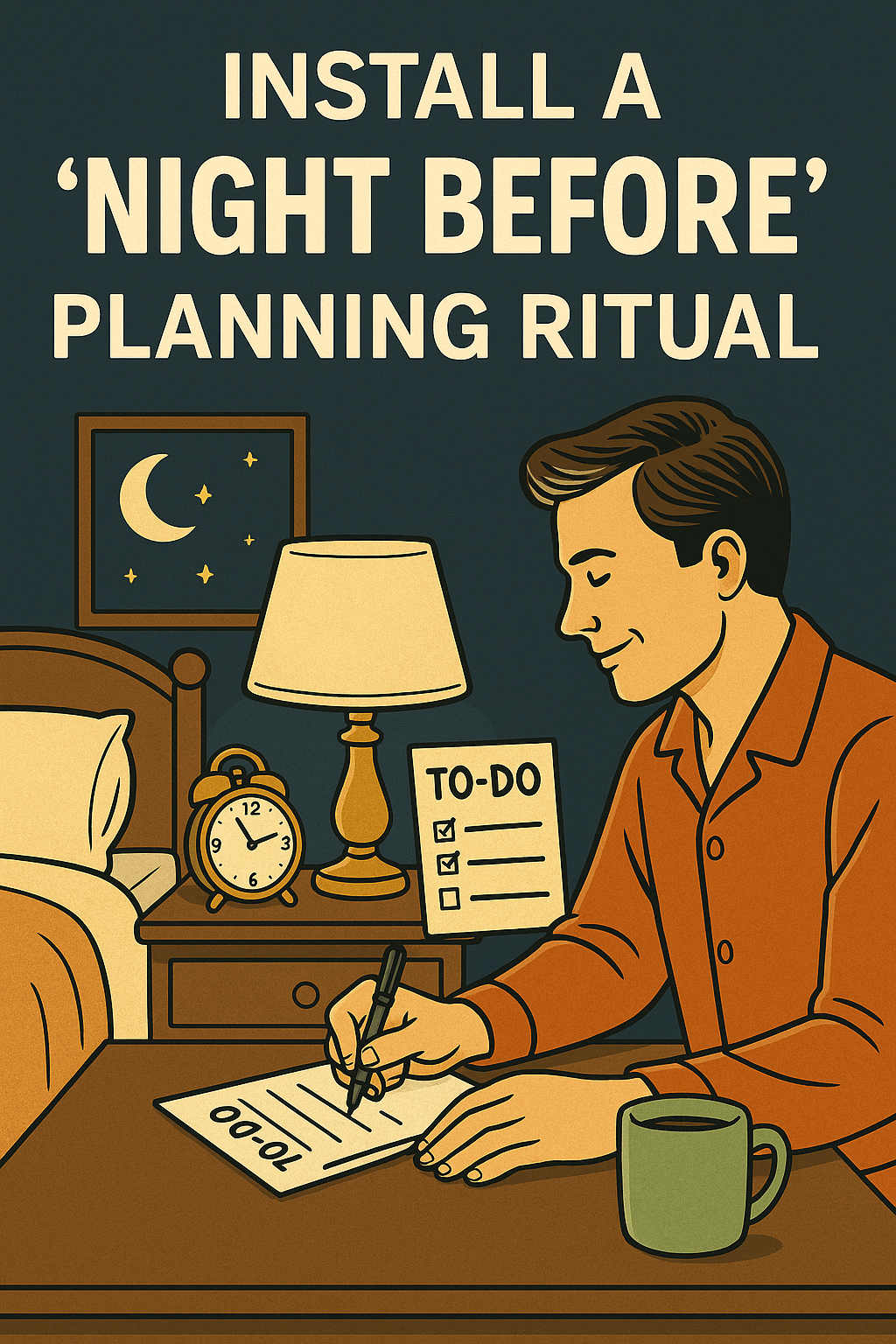
    Install a Night-Before Planning Ritual

    End your day with purpose by planning tomorrow tonight. A simple evening routine of reflecting on today’s progress and mapping out tasks for tomorrow can calm your mind, sharpen your focus, and set you up for a productive morning. Scientific studies show that writing a detailed to-do list at bedtime helps “offload” worries and speeds sleep onset . By making this a habit, you save willpower and reduce decision fatigue – instead of wasting precious morning energy deciding what to do, you wake up with a clear roadmap .

    Benefits of a Nightly Planning Ritual

    Reduced decision fatigue.  When you plan ahead, you eliminate many small morning choices (like what to wear or what task to tackle first). Decision fatigue – a state where mental energy for making choices runs low – builds up each day .  Productivity experts note that by planning the night before you “reduce decision fatigue, and preserve your willpower for your deepest most meaningful work.” . In short, having a plan means your brain isn’t drained by easy decisions, leaving more energy for what matters. Lower stress and anxiety. Jotting down unfinished tasks and worries before bed lets you offload them from your mind. Research found that participants who wrote a to-do list before sleep fell asleep about 9 minutes faster than those who journaled about completed tasks . Writing out tomorrow’s tasks (rather than mentally rehearsing them) reduces “cognitive arousal” and racing thoughts . Doctors advise “don’t take your problems to bed” – instead, schedule a worry-free planning session earlier in the evening . This practice clears your head and can improve sleep quality. Better sleep quality. A consistent bedtime routine signals to your brain that it’s time to wind down. Studies show that structured evening habits – especially a soothing ritual before sleep – are linked to better sleep habits and family well-being .  The sleep study above also found that the more specifically participants wrote their to-do lists, the faster they fell asleep . In other words, the act of detailed planning helps your brain let go of work concerns and drift off more easily. Morning momentum and clarity.  Waking up knowing exactly what to do first creates immediate focus and momentum. As one productivity writer notes, planning your day the night before means you’ll “get more done in less time” and experience “more flow” in the morning . By reviewing your priorities tonight, you remove guesswork from tomorrow’s morning – you know which tasks are top priority, so you can dive in confidently. A clear game plan built the night before means you start each day already moving forward.

    How to Build Your Nightly Planning Ritual

    Reflect on Today.  Spend a few minutes reviewing what you accomplished and what’s pending. Check off completed tasks and celebrate small wins. Noting down what went well (and what didn’t) helps you learn and ensures nothing important slips through the cracks. This reflection closes out the day and makes it easier to move on. Set Tomorrow’s Priorities.  Write a concise to-do list or pick the 3–5 most important things for tomorrow.  The classic Ivy Lee method suggests listing your top tasks before bed and tackling them first thing. Be specific: the sleep research found that detailed to-do lists offload more mental stress . Focus on high-impact goals that align with your bigger objectives. Jotting down these items (on paper, in a planner, or an app) gives your mind permission to rest, knowing you won’t forget them. Prepare Your Space.  Lay out anything you’ll need in the morning: clothes, tools, documents, or even a pre-set coffee mug.  For example, one schedule recommends “prepare for the next day: pack your stuff, choose your outfit” before bed .  Setting out tomorrow’s outfit on the bed (and packing your bag or work supplies) eliminates a key morning decision.  Another habit-stack is setting out your coffee mug or brewing supplies – James Clear points out a simple nighttime stack: after cleaning up, set out your coffee mug for tomorrow morning . These small cues make your morning routine run effortlessly. Wind Down Mindfully.  Turn off work and screens at least 30 minutes before bed. Do a relaxing activity like reading, gentle stretching, or deep breathing. A calming ritual signals it’s time to sleep .  You might also write a brief journal entry – either a gratitude log or a “worry list” – to further clear your mind (many therapists use worry lists to calm anxious thoughts). By separating your planning from active problem-solving, you give your brain the cue that the workday is done and it’s time to rest. Keep a Consistent Schedule.  Try to do this planning ritual at the same time each evening. Habits form best when they’re tied to a routine . For example, plan right after dinner or immediately after your evening shower. Over time, this consistency will make evening planning second nature. The more automatic it is, the easier it is to maintain – soon, writing tomorrow’s list will feel like a normal part of winding down.

    Examples of Effective Nightly Rituals

    One powerful nightly habit is to lay out tomorrow’s essentials before bed.  For example, prepare your outfit and work bag ahead of time – a schedule note advises “prepare for the next day: pack your stuff, choose your outfit” before sleep .  Even small cues help: setting out your coffee mug and ingredients can streamline your morning (as one habit example notes, “After I wipe down the counter, I will set out my coffee mug for tomorrow morning.” ).

    Review Big Goals and Wins.  Take 1–2 minutes to look over your long-term goals or project milestones. Celebrate any progress today and adjust tomorrow’s tasks if needed. This keeps your nightly plan aligned with the big picture. Write a To-Do List.  Handwrite or type the top tasks for tomorrow. Be clear and action-oriented. (Remember: researchers found that a detailed pre-sleep to-do list can actually help you fall asleep faster , so don’t skimp on specifics!) Check Tomorrow’s Calendar.  Scan your schedule for upcoming meetings or deadlines. Confirm any appointments and note what preparations you need. This ensures you wake up mentally prepared for events, not scrambling. Lay Out Clothes or Gear.  Decide what you’ll wear and put it out, or pack your gym/laptop bag. This removes a “morning decision” and can save precious time. Prep Breakfast or Lunch.  If you bring lunch or make morning coffee at home, prepare the night before. Fill the coffee maker, pack ingredients, or set out dishes. These tiny steps can make your morning smoother. Write a Worry List.  Quickly jot down any nagging worries or tasks that are on your mind. Just writing them down can quiet anxious thoughts (a Cognitive Behavioral Therapy technique ), making it easier to relax into sleep. Prep Your Technology.  Charge your phone and laptop so they’re ready. Set your phone to Do Not Disturb or put it away from the bed. Fewer notifications in the morning means a calmer start.

    Each of these simple rituals takes only a few minutes but can have a big payoff. Over time, they add up into a powerful habit loop that makes every morning easier. As one productivity coach puts it, giving yourself a framework for the next day “means there’s no guesswork as to what you’ll be doing when you sit down to work in the morning.”

    Conclusion: Try It Tonight

    Installing a night-before planning ritual is a small step that can transform your days. Imagine waking up calm and confident, with all your priorities lined up. Tonight, before bed, give it a try: spend five minutes jotting down your top goals for tomorrow and set out one item you’ll need (like your outfit or coffee mug). Notice how this clears your mind and jumpstarts your productivity. You might be surprised by how much more focused and energized you feel in the morning. Experiment with this ritual tonight and see the difference tomorrow .

    Give yourself one night to start – your tomorrow will thank you.

  • Hidden Time Leaks and Productivity

    Hidden Time Leaks and Productivity

    Most of us drift through the day distracted by tiny “time leaks” – email pings, phone buzzes, random tasks – that chip away our focus.  In fact, research finds the average person is interrupted just 12 minutes into a task, and needs over 25 minutes to refocus afterward .  These fragments add up: roughly 720 work hours per year (about 18 full work weeks) are lost to distractions .  Every little interruption or idle moment – even checking a message or browsing social media – may feel harmless, but they compound into a massive productivity drain.

    Humans also tend to misjudge time.  The planning fallacy shows that we chronically underestimate how long our tasks will take .  When deadlines feel far away, Parkinson’s Law kicks in: work expands to fill the time allotted .  Give yourself two weeks for a project, and you’ll likely shuffle it for 13 days before scrambling at the end.  This combination of underestimating effort and over-allocating time means you inadvertently create more work and procrastinate, letting tasks stretch out and steal your calendar .

    Meanwhile our brains pay a heavy price for each switch of attention.  Cognitive science shows that multitasking is a myth – the brain can’t truly do two hard tasks at once.  Instead we juggle rapidly between them, burning mental energy with each switch .  As psychologist Daniel Levitin notes, bouncing between tasks spikes stress hormones and glucose burn in the brain .  Even a brief “mental block” from a switch can consume up to 40% of your productive time .  In short, little leaks like interruptions, multitasking and drifted attention slow you down, reduce work quality, and leave you exhausted – even if it feels like you’re busy.

    On top of that, digital distractions are ubiquitous.  One survey found 77% of workers feel more stressed by technology, with notifications tearing away focus .  A phone notification or an email alert doesn’t just nibble a moment – it breaks concentration and often sends you off-task for minutes.  Over a week you may face 160+ such distractions .  No wonder nearly 8 in 10 people report feeling distracted during the workday .  These hidden leaks – the “continuous partial attention” of modern life – quietly sink productivity unless we notice them and act.

    Strategies to Audit Your Time

    The good news is that awareness is the first step to plugging these leaks.  By systematically auditing how you spend each hour, you can surface hidden drains and regain control.  Try these strategies (each corresponds to a point in our infographic grid):

    1. Track Every Minute:  Keep a detailed time log for 1–2 weeks.  Write down how you spend blocks of time (work tasks, email, meetings, breaks, even browsing).  Studies show people grossly underestimate task durations .  Seeing the numbers in black and white sparks urgency: when you know you’re “on the clock,” you tend to focus more .  A log reveals surprises (e.g. how much social media or admin eats your day) and builds time awareness.  This data is the foundation of any audit. 2. Identify Your Leaks:  Analyze your time log for low-value activities.  Which “tasks” are really just buffers or distractions?  Maybe you spent half an hour each day on unnecessary meetings or gossip.  Note how often you check your phone (90% of people say phones are their biggest distraction ).  These leaks often hide in plain sight.  Categorize your activities (deep work, shallow admin, breaks, etc.) and calculate percentages – even a 5% daily leak adds up to over 100 hours a year. 3. Set Hard Time Limits:  Combat Parkinson’s Law by capping how much time a task can take.  Instead of “finish the report by Friday,” timebox it: “3 hours on Monday to outline it.”  Or use a timer/Pomodoro (e.g. 50-minute focus, 10-minute break).  When you give yourself a tight deadline or timer, you force focus and shorten drawn-out tasks.  As one guide notes, be mindful of how long you really need, not just the generous window given .  Shorter deadlines can harness urgency and prevent work from inflating. 4. Focus on One Thing:  Plan to single-task during work blocks.  Each time you try to split your attention (even music in background), you add cognitive load .  Structure your day into focused periods on one project at a time.  During each block, close unrelated tabs and resist switching.  Research shows that concentrated focus (deep work) yields higher-quality output and actually takes less time overall . 5. Batch Similar Tasks:  Group routine or shallow tasks together.  For example, schedule specific times to check email or Slack (say, twice a day) rather than letting them pop up constantly.  Batch phone calls, administrative tasks, or quick errands into dedicated slots.  This reduces the frequency of context switches (which chew time) and lets you tackle similar tasks with momentum.  Batching is especially powerful for tasks that otherwise interrupt bigger projects. 6. Tame Digital Distractions:  Silence or filter notifications.  Turn off app pings, put your phone on Do Not Disturb, or use website blockers during focus time.  The constant lure of news feeds and alerts wrecks concentration – in one survey, nearly half of workers admitted losing focus to irrelevant notifications .  By removing these digital hiccups, you stop many leaks before they start.  If needed, use “focus modes” or tools like noise-cancelling headphones to create a distraction-free zone. 7. Plan Breaks (And Earn Them):  Ironically, taking scheduled breaks can improve overall productivity.  Everyone needs downtime between intense tasks – the trick is to make it conscious, not accidental.  Build short breaks or walk-away moments into your schedule (e.g. a quick stretch every 90 minutes).  Planning breaks prevents random drift (like doomscrolling) and keeps you refreshed.  A rested brain works faster, so a 10-minute pause can save 20 minutes of frustrated effort later. 8. Review and Adjust Weekly:  At the end of each week, revisit your log and goals.  What went well? Where did new leaks appear?  Update your strategy accordingly.  For instance, if email still creeps in, tighten your batching.  If meetings dominated your time, negotiate agendas or attendee lists.  This reflection step turns data into action.  Each week’s audit sharpens your time sense (and improves future planning) .

    Implementing these strategies systematically helps you plug the silent drains on your day.  Over time you’ll channel your hours into meaningful work, not noise.

    Summary and Time-Log Exercise

    Time audit is about awareness and action.  Research tells us that productivity isn’t just harder work; it’s smarter scheduling.  By logging your time, spotting leaks, and enforcing structure (Parkinson’s Law, single-tasking, batching, etc.), you reclaim wasted hours .  Each small improvement – delaying that phone check, or finishing tasks ahead of a self-imposed deadline – compounds into big gains.

    Exercise (Optional): For one week, carry a notebook or use a time-tracking app to record your activities every 15–30 minutes.  At week’s end, break your log into categories (focus work, meetings, admin, breaks, distractions).  Calculate how much time went to priority tasks versus time leaks.  Identify the top two biggest drains (e.g. too many emails or idle social media) and apply the strategies above to fix them next week.  Repeat weekly.

    By treating time as data – measuring, analyzing, and iterating – you turn vague “busywork” into clear priorities.  In this way, you’ll plug the leaks and use every hour intentionally, boosting productivity and making progress feel tangible.

  • 🧠 Introducing: The 100-Step Personal Development Series

    🧠 Introducing: The 100-Step Personal Development Series

    One simple step. Every day. For 100 days.

    Most people fail at self-improvement for one reason:

    It’s too vague. Too overwhelming. Too much theory, not enough traction.

    You’re told to “be better,” but nobody shows you how.

    That ends today.

    🎯 What This Is

    Over the next 100 days, I’m breaking down personal development into 100 clear, proven, and powerful micro-steps.

    Each one comes with:

    A daily graphic you can save and share. A short, actionable breakdown A practical step you can apply instantly

    These steps will cover everything from:

    Discipline and habits Focus and emotional control Communication and confidence Learning systems and mental models Energy, recovery, finance, purpose, and more

    🛠 Why I’m Doing This

    Because I believe every skill can be learned.

    And every goal becomes possible when you break it down into steps.

    This isn’t about motivation.

    It’s about building systems that work even on your worst days.

    This series is for creators, operators, athletes, leaders, and anyone committed to becoming 1% better — every damn day.

    🗓 What to Expect

    📍 Daily infographic posts on X @skillstacked 🧱

    Every 10 steps = a themed module recap on this blog 🧠

    A full flagship product at the end: The Personal Development OS (complete with visuals, explanations, exercises, and systems)

    📬 Follow Along

    You can follow the journey here on the blog.

    But to go deeper — and get early access to the full product when it drops:

    👉 Subscribe to join the list

    (No spam. Just systems that work.)

    Let’s build the system that builds you.

    – Skill Stacker