Tag: personal-growth

  • 🧠 Daily Kaizen #3 – Write One Sentence About How You Actually Feel Right Now

    🧠 Daily Kaizen #3 – Write One Sentence About How You Actually Feel Right Now

    Most people go years without asking themselves this:

    “How do I actually feel right now?”

    Not “how should I feel?”

    Not “how do I want to feel?”

    Just the truth.

    We’re trained to perform.

    To stay strong.

    To hide emotions behind jokes, tasks, and distractions.

    But suppressed emotion doesn’t disappear — it festers.

    And the antidote isn’t a 10-day retreat.

    It’s one honest sentence.

    🧩 Why this works:

    It activates emotional intelligence Interrupts unconscious coping mechanisms Creates a micro-moment of self-connection

    Even writing something like:

    “I feel flat and anxious, but I’m pretending to be fine.”

    is enough to reclaim power from the unconscious.

    💡 Your Kaizen Today:

    Take out your phone, notes app, or a scrap of paper and write this:

    “Right now, I feel ____________.”

    That’s it.

    No journaling.

    No judgment.

    No overthinking.

    Just one sentence. One truth.

    Because when you name it — you start to tame it.

    🧭 Why it matters:

    Small awareness creates massive change.

    This is one of those tiny habits that looks too simple to work —

    Until it becomes your emotional anchor in chaos.

    Try it right now. Then come back tomorrow.

    Because this is what we do here — one small win at a time.

    🔁 Follow Skill Stacked for a new Daily Kaizen every day.

    Small changes. Serious growth.

    Let’s build discipline that compounds.

  • Eliminate One Destructive Trigger: Break Bad Habits and Upgrade Your Daily Routine

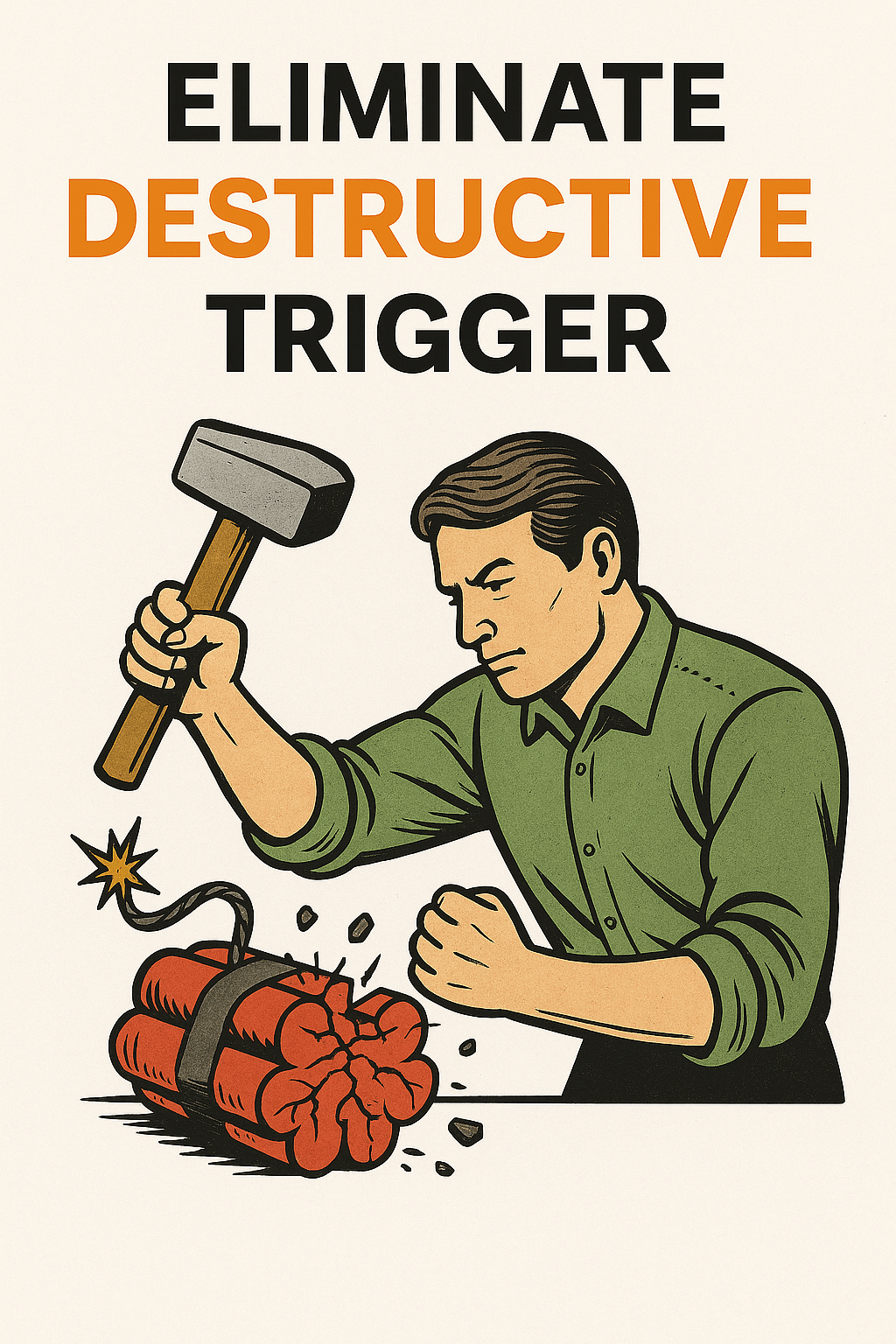
    Eliminate One Destructive Trigger: Break Bad Habits and Upgrade Your Daily Routine

    We all have that one invisible saboteur – a hidden cue or habit that derails our best intentions.  Perhaps it’s the ping of a phone notification that pulls you off task, a snack stored in plain sight that triggers mindless munching, or a late-night routine that leads to sleep loss.  These destructive triggers can quietly sabotage productivity, health goals, and personal growth, even when our motivation is high.  Imagine flipping the script: by identifying and eliminating just one key trigger, you could stop the chain reaction of self-sabotage and take control of your day.  In this post (Part 9 of our series on self-mastery), we’ll dive into the psychology and neuroscience of habit triggers, help you spot your own biggest trigger, and guide you through practical steps to remove or replace it.

    “Identify one destructive cue, remove it, and watch the dominoes of your day fall into place.”

    What Is a Destructive Trigger?

    Every habit starts with a cue – an environmental or emotional trigger that ignites a routine .  In psychology, this is often called the “cue” in the habit loop (cue–routine–reward). For example, seeing your smartphone buzz is the cue that launches a scrolling session, or feeling stressed at the office cues the routine of stress-snacking.  Over time, these cue–response loops become wired into the brain’s habit centers (the basal ganglia) .  The result is automatic behavior: you don’t even think before you reach for that cookie or flip open your phone – the trigger did it for you.

    A destructive trigger is simply one of those cues that consistently leads you off-track.  It’s a part of your environment or routine that sparks an unwanted behavior.  Importantly, removing or modifying this one trigger can prevent the unwanted habit from ever starting.  As cognitive neuroscience research shows, removing the environmental cue for a bad habit can “disrupt[]” the loop that keeps it going .  In other words, break the cue and you break the habit.

    A destructive trigger might be a time of day (e.g. 8 PM signals snack time), an emotion (like stress or boredom), a person, or even a physical object (like a cluttered desk or a pile of unfinished tasks on your calendar).  Whatever it is, it’s a predictable catalyst for self-sabotage.  It aligns closely with what experts call self-sabotage – behaviors that create problems in daily life and interfere with long-term goals .  For instance, Psychology Today notes that procrastination, comfort eating, or phone addiction can all be forms of self-sabotage triggered by specific cues .  Our job is to uncover which cue is your culprit, so you can stop it.

    The Brain and Habit Loops

    Understanding why triggers have such power means looking at your brain’s wiring. Neuroscience tells us that the brain uses habits to conserve energy – routine actions move from the deliberate prefrontal cortex down into the automatic basal ganglia .  Once this happens, a cue can flip the switch on a habitual routine without much conscious thought.  As one science news article summarizes: “habits happen when automatic responses outweigh our ability to consciously control them” .

    In practice, this means even a tiny cue (like your phone lighting up) can hijack your attention and automatically pull you into a familiar, often unwanted behavior .  For example, researchers have found that just hearing your phone buzz (even in your pocket) is enough to break your focus: “Unless your phone is fully silenced or off, it’s probably still distracting you…The familiar buzz buzz of a new notification is not as innocuous as it seems” .  That buzzing sound is literally a trigger that your brain has learned to respond to automatically, over and over again.

    The key insight from neuroscience is that good or bad, habits form from repeated cue–action pairings .  Repetition plus reward cements these associations.  But this also means that those same principles can be used in your favor.  You can replace an unwanted routine with a new one by linking it to the same cue or creating a new cue.  For example, if stress is your cue to snack, you might attach a different routine to that stress cue (like a short walk or a breathing exercise) that still delivers a reward (calm, or a sense of accomplishment) but is healthier . Over time, your brain will forge a new habit loop around the positive routine instead.

    Spot the Cue: Identifying Your Trigger

    First, let’s shine a light on that destructive trigger. This often takes conscious attention, because triggers act on autopilot.  Start by observing and documenting the problem behavior.  Keep a brief “trigger log” or journal. Whenever you catch yourself doing something unhelpful (procrastinating, over-snacking, doomscrolling, etc.), note what happened just before: the time, your location, your feelings, even who or what was around.  Psychology Today advises that “documenting and analyzing behavior is a key component of preventing self-sabotage” . In practice, this might mean writing down, “It’s 3 PM, I feel stressed and the first thing I did was open Instagram,” or “After dinner, saw chips on counter and snacked.” Over days or weeks, patterns will emerge.

    You can also apply a simple question when a negative habit occurs: “What was the trigger?”  Ask yourself what thought or emotion popped up just before the urge hit .  Often we find it was something like boredom, anxiety, or even a specific place or time.  For example, many people discover that Mondays in the office cue a sugary coffee or that arguing with family cues comfort eating.  By bringing this automatic link into awareness, you can catch the trigger in the act.

    Another check is to evaluate whether your behavior is aligned with your goals . If it’s not, the environment or cue around you may be to blame.  Psychology Today notes that misaligned behaviors that repeatedly undermine long-term goals are the hallmark of self-sabotage .  If you find yourself repeatedly veering off-course, look at what external or emotional cue led there.

    “Your environment is a radar; remove one blip, and your signals clear up.”

    Why That One Trigger Matters

    It might sound simple – one cue – but its effect can be huge.  Think of triggers as the first domino in a long chain.  When a trigger hits, it sets off a chain reaction of habits and justifications. For instance, one email notification at the wrong time can spiral into a day lost to distraction, or seeing a piece of cake can spark an entire evening of overeating.  Productivity and habit experts often point out that bad habits and procrastination usually start with an unnoticed trigger .

    Research confirms that even brief distractions have an outsize impact.  A Harvard Business Review article highlights how simply hearing your phone buzz—even if you don’t pick it up—harms your performance .  Similarly, studies on habit change emphasize that even one environmental cue can sustain a pattern of behavior .  That’s why zeroing in on one destructive trigger can feel so effective: when you remove that cue, the whole routine often fizzles out.

    Moreover, eliminating a trigger can help you break the cycle of self-sabotage.  Instead of using willpower alone, you starve the habit of its signal.  Scientists stress that removing triggers is often more reliable than fighting the urge after it appears .  In practice, that means you can stop unwanted habits before they even start.  Personal growth happens incrementally: by tackling just one habit loop at a time, you lay the foundation for bigger change .

    Remove or Replace: Transforming Your Trigger

    Once you’ve identified the culprit trigger, it’s time to eliminate or rewire it.  Here are evidence-based strategies:

    Modify Your Environment. Adjust your surroundings to cut off exposure to the trigger. As researchers note, “making desired behaviors easier to access encourages good habits, while removing cues that trigger unwanted behavior disrupts bad habits” .  For example, if junk food on the counter is your trigger, put it away or replace it with fruit. If your phone buzz distracts you, turn off notifications or place it in another room during focus times. Psychology Today even finds that changing locations can reset patterns: when people visit a new place or rearrange their space, their old habits “don’t stand a chance” thanks to different cues .

    A clutter-free, intentional workspace eliminates many visual cues that could derail focus.

    Use Implementation Intentions. This is a fancy term for “if-then” planning. Set a clear plan for what you’ll do when the trigger appears. For instance, “If I feel stressed in the afternoon, then I will take three deep breaths and stretch for two minutes.”  This kind of pre-planning has been shown to bridge the gap between intention and action by giving your brain an alternative response to an old cue . Replace the Routine. You’re not just ripping out a habit; you’re grafting in a new one. Decide on a positive action to follow the trigger instead. For example, if TV time at night cues snacking, vow to drink herbal tea instead whenever you start that show. Over time, your brain will form a new habit loop: the same cue (TV) now triggers tea and relaxation, not chips.  Western University research on habit change emphasizes this: instead of eliminating a behavior, “the routine can be replaced with a healthier alternative” so long as the new routine yields a satisfying reward .  Consistency is key: each time you honor the new routine, the old neural pathway for the bad habit weakens and the new one strengthens . Practice Mindfulness. Cultivate awareness of the trigger in the moment. Mindfulness slows down the automatic pilot. When you feel the cue or crave hit, pause and take three deep breaths. Ask yourself if you really want to follow the old routine or if there’s another choice. Science suggests that staying mindful and intentional can prevent you from defaulting into bad habits under stress .  Even a few seconds of breathing or noting your thoughts can break the automatic link. Align with Your Identity. Shift your mindset to reinforce the change. According to habit experts, lasting change often starts with believing you are the kind of person who doesn’t fall for that trigger .  Consciously tell yourself, “I am someone who doesn’t use my phone during dinner,” or “I’m the kind of person who chooses a short walk over a sugary snack.”  Each time you act in line with this identity, you gather small wins that prove it to yourself (for example, taking a walk three nights in a row) . Over time, your brain starts to embody that identity and the new behavior becomes second nature.

    These steps combine to break the trigger–habit loop. First, you starve the trigger of its power (by hiding or avoiding it). Then you rewire the loop with a new, healthy response and reward.  Remember: change is most achievable gradually, one small step at a time . Trying to remove every trigger at once can be overwhelming, so focus on the single most destructive one.  Once you eliminate that cue, celebrate the progress and notice how the rest of your day flows more smoothly.

    Action Steps: Your Daily Routine Upgrade

    Ready to put this into practice? Follow these action steps to eliminate your top trigger:

    Identify and Log: Keep a simple log for a few days. Note each time you slip or procrastinate. Write down the preceding cue (time, place, feeling) and your response. This will reveal your key trigger(s) . Analyze the Impact: Ask yourself, “How does this cue derail me?” and “How does the routine serve me (or not)?” Recognize the cycle of self-sabotage it creates . Alter Your Environment: Remove or hide the cue. If possible, take the object or context off the table entirely. (E.g., block distracting websites, put the candy dish out of sight, switch up your workspace .) Plan an Alternative: Decide on a healthier habit to follow the cue. Write an “If trigger, then do X” statement. Practice it until it feels natural . Leverage Identity: Frame the change in terms of who you want to become. Use affirmations or small identity-based goals (e.g. “I’m the type of person who …” ). Each time you act consistently, mentally tick it as a win. Reflect and Reward: Notice the difference when the trigger strikes and you make a new choice. Celebrate any success, no matter how small. This reward reinforces the new habit.

    By taking control of one destructive trigger, you upgrade your daily routine and break free from that nagging cycle of failure.  Over time, your progress compounds.  Eliminate the smallest trigger, and you might find yourself accomplishing tasks you once resisted, sleeping better, or finally sticking to a workout plan. This is the power of habit change: small shifts, big results.

    Actionable Takeaway: Commit right now to tackle one trigger. Carry a notebook or use a phone app for 3 days and track when your bad habit happens and why. Identify the cue. Then remove or change that cue in your environment (move it, hide it, silence it) and plan a positive alternative.  Use your identity (“I am someone who…”) to reinforce this change.  You will be amazed how one smart, research-backed tweak can turn your self-sabotaging patterns into empowerment for personal growth

  • The Four Agreements by Don Miguel Ruiz: 4 Rules That Will Change Your Life

    The Four Agreements by Don Miguel Ruiz: 4 Rules That Will Change Your Life

    What if your life could be transformed by just four simple agreements?

    Don Miguel Ruiz’s The Four Agreements offers ancient Toltec wisdom in a modern package — and the results are radical. These aren’t fluffy affirmations. They are practical commitments to self-liberation.

    By breaking the mental “agreements” we’ve unconsciously made with fear, guilt, and conditioning, we unlock freedom, peace, and personal power.

    Let’s break down each of the Four Agreements and how to live them today.

    1️⃣ Be Impeccable with Your Word

    Your words create your world.

    Ruiz says this is the most important agreement. To be “impeccable” means to use your word with integrity — no gossip, no self-hate, no lies (especially to yourself). Speak truth. Speak life.

    🔁 Takeaway:

    Speak to yourself like someone you deeply love.

    Before speaking, ask: Is this kind, true, and necessary?

    2️⃣ Don’t Take Anything Personally

    Nothing others do is because of you — it’s a projection of their own world.

    When you take things personally, you hand your power to someone else’s emotional state. Ruiz says: “Even when a situation seems so personal, even if others insult you directly, it has nothing to do with you.”

    🔁 Takeaway:

    Someone cut you off, criticized your work, ignored your text?

    Say it to yourself: “That’s about them, not me.”

    3️⃣ Don’t Make Assumptions

    Assumptions create drama. Clarity creates peace.

    We assume people understand us. We assume we know their intentions. And then we get angry over things that aren’t even real. Ruiz urges: Ask. Clarify. Communicate.

    🔁 Takeaway:

    If something feels off, don’t spiral — ask.

    Just say: “Can I clarify something?”

    It saves relationships.

    4️⃣ Always Do Your Best

    Not perfection. Not overachievement. Just your best — and it changes daily.

    This agreement reminds us that our “best” will look different when we’re rested, stressed, or learning. But if you consistently give your honest best effort, you’ll avoid regret, shame, and self-judgment.

    🔁 Takeaway:

    Whatever you do today — training, working, resting — do it fully, with intention. That’s your best.

    💡 1% Better Challenge:

    Choose one agreement you’ve broken lately.

    Recommit to it just for today.

    Maybe it’s pausing to clarify (no assumptions) or saying something kind to yourself (impeccable word).

    One small act of integrity shifts everything.

  • The Mountain Is You by Brianna Wiest: 6 Powerful Insights on Self-Sabotage

    The Mountain Is You by Brianna Wiest: 6 Powerful Insights on Self-Sabotage

    Brianna Wiest’s The Mountain Is You: Transforming Self-Sabotage Into Self-Mastery reframes our inner obstacles as guides rather than judges. She explains that self-sabotage isn’t a sign of weakness but a misguided attempt to protect ourselves . The biggest “mountain” we face is often ourselves, reminding us “it is not the mountain that you must master, but yourself” . Through practical exercises, Wiest shows how to process emotions, rewrite personal narratives, and turn resistance into growth.

    1. Self-Sabotage as Protective Coping

    Wiest notes that self-sabotage comes from fear or unmet needs. “Self-sabotage is not a way we hurt ourselves; it’s a way we try to protect ourselves.” For example, procrastination can hide a fear of failure.

    Action: Notice a self-sabotaging habit (like avoiding a tough task). Ask yourself, “What am I afraid of?” and journal your answer. Understanding the fear behind it begins to dismantle the pattern.

    2. The Mountain = You (Facing Inner Obstacles)

    Wiest’s mountain metaphor shows that outward challenges usually point inward. She reminds us, “it is not the mountain that you must master, but yourself.” When a problem feels insurmountable, it often signals that part of you needs to grow.

    Action: Pick a current challenge (“your mountain”). Ask, “Could my mindset or habits be part of this obstacle?” Then make one small change (a thought shift or habit tweak) that helps you move forward.

    3. Process Your Emotions

    Emotional intelligence is key to breaking the cycle. Wiest outlines steps: understand what upset you, validate the feeling, then choose a course correction . Naming and allowing your emotions releases their hold, so you can choose a positive action.

    Action: Try a quick “feelings check” today. When something upsets you, pause and ask, “Why do I feel this way?” Name the emotion and allow yourself to feel it. Then note one small adjustment you can make to move closer to your goal.

    4. Rewrite Your Identity and Narrative

    Self-sabotage often reveals an outdated inner narrative . Wiest explains our self-image is built from past messages, so changing it is essential. By swapping an “I can’t do this” story for a more truthful belief, we free ourselves to grow.

    Action: Challenge one negative belief about yourself. If you think “I’m not good at this,” question it and replace it with a positive truth (e.g. “I can learn and improve.”). Write this new statement down and repeat it as an affirmation.

    5. Radical Responsibility

    Wiest emphasizes owning our power over life’s outcomes. She writes, “to become a master of oneself is first to take radical and complete responsibility for your life… it is not what happens, but the way one responds, that determines the outcome.” Blaming others keeps you stuck; owning your response gives you freedom.

    Action: Reflect on a recent setback. Instead of asking “Why did this happen to me?”, ask “What can I control here and how will I respond?”. Even owning small reactions (like choosing calm) immediately gives you more control.

    6. Becoming Your Future Self

    Wiest urges: “You must envision and become one with your future self, the hero of your life that is going to lead you from here.” Acting as if you are already that person begins to make it real.

    Action: Picture your most confident future self. What advice would they give you today? Write down one piece of that advice and do it now. For example, if health is important to your future self, take a quick walk as they would.

    1% Better Challenge

    Pick one insight above and apply it in a tiny way today. For example, do a quick “feelings check” (insight 3) when stress hits, or imagine your future self (insight 6) before deciding. These small 1% improvements accumulate into real momentum.

  • Learn the 80/20 Rule (and Apply It Weekly)

    Learn the 80/20 Rule (and Apply It Weekly)

    Have you ever felt swamped by busywork while the real results barely budge? Imagine this: 80% of your impact comes from just 20% of your actions. That’s the magic of the 80/20 rule (Pareto Principle) – a proven productivity hack that can transform your week. Put simply, a small slice of tasks (the “vital few”) drives the lion’s share of success . Mastering this rule means focusing on high-impact habits and letting go of the rest – freeing up time and energy for what really matters. Don’t be the person wasting 80% of your effort on 20% of outcomes. Instead, unleash the power of focus, supercharge your productivity, and revolutionize your time management by applying 80/20 every week.

    Curious how it works? At its core, the Pareto Principle tells us that roughly 80% of consequences come from 20% of causes . For example, Asana explains that “for many outcomes, roughly 80% of consequences come from 20% of causes” . In other words, a tiny fraction of your inputs yields most of your results. This simple statistical pattern shows up everywhere: 80% of a company’s profits often come from 20% of its customers, 20% of tasks produce 80% of daily impact, and even 20% of your wardrobe gets 80% of your wear .

    Why the 80/20 Rule Matters for You

    Embracing the 80/20 rule is a game-changer for anyone chasing more time optimization and self-mastery. It’s the ultimate simplification hack: instead of spreading yourself thin, you concentrate on one-fifth of tasks that yield four-fifths of results . Productivity soars when you do this. As one productivity guide notes, focusing on the top 20% of tasks helps you “work smarter, not harder,” slashing busywork and creating outsized impact . You get more done in less time by ignoring low-value distractions.

    This laser focus also kills inefficiency. Most people scatter effort evenly across tasks, but 80/20 forces you to say no to the trivial many and yes to the vital few . This means less stress and overwhelm – you don’t need to tackle every little thing. Instead, you dramatically increase clarity on what truly moves the needle. With the 80/20 lens, you’ll spot that only a few habits or projects are worth your precious energy .

    Another huge perk: it frees up time for innovation and growth . When you trim away the 80% of tasks that add little value, you carve out space in your schedule. This leaves brain-space for creative thinking, relationship-building, or big-picture goal-setting – the real catalysts of long-term success . In short, the 80/20 rule is about doing less, but better. It helps you ditch the grind of busywork and focus on the key actions that transform your day and your life .

    Key Benefits of 80/20 (in brief):

    Massive impact: 80/20 lets you achieve the same (or better) results with a fraction of the tasks . Less stress: By blocking out the noise, you feel more in control and calm . Sharper focus: You spend your best hours on your most important work . Consistent growth: With weekly 80/20 planning, you continually refine your approach and iterate on what works .

    Find Your Personal 80/20: Action Steps

    Ready to harness this principle? Follow these tactical steps each week to uncover YOUR vital 20%:

    List everything. At the start of each week, dump all your tasks, goals, and projects into one place (paper, spreadsheet, or an app). ActiveCollab recommends doing this weekly so you only repeat the process once — planning five days ahead, which “not only makes it more efficient but also minimizes stress” . Seeing all tasks out in the open removes overwhelm and brings clarity . Spot the 20%. Go through your list and identify the tasks that truly move the needle. Ask: “Which 20% of my tasks will drive 80% of my desired results?” A time-tracking or value-ranking system helps. For example, rate each task on a 1–10 impact scale (like Supernormal suggests) . Or use the Eisenhower Matrix to flag important vs. busywork. The goal: spotlight your high-impact tasks – these are the ones you should prioritize. Prioritize them. Once you’ve identified your top 20%, rank or label them as Priority A. These tasks get top billing. Color-code or highlight them in your planner. ActiveCollab advises assigning your top tasks a “priority label” and making sure only about 20% of your tasks earn it . Schedule these priorities into your week’s calendar first, during your peak energy times . Eliminate or delegate the rest. The remaining ~80% of tasks are lower impact. Decide which of these can be dropped, delegated, or deferred. Think of it as spring cleaning: “constantly making more room for the work that matters and getting rid of the stuff that doesn’t add value” . For example, automate routine tasks, outsource admin work, or simply skip tasks that aren’t essential. Don’t cheat – ruthlessly cull the non-essentials so your schedule clears up. Review & repeat weekly. Each week, do a quick reflection: Did your top tasks produce big results? Tweak your list and strategy based on what you learn. Make a habit of asking: “Was that task part of my 20% most effective activities?” If not, consider cutting it next time. Over time, you’ll sharpen your instincts for high-leverage activities. A weekly 80/20 planning session ensures continuous improvement and keeps you on track .

    80/20 in Action: Real Examples

    Applying the 80/20 mindset works across every area of life. Here are a few real-world examples:

    Business/Work: Often, ~20% of clients or products generate ~80% of revenue. As one guide notes, “80% of a company’s profits come from 20% of customers” . Identify your top clients or projects and give them extra attention. The same applies to tasks: 20% of work tasks usually drive 80% of daily output . Focus meetings, calls, and strategy on that vital 20%. Health & Habits: A few core habits yield the majority of wellness benefits. For most people, regular exercise, good nutrition, and enough sleep (the “vital 20% habits”) produce about 80% of fitness and health outcomes . Instead of trying every trend, prioritize the basics that work for you. For example, a simple 30-minute walk or home workout beats spending hours on ineffective routines. Don’t waste time on 80% of fitness hacks – double down on the crucial few. Relationships: Not all relationships contribute equally to your happiness. Think of your social circle: usually a handful of friends or family (20% of people) provide 80% of your support and joy . Focus energy on those meaningful connections. Schedule quality time with the people who uplift you. By nurturing your vital few relationships and letting go of draining ones, you dramatically boost your personal fulfillment and support network.

    Build a Weekly 80/20 Habit

    The real power of the 80/20 rule comes when you make it a weekly routine. Here’s how to lock it in:

    Schedule a Sunday setup. Block 30–60 minutes each weekend to do your 80/20 planning. List upcoming tasks and identify which are worth your best time. Putting this on your calendar makes it simple and builds momentum. (Pro tip: doing it in one sitting makes your week 5 days smoother .) Time-block your priorities. Once your vital tasks are defined, schedule them on your calendar at high-energy times. Treat these blocks as non-negotiable deep work sessions . Protect them from interruptions (no meetings or notifications allowed!). This ensures the 20% tasks get done effectively. Reflect and adapt. At week’s end, quickly review: Which tasks moved the needle? What drained time without payoff? Adjust next week’s 20% accordingly. This iterative loop (plan → do → review) accelerates your growth. Remember: the goal isn’t to do more tasks, but to continuously hone in on the tasks that matter most. Celebrate 80/20 wins. Recognize the big wins from your high-impact tasks. Celebrate completing that crucial project or having a breakthrough conversation. These successes reinforce the habit and keep you motivated. Share progress with a coach or accountability partner to increase FOMO for not skipping this practice!

    By making 80/20 analysis part of your weekly rhythm, you turn it into a habit that compounds. Each cycle, you get better at spotting the vital few inputs to focus on. Over weeks and months, this commitment leads to massive productivity growth and personal progress.

    Start Today – Don’t Get Left Behind

    Ready to transform your productivity and growth? The 80/20 rule is simple, but its impact is profound. Don’t waste another week on busywork and mediocre results. Instead, decide now to do less, better. Identify your crucial 20% tasks this week, block time for them, and let go of the rest. Feel that surge of relief when your to-do list shrinks and clarity kicks in.

    Remember: time is your most valuable asset. By applying the Pareto principle weekly, you’ll inevitably do more of the work that matters and less of the stuff that doesn’t . Keep tweaking each week – this is your personal growth engine. Embrace the 80/20 mindset, and you’ll watch your productivity, time optimization, and self-mastery soar.

    Make this your highest-impact habit: start planning your next week with the 80/20 rule today, and keep refining it every Sunday. You’ll be amazed at how much you can achieve!

  • Build a Morning Routine That Works on Autopilot

    Build a Morning Routine That Works on Autopilot

    Starting your day with structure and clarity sets you up for success.  A consistent morning routine eliminates decision overload and jumpstarts your energy, focus and positivity.  As productivity experts note, tiny “pre-game” habits – like drinking a glass of water or opening the blinds – cue your brain that the day has begun .  By anchoring new habits to stable cues (a strategy James Clear calls habit stacking ), you’ll build a morning routine that feels automatic and effortless.  In this post we’ll break down six core morning habits – from waking at the same time every day to planning your day’s goals – explaining why each works and how to implement it for maximum impact.

    1. Wake Up at the Same Time Every Day

    A reliable wake-up time is the cornerstone of any successful morning routine.  When you rise at (nearly) the same hour each day, you synchronize your body’s circadian rhythm – the internal clock that regulates sleep, hormone release and metabolism .  This regularity makes it easier to fall asleep at night and feel alert in the morning.  For example, sleep experts at Michigan Medicine note that waking up at the same time “anchors” the circadian clock and can improve sleep quality and daytime energy .  To implement this habit, set a consistent alarm (yes, even on weekends!) and resist the snooze button.  Go to bed at a reasonable hour so you can wake up refreshed.  Opening the curtains or getting morning sunlight right away also helps signal your brain that it’s time to be awake .  Over time, your body will adapt and this consistent wake-up cue will kick on autopilot alertness each morning.

    2. Rehydrate and Fuel Your Body

    A reliable wake-up time is the cornerstone of any successful morning routine.  When you rise at (nearly) the same hour each day, you synchronize your body’s circadian rhythm – the internal clock that regulates sleep, hormone release and metabolism .  This regularity makes it easier to fall asleep at night and feel alert in the morning.  For example, sleep experts at Michigan Medicine note that waking up at the same time “anchors” the circadian clock and can improve sleep quality and daytime energy .  To implement this habit, set a consistent alarm (yes, even on weekends!) and resist the snooze button.  Go to bed at a reasonable hour so you can wake up refreshed.  Opening the curtains or getting morning sunlight right away also helps signal your brain that it’s time to be awake .  Over time, your body will adapt and this consistent wake-up cue will kick on autopilot alertness each morning.

    2. Rehydrate and Fuel Your Body

    Get your blood flowing to really wake up!  Even a brief bout of exercise first thing – whether it’s stretching, yoga, walking or a quick home workout – releases energy-boosting hormones.  Regular exercise “is excellent for boosting energy and reducing fatigue,” one medical source explains, because it pumps oxygen and nutrients to your heart, lungs and muscles .  Morning movement also triggers feel-good neurotransmitters: during exercise your brain produces extra endorphins, natural “happy” chemicals that reduce stress and boost mood .  A 2019 study even found that morning workouts sharpen attention and decision-making for hours afterward .  To implement: start small (even 5–10 minutes of stretching or a brisk walk around the block).  Build consistency first, then gradually add a few more minutes or new moves.  Lay out your workout clothes the night before (habit stacking: for example, “After I brush my teeth, I will put on my sneakers” ) to make moving in the morning automatic.  Physical movement in the AM not only wakes your body but also builds confidence and momentum that carries through the day.

    4. Mindful Practice (Meditation, Journaling or Breathing)

    Spend a few quiet minutes grounding yourself with mindfulness.  This could be a short meditation, deep breathing, or journaling about your priorities and feelings.  Science shows that morning mindfulness has powerful benefits: it calms the mind, reduces anxiety and sets a positive tone.  As one expert writes, practicing meditation in the morning has “beneficial effects on your brain, heart, immune system, and hormones,” which last throughout the day and improve focus, attitude, decision-making and energy .  Journaling can similarly clear mental clutter.  Writing down thoughts or to-dos in a journal helps organize your mind: people who journal often report feeling more relaxed and prepared, with improved productivity .  To implement, find a quiet spot (even your kitchen table or bedside) and spend just 5–10 minutes.  Sit comfortably, close your eyes and focus on your breath, or write three things you’re grateful for.  Many people find “simple affirmations can create a positive mindset” and reduce stress .  Apps like Headspace or Calm can guide a quick meditation, or simply jot a few bullet points in a notebook.  This mindful pause acts like a mental “reset button,” helping you approach the day with clarity and calm.

    5. Cultivate Gratitude and Positivity

    Starting the day with gratitude shifts your focus to the positive.  Take a moment to note two or three things you’re grateful for (your health, family, a new opportunity, etc.) or repeat a positive affirmation.  Research shows that gratitude practices can significantly reduce stress and anxiety while increasing happiness and well-being .  You don’t need fancy words – even thinking “I’m thankful to see this new day” can prime your brain for optimism.  For example, you might write “I appreciate my health” or “I look forward to today’s challenges” on your journal page.  By consciously adopting a grateful mindset in the morning, you set an uplifting tone that colors your thoughts and actions all day.

    6. Plan Your Day’s Top Priorities

    Finally, take a few minutes to outline your most important tasks.  Writing a brief to-do list or identifying two “must-do” goals for the day puts structure around your intentions.  As one productivity source notes, “Taking a few minutes to plan your day in the morning can set the tone for productivity.”  Jotting down tasks or appointments forces you to prioritize by importance, so you’re not scrambling later .  This doesn’t have to be a long list – even listing 3–5 items in order of priority is enough.  Many habit experts recommend habit-stacking this with your journaling or breakfast (for example, “After I make my coffee, I will write down my top three tasks”).  That way, planning becomes a natural part of the sequence.  Having a written plan clears mental space (no more trying to remember everything) and keeps you accountable.  When unexpected events arise, you can confidently adjust because you already know what truly matters for the day ahead .

    Pro Tip: Automate via Habit Stacking

    The ultimate key to an effortless routine is linking (or “stacking”) each step together.  As James Clear teaches in Atomic Habits, tie a new habit to an existing one so it triggers automatically .  For instance, “After I drink my morning water, I will do my stretches,” or “After I meditate, I will immediately review today’s tasks.”  Start with tiny actions – even just one minute – and grow gradually.  Each completed habit strengthens neural connections, making the routine easier and more ingrained over time .  Finally, prepare the night before: set out your exercise gear, journal and a glass of water.  By removing friction and using clear cues, your morning ritual will run on autopilot, leaving you energized, focused and ready to own your day.  Good morning!

    Sources: Science and expert insights on morning habits and circadian rhythm .  (Consult cited links for detailed studies and advice.)

  • Book of the Day: Mindset — The New Psychology of Success by Carol Dweck

    Book of the Day: Mindset — The New Psychology of Success by Carol Dweck

    Introduction: Why Mindset Matters

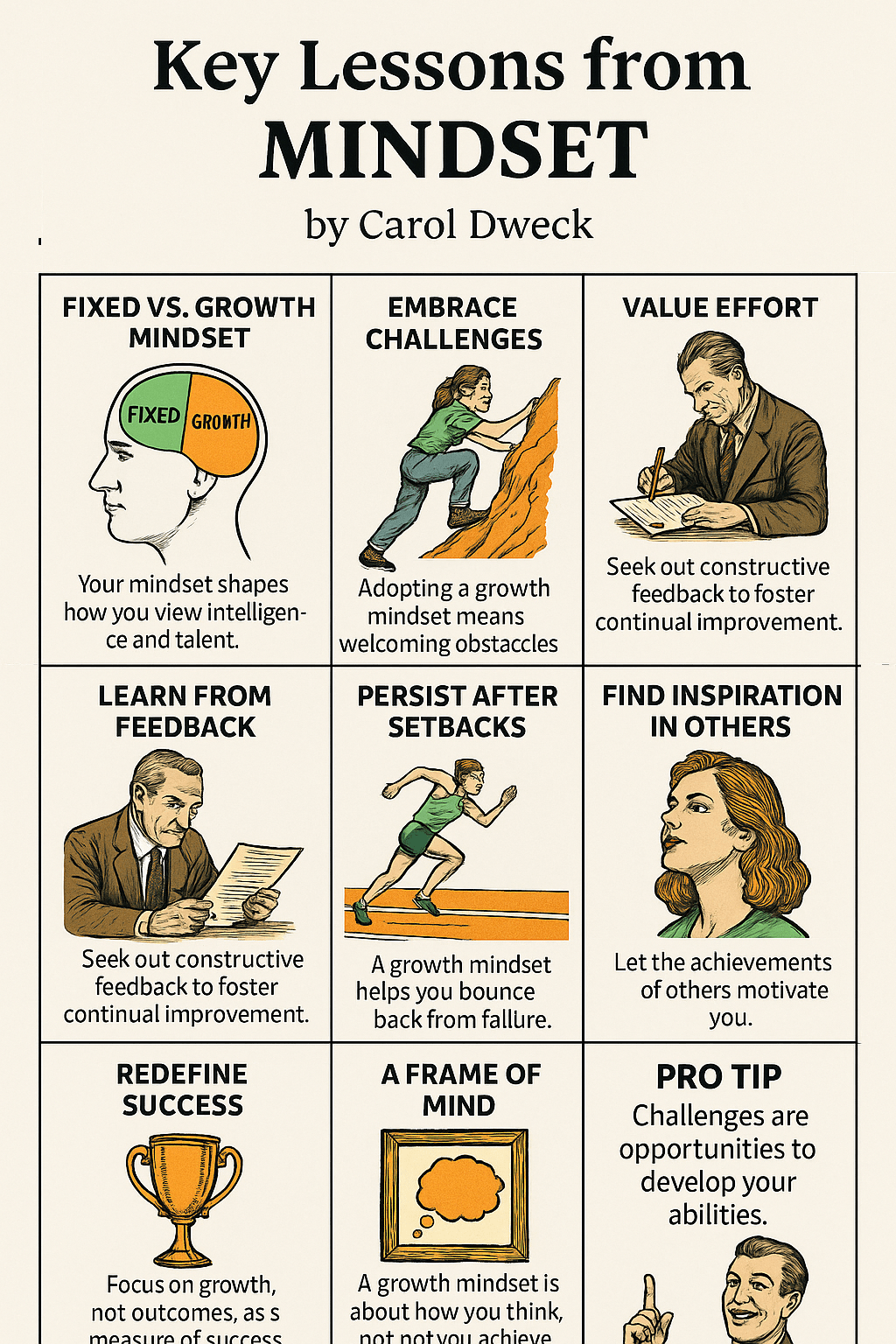
    Have you ever caught yourself thinking, “I’m just not a math person” or “I’ll never be a natural leader”? In Mindset, Stanford psychologist Carol Dweck calls out these self-defeating scripts and shows how a simple shift in mindset can change everything. She identifies two main mindsets – fixed and growth – and argues that developing a growth mindset is essential for success . In short, Mindset reveals how the way you think about talent and effort might be the single most important factor in your personal development and high performance. This isn’t just feel-good hype; it’s grounded in decades of research on achievement and learning.

    Fixed vs. Growth Mindset (The Core Idea)

    In a fixed mindset, you believe traits like intelligence or talent are set in stone. The result? You’re constantly trying to prove yourself. Challenges are scary because failing would mean you’re “not enough.” Dweck explains that if you think your qualities are unchangeable, you’ll likely avoid difficult tasks or criticism to protect your ego . Mistakes feel like personal failures.

    By contrast, a growth mindset means you see abilities as skills to be developed. Talent isn’t a fixed hand you’re dealt, but a starting point – and effort, good strategies, and help from others can grow your capabilities . A growth-minded person embraces challenges and views setbacks as feedback rather than defeat. If you struggle with something, it just means you don’t get it yet . This mindset creates a passion for learning and “stretching” yourself, even when things are tough . In fact, pushing outside your comfort zone (where real growth happens) becomes exciting instead of intimidating.

    3 Key Lessons for Skill Mastery

    Embrace Challenges & Failures: Don’t shy away from challenges – run toward them. People with growth mindsets don’t just accept challenges, they thrive on them . Each tough problem or even failure is actually a chance to learn. Instead of thinking “I failed – I’m no good,” ask “What can I learn from this?” When you treat failures as valuable feedback, you build resilience and bounce back stronger (growth-minded folks see setbacks as a motivating wake-up call ).

    Focus on Effort & Process, Not Talent: Under a fixed mindset, we might assume “If I’m not instantly good, I’ll never be.” Mindset flips that script. Effort is the path to mastery. Dweck’s research found that even geniuses have to work hard – natural talent only takes you so far. It’s consistent effort, practice, and effective strategies that turn potential into accomplishment . In other words, systems and habits beat raw smarts. So celebrate effort and persistence. By focusing on the process (the daily 1% improvements, the habits, the practice sessions), you’ll inevitably get better over time.

    Adopt a “Learner” Identity: Changing your results starts with changing how you see yourself. If you’ve been telling yourself “I’m just bad at ___,” start telling yourself “I’m learning ___.” Dweck often cites sociologist Benjamin Barber: “I don’t divide the world into the weak and the strong… I divide the world into the learners and nonlearners.” Be a learner. This identity-level shift keeps you curious, humble, and willing to try new things. When you identify as someone who is always learning and improving, challenges become part of your mission. You’ll seek out mentors, feedback, and routines that reinforce that identity (this is the essence of the Skill Stacker approach: continuously stacking new skills). Over time, those tiny 1% gains compound into major expertise.

    Daily Kaizen: Flip “Not Yet” into Action

    Today’s 1% improvement: Identify one “fixed mindset” thought you’ve had recently (“I’m just no good at this…”) and add one word to it: “yet.” Then take a small action in that direction. For example, if you’ve been thinking “I can’t speak in public,” tell yourself “I can’t do it yet,” then practice a 2-minute talk in front of a mirror or friend. Embrace the initial discomfort – that’s your growth in progress. This tiny exercise is your 1% better challenge for today.

    Key Takeaways (Infographic-Friendly)

    Fixed Mindset: Believes talent is fixed; often avoids challenges to avoid failure . Growth Mindset: Believes skills can be improved; embraces challenges to learn and grow . Effort Unlocks Ability: No matter your starting talent, effort and practice ignite ability into achievement . Failure = Feedback: Mistakes and setbacks aren’t the end – they’re lessons that guide you toward improvement . Learner Identity: See yourself as a work-in-progress. Choose to be a learner, not a non-learner , and you’ll keep evolving. 1% Better Daily: Small daily improvements compound to massive gains – 1% better each day makes you ~37x better in a year .

  • Why Most People Fail at Skill Building—And How to Fix It

    Why Most People Fail at Skill Building—And How to Fix It

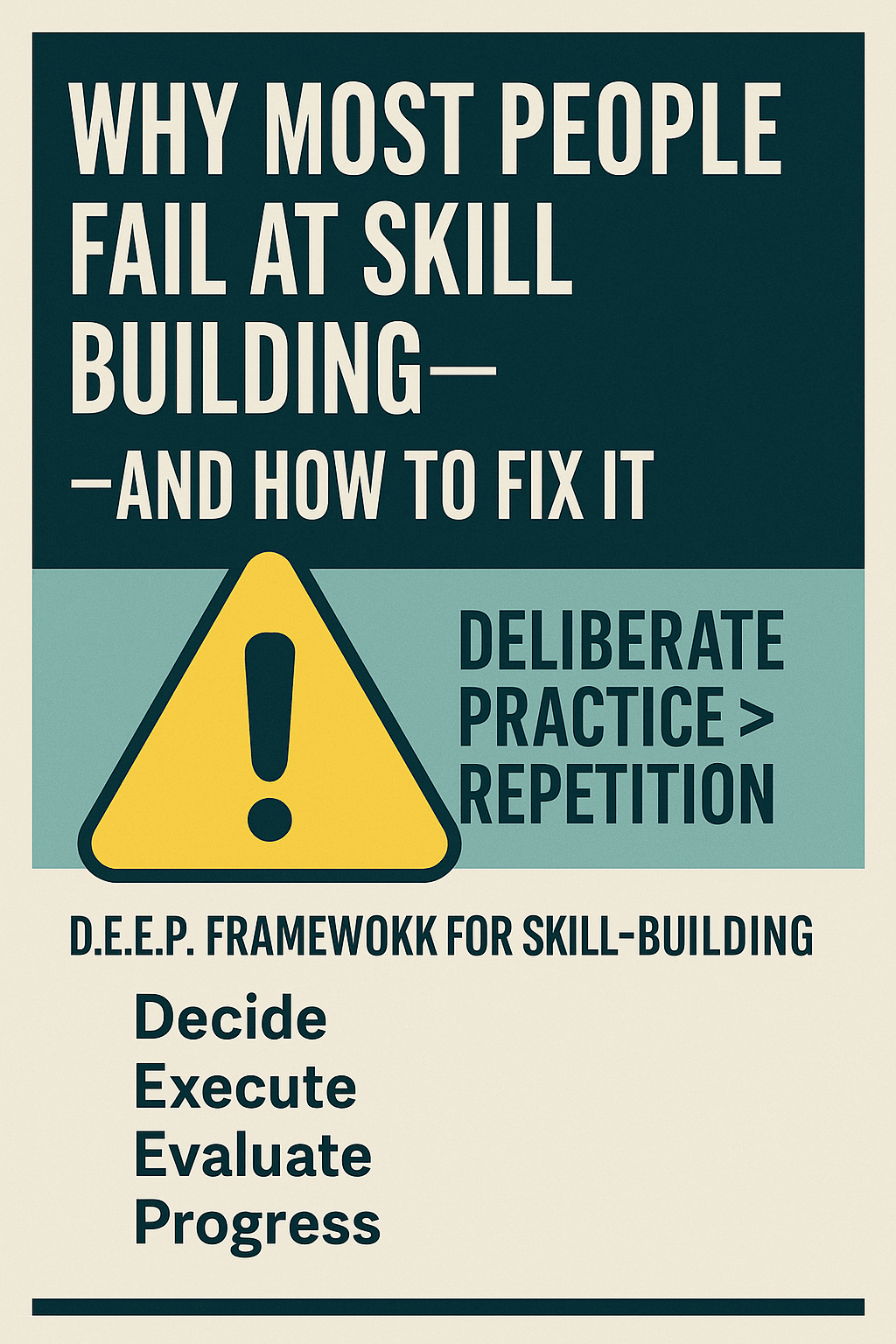
    85% of people quit learning a new skill before they ever master it . Why? Most are practicing wrong and end up discouraged.

    Common Pitfalls:

    Jumping in without clear goals (starting on impulse, then losing focus) . Mistaking passive learning for progress (watching tutorials without real practice) . Relying on mindless repetition with no feedback (reinforcing bad habits instead of improving).

    Deliberate Practice > Repetition: Not all practice is created equal. Simply grinding out hours on a skill doesn’t guarantee growth – you can repeat a bad technique 1,000 times and not get better . Deliberate practice, on the other hand, means practicing with purpose and focus. It’s about targeting specific weaknesses with full concentration and clear goals . This approach leads to real improvement, session after session. In fact, studies of top performers show their mastery was built on countless hours of deliberate practice – not just time on task .

    The D.E.E.P. Framework for Skill-Building:

    Decide: Pick one skill and set a clear, meaningful goal. Avoid vague aims or chasing every “shiny” new skill – clarity beats confusion. Execute: Commit to a consistent practice schedule. Focus on quality over quantity – each session should be purposeful. (You’re literally rewiring your brain with each focused repetition .) Evaluate: Regularly reflect and seek feedback. Identify what isn’t working and adjust. A coach, mentor, or even self-review can pinpoint weaknesses to fix . Progress: Raise the bar as you improve. Push slightly beyond your comfort zone each time – doing something a bit better or harder in every practice session ensures continuous growth .

    Mastery isn’t about how much you practice; it’s about how you practice. Practice with intention, and you’ll join the few who turn effort into real results.

  • Book of the Day: The Obstacle Is the Way by Ryan Holiday

    Book of the Day: The Obstacle Is the Way by Ryan Holiday

    The Obstacle Is the Way by Ryan Holiday is a modern manifesto for turning adversity into advantage. A cult classic embraced by athletes, entrepreneurs, and leaders, it offers a framework for overcoming the obstacles life inevitably throws at us . The core idea, drawn from ancient Stoic wisdom, is that how we respond to challenges defines us . As Marcus Aurelius wrote, “The impediment to action advances action. What stands in the way becomes the way.” Instead of seeing roadblocks as setbacks, Holiday shows that each obstacle can become an opportunity to practice virtue, build strength, and move forward .

    Key Takeaways: Stoic Strategies for Overcoming Obstacles

    Holiday’s method centers on three interrelated disciplines—Perception, Action, and Will —forming a reliable approach to any challenge. Here are five powerful ways to apply these principles immediately:

    Reframe Your Perspective: When faced with a problem, choose to see it objectively rather than with fear or frustration. Our perceptions can be a source of strength or weakness—there is no good or bad until we assign meaning to events . By staying calm and seeing things as they are (without exaggeration or panic), you can spot the opportunity hidden in each obstacle instead of feeling defeated .

    Focus on What You Can Control: Direct your energy only toward what you can change, and let go of the rest. Stoics teach that zeroing in on your own actions and attitudes (and not obsessing over external factors) greatly magnifies your power and effectiveness . When you stop wasting effort worrying about things outside your control, you free up mental bandwidth to solve the problem at hand more creatively and efficiently .

    Take Decisive Action: No amount of worry or theory will remove an obstacle—only deliberate action will . Holiday emphasizes directed, persistent effort: tackle the issue step by step, using ingenuity and courage rather than brute force . Even small wins build momentum. Don’t wait for perfect conditions or permission to start; as Holiday bluntly advises, stop waiting for a miracle and start looking for angles to make progress . In short, action is the antidote—boldly do what you can, and do it right now.

    See Failure as Feedback: Every setback is a lesson in disguise. “Failure shows us the way—by showing us what isn’t the way,” Holiday writes . Instead of interpreting failure as a permanent defeat, view it as valuable feedback. Each unsuccessful attempt reveals what to adjust or avoid next time (recall Thomas Edison’s 10,000 “ways that won’t work”). Adopting this attitude turns failures into data points on the path to success, keeping you resilient and motivated to try new approaches until you triumph .

    Build Inner Resilience (Will): Some challenges can’t be changed; they can only be endured and met with character. Holiday encourages building an “Inner Citadel” of strength that no external adversity can break . This means preparing yourself mentally to handle hard times and choosing to find meaning in hardship rather than despair. For example, Abraham Lincoln endured lifelong bouts of depression yet used that suffering to develop profound patience, humility, and compassion in service of a cause greater than himself . By cultivating quiet endurance, humility, and faith that “this too shall pass,” you fortify your will . With a resilient mindset, even the worst trials become fuel for growth.

    Embrace the Obstacle – Closing Thoughts

    In essence, The Obstacle Is the Way reframes life’s difficulties as the raw material for greatness. Obstacles are not roadblocks to success—they are the path to success. Every challenge provides a chance to practice excellence and strengthen yourself . As Holiday summarizes: “See things for what they are. Do what we can. Endure and bear what we must.” Adopt this mindset, and the obstacles that once intimidated you will become stepping stones on your journey of self-mastery.

  • Kaizen for Busy Professionals: 3 Micro-Habits You Can Start Today

    Kaizen for Busy Professionals: 3 Micro-Habits You Can Start Today


    In a world where productivity feels like a never-ending sprint, the Japanese philosophy of Kaizen offers a refreshing, sustainable approach. Kaizen emphasizes continuous improvement through small, consistent actions. Instead of massive overhauls or overwhelming changes, Kaizen invites us to focus on tiny steps that, over time, lead to significant personal and professional growth.

    For busy professionals, this is game-changing. Time is often scarce, but progress doesn’t have to wait. Today, I’ll show you three micro-habits you can start today—each taking just a few minutes but offering compounding benefits over time.


    🔑 1. The 2-Minute Rule: Tackle Small Tasks Immediately

    We’ve all faced the creeping anxiety of a to-do list that grows faster than it shrinks. Enter the 2-Minute Rule, a simple principle that says:
    If a task takes two minutes or less, do it immediately.

    This approach, popularized by productivity expert David Allen, helps eliminate the mental load of tiny tasks that pile up and weigh on your mind.

    Examples You Can Apply Today:

    • Respond to a short email or message.
    • File that one document cluttering your desk.
    • Empty your recycling bin.
    • Stretch your legs or do a few neck rolls.
    • Prep a healthy snack for later.

    By completing these micro-tasks as they arise, you reduce clutter—both physical and mental—and maintain a sense of control throughout the day. It’s a small act that creates a ripple effect of productivity and calm.

    💡 Kaizen twist: Even if you’re swamped, taking these mini-actions reinforces a “can-do” mindset and builds positive momentum.


    🔑 2. Morning Movement: Jumpstart Your Day with Energy

    How often do you reach for your phone before you even get out of bed? Let’s flip the script. Instead of scrolling, use those first few minutes to invest in yourself.

    A 5-minute morning movement ritual can set a powerful tone for your day. It doesn’t have to be a full workout. Simple stretching, a few push-ups, or a brisk walk can be enough to wake up your body and focus your mind.

    Quick Routine to Try:

    • 30 seconds neck and shoulder rolls to release tension.
    • 5–10 push-ups to get your blood pumping.
    • 1-minute forward fold to stretch your hamstrings and back.
    • A short walk around your home or outside to energize.

    Why It Works:

    • Activates your body’s systems for focus and clarity.
    • Reduces morning stress and sets a proactive tone.
    • Builds confidence—if you can conquer movement first thing, you can handle whatever the day throws at you.

    💡 Kaizen twist: Start with just one exercise for a few days. Once it feels natural, layer on another. The key is sustainability, not intensity.


    🔑 3. Evening Reflection: Learn, Acknowledge, and Reset

    The end of the day often feels like a blur. But what if you took just one minute to pause, reflect, and reset? This micro-habit helps you track progress, identify areas for improvement, and prime your mind for tomorrow.

    How to Practice Evening Reflection:

    • Grab a sticky note, journal, or your phone’s notes app.
    • Ask yourself:
      • What’s one thing I did well today?
      • What’s one thing I can improve tomorrow?
    • Write it down. That’s it.

    Benefits:

    • Reinforces a sense of achievement, no matter how small.
    • Encourages continuous growth through daily reflection.
    • Clears mental clutter and improves sleep quality.

    💡 Kaizen twist: Don’t aim for perfection. Some days your “win” might be as simple as remembering to take a deep breath during a stressful moment. Celebrate it.


    🌿 Bringing It All Together

    The beauty of Kaizen is its simplicity and sustainability. You don’t need hours of free time or an elaborate system. You just need the willingness to start small and the discipline to keep going.

    These three micro-habits—tackling 2-minute tasks, morning movement, and evening reflection—are your stepping stones. They’re flexible, adaptable, and powerful when practiced consistently.

    🚀 Your Kaizen Challenge

    Pick one of these micro-habits and commit to it for the next seven days. Notice how even the smallest shifts create positive momentum in your life.

    Comment below: Which micro-habit are you starting today? Let’s inspire each other to embrace continuous improvement!